
What are AI solutions in healthcare?
AI solutions in healthcare are technologies that use machine learning, deep learning, natural language processing, and computer vision to improve diagnostics, automate clinical workflows, accelerate drug discovery, personalize treatments, and enhance patient care across the entire healthcare continuum. Unlike single-task tools, AI in healthcare orchestrates end-to-end clinical and operational processes — connecting people, data, and systems within a unified intelligent platform. The result: faster diagnoses, measurably lower costs, fewer errors, and care that scales without adding headcount.
10 Powerful AI Solutions in Healthcare Driving Medical Innovation
What if the doctor who never sleeps, never forgets a patient’s history, and never misses a symptom was already working in hospitals around the world? That’s not science fiction — that’s what AI solutions in healthcare are delivering right now.
Healthcare has always been one of the most demanding industries on the planet. Clinicians are under enormous pressure: rising patient volumes, complex diagnoses, administrative overload, and the constant challenge of staying current with medical research. The result? Burnout, diagnostic errors, delayed treatments, and spiraling costs.
Artificial intelligence is changing that equation. From AI-powered diagnostic tools and predictive analytics to robotic surgery and intelligent drug discovery platforms, AI in the healthcare industry is no longer a futuristic concept — it’s a present-day revolution. According to a 2024 report by Grand View Research, the global AI in healthcare market is expected to surpass $187 billion by 2030.
Whether you’re a hospital administrator, a health-tech entrepreneur, or a medical professional exploring AI tools in healthcare, this guide breaks down the 10 most impactful AI applications shaping modern medicine today. For a deeper look at how AI is transforming business operations more broadly, visit Exotica AI Solutions.
What Is the Role of AI in Healthcare?
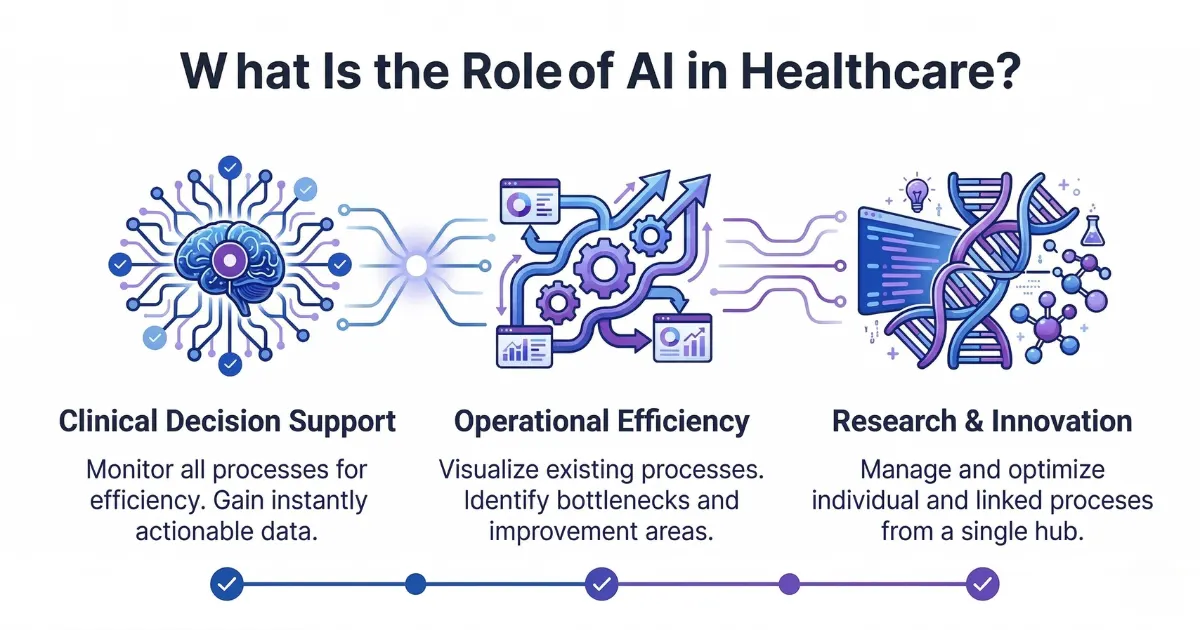
AI in healthcare means applying machine intelligence to analyze complex medical data, recognize patterns, support clinical decisions, and automate repetitive tasks. The role of AI in healthcare spans three major dimensions:
- Clinical Decision Support — helping physicians diagnose and treat more accurately.
- Operational Efficiency — automating administrative tasks, scheduling, and billing.
- Research & Innovation — accelerating drug development, genomics, and population health studies.
The key differentiator between AI and traditional software? AI learns. Every new patient dataset, scan, lab result, and outcome refines the model — making it smarter and more precise over time. So, how is AI used in healthcare in practice? Let’s explore the 10 most powerful solutions leading this transformation.
| AI Type | What it handles | Best for | Example applications |
|---|---|---|---|
| Machine Learning | Pattern recognition from clinical data | Predictive analytics, risk stratification | Readmission prediction, sepsis alerts |
| Deep Learning | Image analysis and feature detection | Medical imaging, pathology | Cancer detection, radiology AI |
| NLP | Understanding and generating human language | Clinical documentation, EHR data | Ambient scribing, clinical coding |
| Computer Vision | Visual data interpretation | Diagnostics, surgical assistance | Skin lesion detection, robotic surgery |
| Generative AI | Content creation and reasoning | Drug discovery, patient communication | Molecule generation, discharge summaries |
| RPA + AI | Workflow execution and decisioning | Claims processing, admin automation | Exotica AI, billing automation |
The 10 Most Powerful AI Solutions in Healthcare
1. AI-Powered Medical Imaging and Diagnostics
Medical imaging is where AI in healthcare first made its most dramatic impact — and continues to lead. AI diagnostic tools use deep learning algorithms trained on millions of medical images — X-rays, MRIs, CT scans, pathology slides — to detect abnormalities with precision that rivals, and in some cases exceeds, human radiologists.
Google’s DeepMind detected over 50 types of eye disease from retinal scans with 94% accuracy. Zebra Medical Vision’s AI detects findings like breast cancer, liver disease, and cardiovascular conditions from standard imaging. Aidoc’s radiology AI flags life-threatening findings in real time, reducing time-to-treatment for stroke and pulmonary embolism patients by up to 60%.
2. Predictive Analytics for Patient Risk Stratification
One of the most valuable AI use cases in healthcare is predicting which patients are at the highest risk — before a crisis occurs. Predictive AI models analyze electronic health records (EHRs), lab results, vital signs, medication history, and social determinants of health to identify patients at risk of readmission, deterioration, sepsis, or chronic disease progression.
Hospitals use AI to flag patients likely to deteriorate in the next 24 hours, enabling proactive intervention. Insurance companies use risk stratification tools to identify high-cost members and deploy preventive care programs. Primary care practices use predictive models to prioritize outreach to patients with uncontrolled diabetes or hypertension.
3. Natural Language Processing for Clinical Documentation
Physicians spend up to 50% of their working day on documentation. AI-powered NLP is solving this crisis directly. NLP tools transcribe doctor-patient conversations in real time, extract structured data from unstructured clinical notes, auto-populate EHR fields, and generate discharge summaries and referral letters automatically.
Nuance’s DAX Copilot uses ambient AI to generate clinical documentation from visit conversations. Amazon Comprehend Medical extracts medical entities from free-text clinical notes at scale. AI-powered NLP reduces documentation time by 30–45%, freeing clinicians to focus on patients rather than paperwork — a measurable win for both physician satisfaction and patient experience scores.
4. AI-Driven Drug Discovery and Development
Bringing a new drug to market traditionally takes 10–15 years and costs over $2 billion. AI is compressing that timeline significantly. Machine learning models analyze massive biological datasets — genomics, proteomics, clinical trial data — to identify potential drug candidates, predict compound interactions with biological targets, and repurpose existing drugs for new indications.
Insilico Medicine used AI to identify a novel drug candidate for idiopathic pulmonary fibrosis in just 18 months — a process that typically takes 4–5 years. BenevolentAI identified baricitinib as a potential COVID-19 treatment by analyzing existing drug data — weeks before clinical trials confirmed it. Atomwise screens over 10 billion compounds virtually, dramatically speeding up the early discovery phase.
5. AI-Enabled Robotic Surgery and Surgical Assistance
Robotic surgery has been around for decades, but AI is taking it to an entirely new level. Modern AI-assisted surgical platforms use computer vision, machine learning, and real-time data analysis to guide surgeons with unprecedented precision — going beyond robotic arms to intelligent intraoperative decision support.
The da Vinci Surgical System, enhanced with AI, provides real-time performance feedback and tissue identification. AI-powered surgical planning tools analyze pre-operative imaging to help surgeons map procedures before making a single incision. Hospitals using AI-assisted robotic surgery report shorter procedure times, fewer complications, reduced blood loss, and faster patient recovery.
6. Virtual Health Assistants and AI Chatbots
AI-powered virtual assistants and chatbots are transforming the patient experience — providing 24/7 access to health information, symptom checking, appointment scheduling, medication reminders, and mental health support without requiring staff involvement for routine interactions.
Symptom checkers like Ada Health and Babylon guide patients through their symptoms and recommend appropriate care levels. Post-discharge bots monitor recovery at home and flag complications early. Mental health apps like Woebot deliver cognitive behavioral therapy techniques at scale. Just as innovative organizations like Exotica AI Solutions use intelligent digital tools to streamline communication and service delivery across industries, healthcare systems are discovering that AI assistants create significant operational efficiencies without sacrificing care quality.
7. Personalized Medicine and AI-Driven Genomics
One of the most exciting frontiers in AI applications in the healthcare sector is personalized medicine — using AI to tailor treatments to the individual genetic makeup of each patient. AI analyzes genomic data, biomarkers, lifestyle factors, and clinical history to predict how a specific patient will respond to a given drug or therapy.
In oncology, AI identifies which cancer patients will respond to immunotherapy versus chemotherapy, avoiding ineffective treatments. Pharmacogenomics AI determines optimal drug dosing based on a patient’s genetic metabolism profile. For rare diseases, AI analyzes genomic sequences to identify rare mutations that might take years to diagnose manually — dramatically shortening the diagnostic odyssey for affected families.
8. AI for Hospital Operations and Administrative Efficiency
AI
AI is not just transforming clinical care — it’s revolutionizing the business side of healthcare too. Healthcare administrative costs account for nearly 25–30% of total US and Canadian healthcare expenditure. AI solutions in healthcare administration are attacking this inefficiency at every level — from scheduling and staffing to billing and supply chain.
Intelligent scheduling systems optimize physician calendars, procedure rooms, and staff allocation based on demand patterns. Revenue cycle management AI reduces claim denials, speeds up billing, and identifies coding errors before submission. Patient flow optimization AI predicts ED surges and adjusts staffing proactively. For healthcare executives, these tools translate directly to bottom-line results. Learn more about operational AI capabilities at ai.exoticaitsolutions.com.
9. Remote Patient Monitoring and Wearable AI
The COVID-19 pandemic accelerated telehealth and remote patient monitoring (RPM) adoption — and AI is the engine powering these systems at scale. AI analyzes continuous data streams from wearables — smartwatches, biosensors, implanted devices — to monitor vital signs, detect anomalies, and alert care teams when intervention is needed, before a patient ever calls 911.
Apple Watch’s AI detects atrial fibrillation and generates ECG reports, prompting users to seek medical attention before a stroke occurs. Continuous glucose monitoring systems use AI to predict blood sugar trends for diabetes patients. AI-powered RPM platforms monitor heart failure patients at home, reducing hospitalizations by up to 40% — keeping patients healthier and out of expensive acute care settings.
10. AI in Mental Health Diagnosis and Treatment
Mental health is one of the most underserved areas in medicine, with long wait times, a critical shortage of providers, and significant stigma preventing people from seeking help. AI is opening new pathways that weren’t previously available at scale.
NLP-based tools analyze speech patterns, word choice, and vocal tone to detect early signs of depression, anxiety, PTSD, and suicidal ideation. AI platforms analyze digital biomarkers to identify individuals at mental health risk before they reach crisis. Intelligent therapy apps deliver evidence-based CBT interventions to millions of users simultaneously — addressing the global shortage of mental health professionals in a way that no traditional staffing model can match.
AI Solutions in Healthcare: At a Glance (2026)
| AI Solution | Primary use case | AI capability | Implementation complexity | Typical ROI timeline |
|---|---|---|---|---|
| Medical Imaging AI | Diagnostics & radiology | Advanced (deep learning) | Medium — EHR integration required | 6–12 months |
| Predictive Analytics | Risk stratification | Advanced (ML models) | Medium — data quality dependent | 6–18 months |
| NLP / Clinical Documentation | Documentation automation | Strong (generative AI) | Low-Medium — EHR dependent | 3–6 months |
| Drug Discovery AI | R&D acceleration | Advanced (generative AI) | High — specialized platform | 18–36 months |
| Robotic Surgery AI | Surgical precision | Advanced (computer vision) | High — capital + training | 12–24 months |
| Virtual Assistants | Patient engagement | Strong (conversational AI) | Low — SaaS deployment | 3–9 months |
| Genomics / Precision Medicine | Personalized treatment | Advanced (ML + genomics) | High — data infrastructure | 12–36 months |
| Operations AI | Admin & revenue cycle | Strong (RPA + AI) | Medium — system integration | 6–12 months |
| Remote Patient Monitoring | Chronic disease management | Strong (IoT + ML) | Medium — device + workflow | 6–12 months |
| Mental Health AI | Behavioral health access | Strong (NLP + biomarkers) | Low-Medium — regulatory review | 6–18 months |
How to Choose the Right AI Solution for Your Healthcare Organization
Selecting the wrong AI solution in healthcare costs more than money — it costs clinical trust, implementation momentum, and the organizational confidence that makes every subsequent AI initiative harder to fund. Here is the decision framework experienced healthcare leaders use when evaluating AI tools in healthcare:
-
Start with your highest-pain clinical or operational workflow. Don’t start with vendor demos. Start with a workflow audit. Document where manual handoffs create delays, where data is re-entered across systems, and where errors cause downstream patient safety or financial risk. The best AI solutions in healthcare deliver zero value on a broken or inconsistent process — standardize first, then automate.
-
Classify your workflows by complexity before matching to an AI solution. High-volume, rule-based administrative workflows suit lighter AI tools. Complex multi-system clinical workflows need purpose-built healthcare AI platforms. End-to-end diagnostic or genomic applications need specialized deep learning infrastructure. Matching complexity to the platform eliminates the majority of failed AI in healthcare implementations before they begin.
-
Assess your technical environment and data infrastructure honestly. Are you primarily on Epic, Cerner, or Oracle Health? Do you have HL7 FHIR APIs enabled? What’s your team’s real capacity for implementing and maintaining a healthcare AI platform? Your answers eliminate at least half the vendor options on any AI in healthcare comparison list before you’ve spent a dollar on evaluation.
-
Define your compliance and regulatory requirements upfront. A primary care practice deploying a patient scheduling chatbot needs a fundamentally different compliance review than a hospital deploying AI diagnostic software under FDA SaMD guidance. Volume, patient safety risk, and regulatory scope must drive your platform selection. For AI in healthcare consulting that matches your requirements to the right solution, the Exotica AI team is available to guide your evaluation.
-
Model total cost of ownership — not just license fees. Most AI healthcare evaluations only compare software licensing costs. This misses the real picture. Factor in implementation time, EHR integration development, staff training, clinical validation, change management, and ongoing model maintenance. Some lower-priced AI platforms cost significantly more to operate than higher-priced alternatives with better out-of-the-box healthcare-specific capabilities.
-
Pilot on one real workflow before committing at scale. Every credible healthcare AI vendor supports a proof of concept. Run one end-to-end workflow in production — not in a sandbox — before signing an enterprise contract. This consistently surfaces integration failures, alert fatigue issues, and workflow gaps that vendor demos and free trial environments reliably hide.
AI Solutions in Healthcare by Department
The highest-ROI AI applications in the healthcare sector differ significantly by department. Here’s where AI is delivering the most measurable returns across the care settings deploying it most aggressively in 2026:
| Department | Top AI use cases | Typical efficiency gain |
|---|---|---|
| Radiology & Pathology | AI image analysis, automated preliminary reads, critical finding alerts, and worklist prioritization. AI in the medical field is reducing diagnostic turnaround times by 40–60% in high-volume radiology departments. | 40–60% turnaround reduction |
| Emergency Medicine | Sepsis prediction, triage AI, patient flow optimization, ED surge forecasting, and real-time bed management. See our healthcare AI solutions for ED-specific applications. | 25–45% LOS reduction |
| Revenue Cycle | AI tools in healthcare billing — claim scrubbing, denial prediction, coding optimization, prior authorization automation, and underpayment identification. | 20–40% denial rate reduction |
| Primary Care | Chronic disease risk stratification, care gap identification, ambient documentation, preventive care outreach, and population health management. | 30–50% admin workload reduction |
| Pharmacy & Medication Management | Drug interaction alerts, pharmacogenomic dosing recommendations, medication adherence AI, and formulary optimization. | 35–55% adverse event reduction |
| Behavioral Health | AI in healthcare mental health — crisis risk prediction, digital therapy platforms, appointment adherence tools, and workforce scheduling for behavioral health programs. | 40–60% access improvement |
What’s Actually New in AI Solutions in Healthcare in 2026
The biggest shift across AI solutions in healthcare in 2026 is the deep convergence with generative AI and large language models built specifically for clinical contexts. Every serious healthcare AI platform has added AI layers — but the change that matters is how that AI is being operationalized inside real clinical workflows:
- Ambient clinical intelligence at scale — the leading AI tools in healthcare now listen passively during patient encounters, document the visit, code the encounter, and generate referral letters — all without the physician touching a keyboard. This is now in production deployment at thousands of practices, not just pilots.
- Foundation models trained on clinical data — general-purpose LLMs are being replaced by purpose-built clinical AI models trained on de-identified EHR data, radiology reports, and pathology notes — delivering dramatically better performance on healthcare-specific tasks than generic AI tools.
- AI-powered prior authorization automation — the most hated administrative bottleneck in US healthcare is finally being addressed. AI in healthcare platforms can now submit, track, and appeal prior authorizations automatically — reducing physician time on PA by 60–80%.
- Multimodal diagnostic AI — systems that combine imaging, genomics, EHR data, and wearable data into unified diagnostic models — delivering more accurate and comprehensive diagnoses than any single-modality AI can achieve independently.
- Federated learning for privacy-preserving AI — healthcare AI models can now be trained across multiple institutions without sharing raw patient data, solving the privacy challenge that previously limited the scale of collaborative clinical AI development.
- Custom self-hosted healthcare AI stacks — organizations with strict data residency requirements are deploying on-premise AI infrastructure with full control over patient data flows and no third-party SaaS exposure — an increasingly viable option as open-source clinical AI matures.
Organizations like Exotica AI Solutions are helping mid-market and enterprise healthcare clients implement these advanced AI solutions in healthcare — from platform selection through production-scale deployment — with documented, measurable ROI at each phase. For a broader perspective on AI capabilities across industries, visit Exotica IT Solutions.
Common Mistakes Healthcare Organizations Make When Adopting AI
- Adopting AI before standardizing the underlying process. If five physicians document the same condition five different ways, your AI in healthcare tool locks in clinical inconsistency at scale. Standardize clinical workflows and documentation practices first — then automate.
- Underestimating clinician change management. Clinical staff resists AI tools in healthcare when deployment feels like surveillance or a threat to autonomy. Physician champions, transparent communication, and genuine involvement in workflow design matter as much as platform selection.
- Piloting AI in a sandbox instead of real clinical workflows. Healthcare AI that performs brilliantly in a demo environment consistently underperforms in real-world clinical settings with messy EHR data, outlier patients, and workflow variations. Pilot in production with real patients and real-time pressure — or your validation data won’t predict real-world performance.
- Ignoring alert fatigue as an implementation risk. Clinical AI that generates too many low-specificity alerts trains clinicians to ignore the system entirely — including the alerts that matter. Alert threshold calibration is a clinical workflow design challenge, not a technical afterthought.
- Not measuring baseline performance before deployment. You cannot prove ROI from AI solutions in healthcare if you didn’t document how long the manual process took, how often errors occurred, and what it cost per transaction before automation. Measure first — then automate — then prove the case for the next phase.
- Selecting AI based on marketing claims rather than clinical validation. A healthcare AI tool with impressive press releases and 1,000 claimed features is far less valuable than a validated, peer-reviewed solution that reliably improves one high-volume clinical workflow. Demand published validation data on your specific patient population before committing.
Frequently Asked Questions
AI is impacting healthcare right now through five major channels: reducing diagnostic turnaround times in radiology by 40–60%, cutting clinical documentation time by 30–45% through ambient scribing, preventing hospitalizations through continuous remote monitoring of chronic disease patients, reducing claim denial rates by 20–40% in revenue cycle management, and accelerating drug discovery timelines from years to months for early-stage compound identification. These are not projected future impacts — they are documented outcomes from current production deployments across US and Canadian health systems.
Final Verdict: Which AI Solution Should Your Healthcare Organization Prioritize?
There is no universally best AI solution in healthcare — only the right AI application for your specific workflows, patient population, technical environment, and organizational readiness. Here’s the short version:
High-volume radiology or pathology department: AI medical imaging — the fastest path to measurable diagnostic efficiency gains with documented accuracy improvements and clear ROI from reduced turnaround times.
Multi-specialty physician practice with documentation burden: NLP-powered ambient clinical documentation — the highest-satisfaction AI implementation among clinicians, with 30–45% documentation time reduction and measurable burnout impact.
Health system managing chronic disease populations: Predictive analytics combined with remote patient monitoring — the highest-ROI combination for reducing preventable hospitalizations and performing under value-based care contracts.
Hospital or health system administration: Operations AI for revenue cycle management — the clearest ROI case in healthcare AI, with denial rate reductions and billing accuracy improvements that pay for implementation in months, not years.
Pharmaceutical or biotech organization: AI-driven drug discovery — the highest-impact AI investment for organizations whose core business is bringing new therapies to market faster and with fewer late-stage failures.
Behavioral health program or integrated care organization: Mental health AI and virtual health assistants — the most scalable solution for organizations facing provider shortages and access gaps that traditional staffing models cannot solve.
The healthcare organizations leading in 2026 are not those with the most sophisticated AI solutions in healthcare. They are the ones who selected the right AI application for their highest-pain clinical workflow, implemented it correctly around standardized processes, and compounded their gains systematically quarter by quarter. The technology is the enabler. The clinical and operational discipline of sequencing, measuring, and scaling is the real differentiator.
Start with one process. Validate it thoroughly. Measure the result. Then scale across your organization with confidence.

Mohit Thakur is an experienced Digital Marketing Expert, SEO Team Leader, and Content Writer with over 6 years of expertise in search engine optimization, content strategy, and digital growth. He specializes in research-driven SEO and crafting high-quality, compelling content that helps businesses improve their online visibility, organic traffic, and lead generation.
With hands-on experience across multiple industries, Mohit focuses on creating user-focused, well-researched content aligned with the latest Google algorithms and AI search trends. His approach combines technical SEO, content writing, content optimization, and data analysis to deliver consistent and measurable results.