
AI Chatbot in Real Estate Agents — 2026 Complete Guide
The AI chatbot in real estate is the system that top agents use to capture, qualify, and convert prospects — 24 hours a day, without hiring more staff. Modern AI chatbots understand intent, maintain conversation context, and integrate directly with your CRM and calendar tools, making sure no lead ever lands in a void again.
You paid for the ads. The listing went live. Traffic is coming in. And then — nothing. No form fills. No calls. Just a quiet CRM and the creeping feeling that someone else is closing the deals you generated.
Here’s the brutal truth: the lead didn’t disappear. You just didn’t respond fast enough. Research from Harvard Business Review found that responding to a lead within five minutes makes you 21 times more likely to qualify it. The median real estate agent responds in over 15 hours. By then, your prospect has toured two competitor websites, saved three listings on Zillow, and booked a call with another agent.
This is the exact problem that Chatbot Real Estate is built to solve — and in 2026, agents who understand this are pulling away from those who don’t. This guide gives you the complete picture: what AI chatbots actually do in a real estate context, why they outperform every alternative, and how to deploy one intelligently so it becomes your highest-performing team member.
| Stat | Detail |
|---|---|
| 21× | More likely to qualify a lead if you respond within 5 minutes |
| 15.3 hrs | Average agent response time — where commissions go to die |
| <10 sec | Average AI chatbot response time, any hour of the day |
What Is an AI Chatbot in Real Estate — and Why Does It Matter Now?
An AI chatbot is a software tool powered by large language models (LLMs) that can hold natural, context-aware conversations with your website visitors, social media followers, and inbound leads — without any human involvement on your end.
This isn’t the old-school chatbot that spits out a canned menu of options and collapses the moment someone asks something unexpected. Modern AI chatbots understand intent. They read context. They ask smart follow-up questions. They remember what was said earlier in the conversation. And they do all of this across WhatsApp, Instagram, Facebook, your website, and every other channel your prospects use to find you.
For a real estate agent or brokerage, this means one thing: no lead ever lands in a void again. Every visitor gets an immediate, intelligent response — whether it’s 11 am on a Tuesday or 2 am on a Saturday.
“The question isn’t whether AI chatbots work for real estate. The question is how many leads you’re willing to keep losing before you deploy one.”
How Did We Get Here? The Evolution of Real Estate Chatbots
Early chatbots in the mid-2000s were little more than glorified FAQ pages. They required agents to manually script every possible question and its answer. The moment a prospect deviated from the script — which happened constantly — the bot would fail.
Natural language processing (NLP) in the 2010s changed the game by enabling chatbots to understand intent rather than just keywords. A prospect could type “3-bedroom near good schools, budget around 600k,” and the bot would actually parse and respond intelligently.
Today’s AI chatbots go further still. They analyze conversational tone (sentiment analysis), maintain full context across multi-turn conversations, integrate directly with CRMs and calendar tools, and hand off seamlessly to human agents when the moment demands it. They are, for all practical purposes, a tireless digital member of your team. For a deeper look at how this technology fits into broader automation, see our guide on Intelligent Automation Services: ROI, Use Cases & Getting Started.
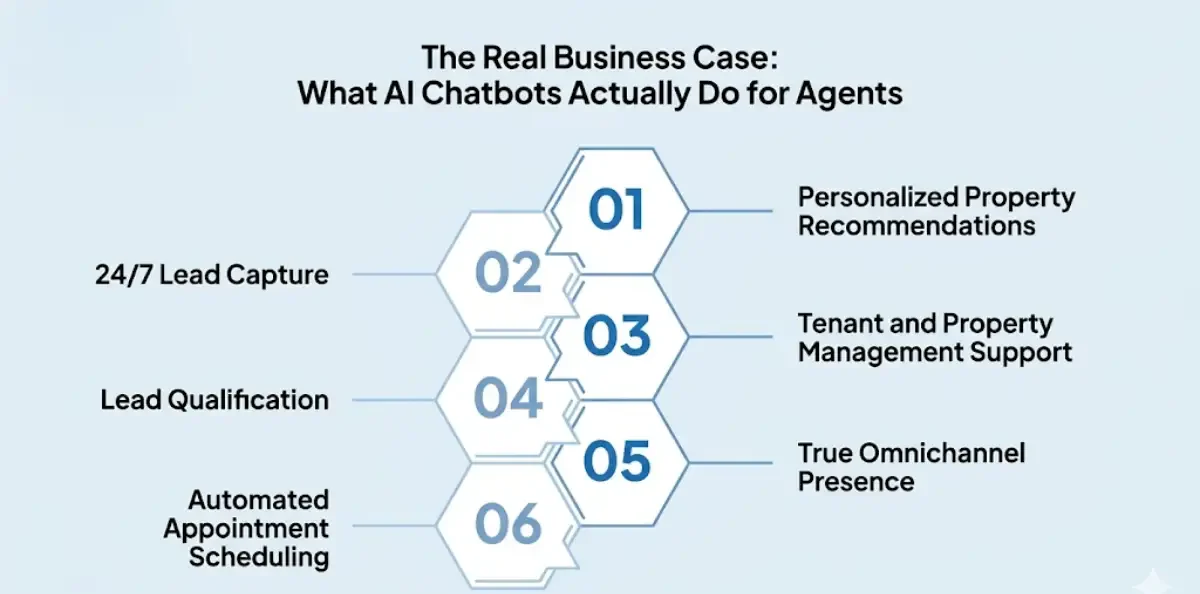
The Real Business Case: What AI Chatbots Actually Do for Agents
Let’s cut past the hype and look at the specific functions that directly impact your pipeline and revenue.
1. 24/7 Lead Capture — Especially the Leads You Never Knew You Were Losing
Nearly 50% of property searches happen outside of business hours. That’s not a niche edge case — that’s half your potential buyers browsing your listings when your phone is on silent.
An AI chatbot greets every single visitor the moment they land, regardless of the hour. It collects their name, contact details, what they’re looking for, and their timeline — then logs all of it into your CRM so it’s ready for your morning follow-up. No missed queries. No “sorry we were closed.” Just a pipeline that fills while you rest.
2. Lead Qualification That Saves You Hours Every Week
Not every inquiry is worth your time. Chasing unqualified leads is one of the biggest time drains in real estate. An AI chatbot handles pre-qualification automatically:
- It asks about budget range, preferred property type, and buying vs. renting intent
- It identifies whether the prospect is in research mode or ready to transact
- It tags and scores leads so your team always knows who to call first
- It filters noise so only warm, relevant prospects reach your desk
The result: you spend your time on conversations that are likely to close, not on cold callbacks that go nowhere. This is closely tied to how CRM integration works alongside AI to create a fully automated sales operations layer.
3. Automated Appointment Scheduling — No More Inbox Ping-Pong
The back-and-forth of scheduling property viewings is a productivity killer. “Does Thursday work?” “What time?” “Actually, can we do Friday?” An AI chatbot eliminates this.
Once a prospect expresses interest, the chatbot checks your calendar, offers available slots, and books the appointment — sending automatic reminders to reduce no-shows. This works seamlessly across your website, WhatsApp, and landing pages without any manual input from your side.
4. Personalized Property Recommendations
Sending a generic property catalogue to every lead is lazy and ineffective. AI chatbots change this by using qualification data — budget, location preference, property type, lifestyle needs — to surface two or three listings that actually match what a prospect is looking for.
When a listing sells, the chatbot proactively follows up with comparable alternatives, keeping the conversation alive rather than letting it go cold. Prospects who feel understood spend more time on your platform and are dramatically more likely to book a viewing.
5. Tenant and Property Management Support
For property managers and landlords, AI chatbots handle the repetitive inquiries that eat up hours every week: rent due dates, maintenance request routing, lease renewal reminders, and community notices. Faster resolution means happier tenants and fewer vacancies — a direct impact on your NOI.
6. True Omnichannel Presence
Your prospects find you in different places. Some come through Google. Some DM you on Instagram. Some message you on WhatsApp. An AI chatbot deploys across all of these simultaneously, delivering a consistent experience and routing every conversation into a single CRM view. No lead slips through a channel gap again. For businesses looking to automate across multiple platforms, our Workflow Automation Services cover the full integration architecture.
How AI Chatbots Actually Work in Practice
You don’t need to understand machine learning to benefit from AI chatbots. But a working understanding helps you deploy and configure one intelligently.
Intent recognition: When a visitor types “looking for a 2BHK near good schools under 80 lakhs,” the chatbot doesn’t just keyword-match. It understands the intent — property search with specific criteria — and responds accordingly, asking relevant follow-up questions.
Sentiment analysis: If a prospect seems frustrated, impatient, or emotionally invested, the chatbot adjusts its tone. This is the difference between a conversation that feels human and one that feels robotic.
Contextual memory: If a prospect mentions early on that they’re relocating for work and asks about school districts, 10 messages later, the chatbot connects those dots without asking them to repeat themselves. This is what makes the experience feel genuinely intelligent.
Graceful handoff: When a conversation reaches a point where a human agent adds the most value — a serious buyer ready to negotiate, a complex query about financing — the bot hands off the full conversation history to your team. You don’t get a cold lead; you get context, qualification data, and a warm prospect ready to talk.
Real Agent Insight: Teams that implement AI calling agents in real estate consistently see the same transformation: they stop chasing leads and start closing deals. Growth no longer comes from working harder—it comes from building a smarter, more efficient system..
AI Chatbot vs. Traditional Chatbot: Why the Difference Is Everything
| Factor Traditional Chatbot AI | AI Chatbot | |
|---|---|---|
| Response Capability | Preset scripts only | Open-ended, natural conversation |
| Lead Qualification | Fixed form fields | Conversational, dynamic qualification |
| Setup & Maintenance | Manual mapping of every scenario | Learns from conversations over time |
| Personalization | One-size-fits-all responses | Adapts to each prospect’s context |
| CRM Integration | Limited, often custom dev needed | Native integration with major CRMs |
| Long-Term ROI | High maintenance, missed leads | Consistently high conversion uplift |
For a broader comparison of automation platforms and how AI fits within them, see our guide on Best Business Process Automation Tools in 2026.
Why Real Estate Expertise Changes Everything About AI Chatbot Implementation
This is where most technology vendors get it wrong — and why it matters for your decision.
A generic AI chatbot built by a software company treats real estate like any other industry. It can capture a name and an email. But it doesn’t know the difference between a buyer at the beginning of a 6-month search cycle and a buyer who’s been pre-approved and ready to move in 30 days. It doesn’t understand how to qualify a luxury property lead differently from a first-time buyer inquiry. It doesn’t know when to ask about pre-approval status, when to bring up the off-plan advantage, or how to handle a tenant who’s frustrated about a maintenance delay.
Real estate-specific AI chatbot implementation requires domain knowledge, not just software. The qualification logic, the conversation flows, the lead scoring criteria — these need to be built by people who understand how real estate deals actually close.
At Exotica AI Solutions, our chatbot deployments are built on real estate transaction intelligence, not generic tech templates. That’s the difference between a chatbot that captures names and a chatbot that generates closings. You can explore our full approach on the AI Chatbot service page.
The Future of AI Chatbots in Real Estate: What’s Coming in the Next 24 Months
The current generation of AI chatbots is already delivering measurable ROI for agents and brokerages. But the technology continues to evolve rapidly. Here’s what forward-thinking operators are preparing for:
- Voice-enabled chatbots: Fully conversational property search via voice, without typing — ideal for mobile-first markets and accessibility.
- Predictive lead scoring: Beyond what a lead says, AI will analyze behavioral signals to predict closing probability before a conversation even starts.
- AR/VR tour integration: Chatbots that guide prospects through immersive virtual property walkthroughs in real time, answering questions as they explore.
- Regional language support: Conversational AI in local languages, opening underserved markets that English-only platforms can’t reach.
- Autonomous transaction support: Early-stage document collection, compliance checks, and form pre-population — shrinking the timeline from first contact to signed agreement. This is closely related to the RAG and AI document processing capabilities that power intelligent automation today.
The agents and brokerages who get ahead of this curve now will have data advantages, refined conversation models, and established lead pipelines that late adopters will struggle to match.
Conclusion: The Pipeline Doesn’t Wait
Real estate is a business of timing and trust. A prospect who doesn’t hear from you within minutes will find an agent who responds faster. That’s not a maybe — that’s the consistent pattern in every market, at every price point.
An AI chatbot doesn’t replace your expertise, your relationships, or your negotiation skills. It makes sure those things actually get the chance to matter. It holds the door open when you can’t be there. It qualifies the lead before you show up. It books the appointment while you’re showing another property.
The difference between agents who grow their pipeline in 2026 and those who plateau won’t be who works harder. It will be the one who builds the smarter infrastructure. Start there.
Ready to see this in action? Talk to the Exotica AI Solutions team today.
Frequently Asked Questions
Related Reading
- AI Chatbot Services — Exotica AI Solutions
- CRM Integration Services
- Intelligent Automation Services: ROI, Use Cases & Getting Started
- Best Business Process Automation Tools in 2026
- Workflow Automation Services
- RAG and AI Document Processing
- Harvard Business Review — The Short Life of Online Sales Leads
- Zillow Research — Real Estate Market Data

Mohit Thakur is an experienced Digital Marketing Expert, SEO Team Leader, and Content Writer with over 6 years of expertise in search engine optimization, content strategy, and digital growth. He specializes in research-driven SEO and crafting high-quality, compelling content that helps businesses improve their online visibility, organic traffic, and lead generation.
With hands-on experience across multiple industries, Mohit focuses on creating user-focused, well-researched content aligned with the latest Google algorithms and AI search trends. His approach combines technical SEO, content writing, content optimization, and data analysis to deliver consistent and measurable results.