
Business process automation software is a category of technology platforms that automate repetitive, rule-based workflows across business departments — finance, HR, operations, sales, and customer service — without continuous human intervention. Unlike single-task tools, BPA software orchestrates end-to-end processes involving people, data, systems, and decisions within a unified platform. The result: faster operations, measurably lower costs, and workflows that scale without adding headcount.
Business Process Automation Software: Guide for Business Owners
If your team is still manually routing approvals, re-entering data across systems, or chasing status updates by email, you are paying an operational tax your competitors are eliminating. Business process automation software has matured dramatically, and in 2026, the right BPA software is no longer reserved for enterprise organizations with large IT budgets. Businesses of every size are deploying AI tools for business automation to cut costs, reduce errors, and scale without adding headcount.
This guide gives you a straight, experience-grounded breakdown of the best business process automation software available today — what each platform does well, who it’s designed for, and how to choose the right process automation platform without wasting months on the wrong solution. For a side-by-side look at specific business automation tools, see our related guide on the best business process automation tools in 2026.
What Is Business Process Automation Software?
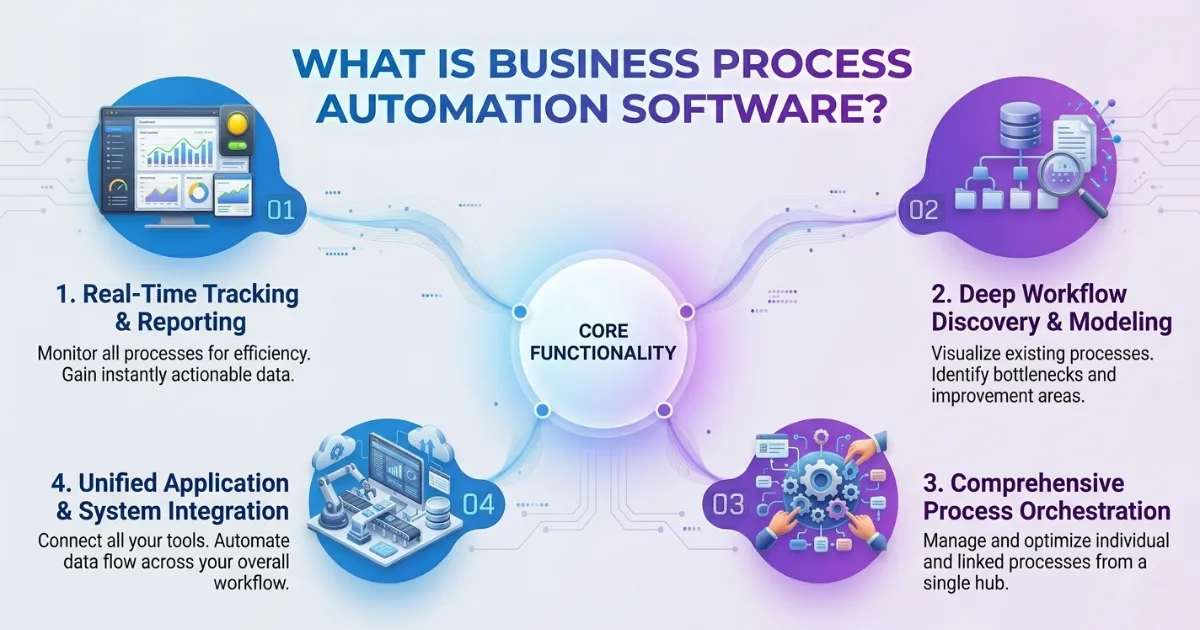
Business process automation (BPA) software is a platform that orchestrates multi-step, rule-based workflows across people, systems, and data — automatically. Unlike workflow management software that only maps and routes tasks, business process automation software actually executes them — connecting systems, transforming data, applying conditional logic, and handling exceptions without human intervention for standard cases.
The distinction between task automation and true process automation software matters significantly for how you evaluate and deploy it. A task automation tool handles a single trigger-action pair. BPA software orchestrates an entire end-to-end process: loan origination, employee onboarding, invoice-to-payment, or multi-tier approval chains — with intelligent exception routing built in at every step.
Modern business automation software in 2026 has converged deeply with AI, meaning platforms no longer just follow static rules. They learn from patterns, process unstructured inputs like emails and scanned documents, and trigger actions based on predictive signals. This is what separates AI business automation software from legacy BPA tools that still dominate many enterprise environments.
| Automation type | What it handles | Best for | Example platforms |
|---|---|---|---|
| Task automation | Single-step, trigger-based actions | Small teams, simple SaaS connections | Zapier, Make (basic) |
| Workflow automation | Multi-step, conditional sequences across systems | Mid-market operations | Make, Power Automate |
| Process automation (BPA) | End-to-end orchestration: humans, decisions, data | Enterprise departments | Appian, Pega |
| RPA | UI-level, screen-based mimicry of human actions | Legacy system integration | UiPath, Automation Anywhere |
| Intelligent / AI automation | Adaptive, self-improving workflows with ML | Document-heavy, decision-intensive processes | UiPath AI, Exotica AI |
| Hyperautomation | Enterprise-wide: RPA + AI + process mining | Full digital transformation programs | UiPath, Pega, custom stacks |
Why Business Owners Are Searching for BPA Software Right Now
The demand for business process automation software and enterprise process automation solutions has surged in 2026 — and the drivers are structural, not temporary. Here’s what’s pushing real business owners to prioritize software to automate business processes:
- Labor costs are structurally higher. Deploying business automation software is now a core margin preservation strategy — not an IT discretionary budget item.
- Remote and hybrid operations demand digital handoffs. Paper-based or email-driven processes collapse without physical proximity. Digital process automation software provides the connective tissue distributed teams need.
- Compliance complexity is increasing. Regulated industries need process automation software with audit trails and compliance logging — not spreadsheets and manual record-keeping.
- AI is now table stakes. Business owners who were evaluating AI tools for business automation in 2023–2024 are now in full production deployment. The best business process automation software in 2026 is already running at your competitors.
- The competitive gap is compounding. Organizations that automated aggressively two years ago now operate at 30–50% lower cost per transaction. That advantage widens every quarter you delay.
The Top Business Process Automation Software in 2026
UiPath — Best Enterprise Business Process Automation Software for RPA + AI
UiPath remains the dominant enterprise process automation software for organizations that need to blend RPA execution with broader business process orchestration. Its 2026 platform integrates natively with AI agents that handle unstructured data — invoice extraction, document classification, and email triage — making it the most capable enterprise-level automation software powered by AI insights for large-scale operations. For organizations managing legacy infrastructure alongside modern cloud systems, UiPath bridges both environments without requiring platform replacement.
Make (formerly Integromat) — Best Mid-Market Business Automation Software Without Code.
Make has established itself as the leading AI workflow automation software for mid-market teams that need sophistication without Python developers. Its canvas-based interface lets non-technical operators build complex, multi-step automations connecting 1,500+ apps — with conditional routing, error handling, and data transformation built in. It sits squarely among the best business process automation software options for growing organizations that need reliable, production-grade automation without an enterprise IT team behind it.
Microsoft Power Automate — Best BPA Software for Microsoft-First Organizations
If your organization runs on Microsoft 365, Teams, SharePoint, and Dynamics, Power Automate is the default business process automation software choice, and for good reason. It integrates natively across the entire Microsoft stack, supports Copilot-assisted workflow automation design, and connects to hundreds of external services through certified connectors. For Microsoft-centric enterprises, it delivers the fastest path from workflow idea to production automation without introducing a third-party platform into the stack.
Zapier — Best Entry-Level Business Process Automation Software for Small Business
Zapier remains the most accessible business automation software for small businesses and startups. With 7,000+ app integrations — more than any other platform on this list — and a no-code interface that requires zero technical background, it covers the most common automation use cases: lead capture to CRM, e-commerce order routing, notification sequences, and form-to-database syncing. For teams evaluating free business process automation software, Zapier’s free tier remains the most accessible entry point available in 2026.
n8n — Best Open Source Business Process Automation Software
For organizations that need enterprise-grade workflow automation software without SaaS licensing costs — or that have strict data residency and privacy requirements — n8n is the leading open source business process automation software in 2026. Self-hosted deployment gives full control over data and infrastructure, while 400+ integrations and a visual node-based builder deliver the flexibility of commercial platforms at a fraction of the operating cost. For a detailed comparison against Zapier, see our analysis of n8n vs. Zapier for hyperautomation savings.
Pega Platform — Best Decision-Intensive Business Process Automation Software
Pega is purpose-built for industries where process automation software intersects with high-stakes, regulated decision-making: banking, insurance, healthcare, and government. It is the most capable enterprise process automation software for organizations automating complex case management, claims adjudication, loan processing, and compliance workflows where AI must handle nuanced policy logic in real time — with full audit trails required at every decision point.
Appian — Best Low-Code Business Process Automation Platform for Cross-System Orchestration
Appian occupies the strategic middle ground between RPA-heavy enterprise platforms and lightweight AI workflow automation software. Its low-code environment lets business analysts build and modify workflows without deep developer dependency — a critical differentiator for teams that need operational agility in their business process automation framework without waiting on development sprint cycles for every workflow change.
Business Process Automation Software in 2026
| Software | Best for | AI capability | Ease of use | Starting cost |
|---|---|---|---|---|
| UiPath | Enterprise RPA + BPA | Advanced (doc AI, ML agents) | Low — IT/RPA team required | Custom enterprise pricing |
| Make | Mid-market no-code | Strong (conditional AI routing) | High — visual canvas | Free tier; usage-based paid |
| Power Automate | Microsoft-first orgs | Strong (Copilot AI design) | High — for M365 users | ~$15/user/month+ |
| Zapier | Small business/startup | Basic (AI steps add-on) | Very high — no-code | Free; $19.99/month+ |
| n8n | Technical teams / open source | Strong (extensible AI nodes) | Medium — technical setup | Free self-hosted; cloud paid |
| Pega | Regulated enterprise | Advanced (adaptive AI) | Low — certified devs | Custom enterprise pricing |
| Appian | Low-code enterprise | Strong (process mining) | Medium — low-code | Custom enterprise pricing |
How to Choose the Right Business Process Automation Software
Selecting the wrong process automation platform costs more than money — it costs six to eighteen months of failed implementation and organizational skepticism that makes every subsequent automation initiative harder to fund. Here is the decision framework experienced operators use when evaluating business process automation software:
-
Map your actual processes before evaluating any software. Don’t start with vendor demos. Start with a process audit. Document where manual handoffs create delays, where data is re-keyed between systems, and where errors accumulate. The best software to automate business processes delivers zero value on a broken or inconsistent process. This step is the foundation of any sound business process automation solution.
-
Classify your workflows by complexity before matching to the software tier. Simple trigger-action workflows suit no-code tools like Zapier or Make. Multi-system orchestration with human approval steps needs a platform like Power Automate, n8n, or Appian. End-to-end enterprise processes with AI decision layers need UiPath or Pega. Matching complexity to the platform eliminates the majority of failed BPA software implementations.
-
Assess your technical environment honestly. Are you primarily in the Microsoft, Google, or Salesforce ecosystem? Do you have legacy on-premise systems without APIs? What’s your team’s real capacity for implementing and maintaining a business process automation platform? Your answers eliminate at least half the options on any business process automation software comparison list before you’ve spent a dollar on evaluation.
-
Define your compliance and scale requirements upfront. A startup automating lead routing needs a fundamentally different platform than a bank automating loan processing under regulatory oversight. Volume, compliance requirements, and exception-handling complexity must drive your tier selection — not marketing feature lists or analyst rankings. For business process automation consulting that matches your requirements to the right platform, reach out to the Exotica AI team directly.
-
Model total cost of ownership — not just license fees. Most business process automation software comparison exercises only compare licensing costs. This misses the real picture. Factor in implementation time, integration development, staff training, ongoing maintenance, and consulting costs. Some lower-priced platforms cost more to operate than higher-priced alternatives with better out-of-the-box capabilities for your use case.
-
Pilot on one real workflow before committing to any platform. Every credible vendor supports a proof of concept. Run one end-to-end workflow in production — not in a sandbox environment — before signing an annual contract. This consistently surfaces integration failures and exception-handling gaps that vendor demos and free trial environments hide.
Business Process Automation Software by Industry
The highest-ROI automation opportunities differ significantly by sector. Here’s where software to automate business processes is delivering the most measurable returns across the industries deploying it most aggressively in 2026:
| Industry | Top BPA software use cases | Typical efficiency gain |
|---|---|---|
| Financial Services & Fintech | Loan processing automation, KYC/AML compliance workflows, reconciliation, and regulatory reporting. Software to automate business processes in banking is reducing per-loan costs 40–60% at leading digital lenders. | 50–70% cycle time reduction |
| Healthcare & Insurance | Claims processing, eligibility verification, prior authorization, patient onboarding, and compliance documentation. See our insurance automation solutions for specifics. | 60–80% claims cycle reduction |
| Telecommunications | Business process automation software for telecom covers provisioning automation, BSS/OSS data reconciliation, billing validation, and SLA compliance reporting. | 40–60% manual processing reduction |
| Manufacturing & Industrial | Software for business process automation in manufacturing — purchase order processing, inventory alerts, quality reporting, vendor communication, and ERP integration workflows. | 35–55% processing time reduction |
| Energy & Renewables | Business process automation software for energy — asset maintenance workflows, compliance reporting, contract management, and billing cycle automation. | 40–55% admin workload reduction |
| Pharmaceuticals & Biotech | Business process automation software for the pharmaceutical industry — regulatory submission workflows, batch record processing, QMS automation, and clinical trial data management. | 50–65% compliance prep reduction |
What’s Actually New in Business Process Automation Software in 2026
The biggest shift across all business process automation software in 2026 is the deep convergence with generative AI. Every serious enterprise automation platform has added AI layers — but the change that matters is in how that AI is being operationalized inside production workflows:
- Intelligent document processing built in — top BPA software now handles unstructured inputs — emails, PDFs, voice transcripts, scanned forms — without manual template configuration. This powers RAG-based knowledge retrieval directly inside automation workflows for the first time at scale.
- AI-assisted workflow design — the best workflow automation software in 2026 lets non-technical operators describe a business process in plain language and auto-generate the automation logic. Copilot (Power Automate), AI Builder, and similar tools have made this practical rather than promotional.
- Anomaly detection and compliance monitoring — process automation software now flags exceptions before they become regulatory or financial errors. Critical for financial reconciliation, insurance claims, and any regulated workflow where an undetected error has downstream consequences.
- AI sales and marketing automation — leading business automation software now triggers personalized outreach, scores leads in real time, and updates CRM records without human intervention — compressing revenue cycles without adding sales headcount.
- Conversational process triggers — automation can now be initiated through AI chatbot inputs or voice commands, not only from form submissions or scheduled triggers — reflecting the shift toward employee-facing automation through natural language interfaces.
- Custom self-hosted automation stacks — organizations building automation outside standard SaaS platforms are increasingly deploying n8n workflow automation for self-hosted, extensible pipeline orchestration with no per-operation licensing costs at scale.
Firms like Exotica AI Solutions are helping mid-market and enterprise clients implement these AI-powered business process automation solutions — from platform selection through production-scale deployment — with documented, measurable ROI at each phase. For a broader perspective on selecting automation infrastructure, visit Exotica IT Solutions.
Common Mistakes Businesses Make When Selecting BPA Software
- Choosing software before mapping processes. If five people execute the same workflow five different ways, your business process automation software locks in inconsistency at scale. Standardize the process first, then automate it.
- Underestimating change management. Staff resists automation software when deployment feels like a threat rather than a relief from tedious work. Communication and retraining investment matter as much as the platform selection itself.
- Over-engineering the first implementation. Start with high-volume, low-complexity workflows. Quick wins build organizational confidence, surface real-world edge cases safely, and create the executive proof points that fund the next automation phase.
- Ignoring exception handling architecture. Every automated workflow hits an edge case that doesn’t fit the standard logic. Build exception routes and human escalation paths into your process automation software from day one — or your automation creates a backlog instead of clearing one.
- Not measuring baseline performance before deployment. You cannot prove ROI from business process automation software if you didn’t document how long the manual process took before automation. Measure cycle time, error rate, and labor cost per transaction first — then automate.
- Selecting based on feature lists rather than workflow fit. A BPA platform with 1,000 features you don’t need is far less valuable than a simpler tool that executes your five highest-volume workflows reliably. Match the platform to the actual process complexity.
Frequently Asked Questions
A business process is a strong automation candidate when it is: high-volume, rule-based, repetitive, and executed consistently the same way every time. If the process requires nuanced human judgment, creative problem-solving, or relationship management in every instance, it’s not ready for full automation yet. The practical test: could you document every step precisely enough that a new employee could follow it perfectly on day one? If yes, business process automation software can execute it. If the answer involves “it depends” on most steps, you need to standardize before you automate.
Final Verdict: Which Business Process Automation Software Should You Choose?
There is no universally best business process automation software — only the right process automation platform for your specific workflows, technical environment, industry requirements, and scale. Here’s the short version:
Small business or startup: Zapier or Make — the most accessible business automation software with no-code interfaces and free tiers for initial automation without IT investment.
Microsoft-first organization: Microsoft Power Automate — the native business process automation solution built into your existing M365 and Dynamics stack with AI-assisted design.
Technical team or data privacy requirement: n8n — the leading open source business process automation software for self-hosted, cost-effective workflow orchestration at scale without per-operation licensing.
Mid-market needing multi-system flexibility: Make or Appian — powerful AI workflow automation software that grows with process complexity without requiring enterprise-level licensing or dedicated RPA teams.
Enterprise with legacy systems and high volume: UiPath or Pega — the gold standard in enterprise process automation software, combining RPA execution with AI-driven decisioning at production scale.
Regulated industry with complex decision logic: Pega Platform — the leading business automation solution for compliance-heavy environments where adaptive AI and full audit trail architecture are non-negotiable requirements.
The businesses winning in 2026 are not those with the most sophisticated business process automation software. They’re the ones that selected the right platform for their actual workflows, implemented it correctly around standardized processes, and compounded their gains systematically quarter by quarter. The technology is the easy part. The discipline of sequencing, measuring, and scaling is the real differentiator.
Start with one process. Automate it well. Measure the result. Then scale.

Mohit Thakur is an experienced Digital Marketing Expert, SEO Team Leader, and Content Writer with over 6 years of expertise in search engine optimization, content strategy, and digital growth. He specializes in research-driven SEO and crafting high-quality, compelling content that helps businesses improve their online visibility, organic traffic, and lead generation.
With hands-on experience across multiple industries, Mohit focuses on creating user-focused, well-researched content aligned with the latest Google algorithms and AI search trends. His approach combines technical SEO, content writing, content optimization, and data analysis to deliver consistent and measurable results.