
What is the difference between intelligent automation and artificial intelligence?
Intelligent automation is the combination of robotic process automation (RPA), machine learning, and AI to execute and optimize multi-step business processes without constant human intervention. Artificial intelligence is the broader capability that enables machines to learn, reason, and make decisions from data. In the intelligent automation vs artificial intelligence debate, AI is the brain — and intelligent automation is that brain applied systematically inside your business operations.
The practical business difference: AI alone generates insight. Intelligent automation acts on it — at scale, with full auditability, across every department that still runs manual processes today.
Every technology vendor today claims to offer “AI-powered automation.” Every software demo shows dashboards that look impressive and workflows that appear to run themselves. But when you are making a real capital allocation decision — deciding where to invest your operations budget in 2026 — you need more than marketing language. You need to understand exactly how intelligent automation vs artificial intelligence differ, where each delivers measurable value, and how they work together inside a production business environment.
Intelligent automation is not simply AI with a different label. It is a specific architectural pattern — one that combines rule-based process execution with AI-driven decision-making to handle the full spectrum of business workflows: structured and unstructured, predictable and exception-driven, simple and judgment-intensive. And understanding that distinction precisely is what separates organizations that extract real ROI from automation programs from those that invest in technology and wonder why the results never match the demo.
According to McKinsey’s automation and AI research, businesses that deploy intelligent automation strategically — not just AI tools or standalone RPA — reduce process operating costs by 40–75% and recover up to 20% of total employee time for higher-value work within the first year of systematic deployment.
What Is Intelligent Automation — And How Is AI Different From Automation?
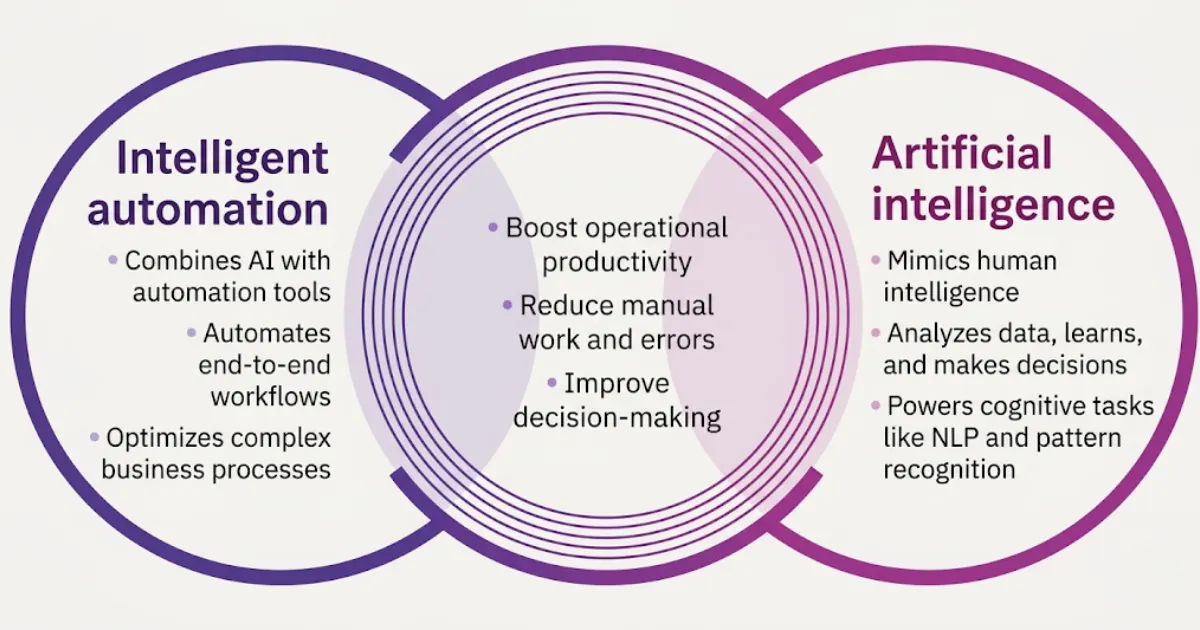
Intelligent automation is the systematic application of artificial intelligence within automated business processes — enabling those processes to handle not just structured, rule-based tasks but also judgment-intensive decisions, unstructured data, and dynamic exceptions. The difference between AI and automation is architectural: traditional automation executes fixed rules; AI learns patterns and makes decisions; intelligent automation combines both into production-grade business systems.
Here is the clearest framework for understanding how AI is different from automation:
Traditional automation operates on explicit logic: if invoice total exceeds $10,000, route to finance director. The rule is fixed. The outcome is deterministic. Change the format of the incoming invoice and the automation breaks. Artificial intelligence operates on learned patterns: trained on thousands of invoice examples, an AI model can extract data from invoices it has never seen before — handwritten, scanned, multilingual, or in non-standard formats — and make routing decisions based on learned context, not hard-coded rules.
Intelligent automation is what you get when both work together inside a single business process. The AI handles the perception and decision layer — reading documents, classifying intent, predicting outcomes, flagging anomalies. The automation layer handles the execution — routing, triggering downstream systems, logging compliance records, escalating exceptions. Neither layer alone delivers what they deliver together. For a full technical breakdown of how these components connect in a production stack, our workflow automation services guide covers every architectural layer from process orchestration to AI model integration.
What separates intelligent automation from basic AI tool deployment is the same thing that separates enterprise workflow systems from consumer apps: governance. Production-grade intelligent automation platforms provide full audit trails, role-based access controls, exception handling paths, compliance logging for regulated industries, and multi-system integration that consumer AI tools simply cannot deliver. Deploying an AI tool without automation infrastructure is insight without action. Deploying automation without AI is execution without adaptability. The combination is the operational capability that drives compounding ROI.
Why the Distinction Matters for Real Business Decisions in 2026
The intelligent automation vs artificial intelligence distinction is not academic — it has direct consequences for technology investment decisions, vendor selection, team structure, and ROI timelines. Organizations that conflate the two categories consistently make one of two expensive mistakes: they deploy AI tools without the automation infrastructure to act on AI outputs at scale, or they deploy RPA automation without the AI layer needed to handle the document variability, exception volume, and decision complexity of real enterprise processes.
The intelligent automation market trends in 2026 reflect accelerating adoption across every vertical — driven by three converging forces. First, the maturity of agentic AI automation that handles multi-step judgment processes without human instruction at each step. Second, the availability of cloud-native intelligent automation platforms that eliminate on-premise infrastructure requirements and compress deployment timelines from months to weeks. Third, the compounding competitive pressure from organizations that have already deployed intelligent automation at scale and now process the same workflows at 3–5× the speed with 80%+ fewer errors.
According to Gartner’s hyperautomation research, by 2026 organizations that have not deployed intelligent automation across at least three core operational workflows will face measurable competitive disadvantage in process efficiency, cost structure, and speed-to-market compared to peers that have. The question for every business leader is no longer whether to deploy — it is which workflows to target first and which platform architecture delivers the strongest ROI for your specific compliance, integration, and scale requirements.
High-Impact Intelligent Automation Use Cases by Industry
Understanding where process automation examples deliver the strongest measurable ROI helps operations leaders build prioritized automation roadmaps rather than reactive point solutions. These are the use cases generating the highest documented returns in 2026:
Intelligent automation in financial services
Intelligent automation in finance targets the highest-volume, highest-friction administrative processes in banking, insurance, and wealth management. AI-powered document extraction combined with automated approval routing reduces loan application processing from 5 business days to under 4 hours — while improving credit risk prediction accuracy through ML models trained on thousands of historical applications. Automated fraud detection using intelligent automation monitors transaction patterns in real time, flagging anomalies that rule-based systems miss because they adapt to evolving fraud tactics rather than matching against a fixed rule set. Our industry AI solutions page covers the specific automation architectures deployed across financial services, insurance, and fintech environments.
AI automation in healthcare and insurance
AI automation in healthcare delivers measurable impact across claims processing, prior authorization, clinical documentation, and patient communication workflows — all areas where unstructured data, regulatory complexity, and exception volume make pure rule-based automation insufficient. Intelligent automation platforms using natural language processing extract clinical data from unstructured physician notes, route prior authorization requests based on clinical criteria, and flag claims anomalies for human review — reducing administrative overhead by 35–50% while improving compliance documentation completeness. AI workflow automation compliance HIPAA requirements are native to healthcare-grade intelligent automation platforms: every AI decision is logged with model version, timestamp, input data classification, and output rationale. Our healthcare AI solutions service covers the full HIPAA-compliant intelligent automation stack.
Intelligent automation in supply chain and logistics
Intelligent automation in supply chain handles the multi-system, multi-party coordination workflows that make logistics operations expensive and error-prone at scale. AI-powered demand forecasting reduces overstock by 22% and out-of-stock incidents by 35% by combining ML models with automated procurement triggers — so the system does not just predict demand, it acts on the prediction without waiting for a planner to review a report and place an order manually. Vendor onboarding automation eliminates the manual coordination between procurement, compliance, IT provisioning, and finance — triggering and completing every required step in sequence without human follow-up at each stage. Our logistics and supply chain AI solutions cover the full automation architecture for distributed, multi-party supply chain environments.
AI document processing and contract automation
AI document processing is one of the highest-ROI entry points for intelligent automation in any industry — because every organization handles high volumes of unstructured documents that traditional automation cannot process. Intelligent document processing platforms using large language models extract data from contracts, invoices, purchase orders, compliance filings, and correspondence — regardless of format, language, or layout variation. Combined with automated routing, approval, and execution workflows, intelligent document automation reduces manual document handling by 80–90% and error rates by over 85%. Our n8n workflow automation service builds custom intelligent document processing pipelines for organizations that need self-hosted, auditable AI document workflows without per-document pricing constraints.
AI in customer service automation
AI in customer service automation has moved well beyond rule-based chatbots. Modern intelligent automation platforms deploy conversational AI that understands intent, sentiment, and context — routing conversations based on real-time classification, drafting personalized responses from knowledge bases, and escalating to human agents with full context handoff when complexity exceeds AI confidence thresholds. Organizations deploying intelligent customer service automation report 40–60% reductions in average handle time and 25–35% improvements in first-contact resolution rates. Our AI chatbot development service and AI calling agent service are both built on LLM-agnostic architectures — ensuring organizations are not locked to a single AI provider as model capabilities evolve.
HR automation with AI
HR automation AI covers the administrative overhead that consumes HR team capacity without generating strategic value — job posting distribution, candidate screening, interview scheduling, onboarding document collection, benefits enrollment, and compliance reporting. Intelligent automation platforms connect HRIS, ATS, communication tools, and compliance systems into automated onboarding pipelines that complete every required step in sequence, triggering the next action automatically when each prior step is confirmed. HR teams using intelligent onboarding automation report reducing new hire administrative processing time from 3–5 days to under 4 hours — while improving new hire experience scores through consistent, timely communication.
What are some examples of automation in office environments
What are some examples of automation that deliver immediate ROI in everyday office operations? The highest-impact examples include: automated expense report routing and approval triggered by receipt submission; PTO request workflows that check policy rules, calendar availability, and team coverage automatically; meeting preparation sequences that pull relevant documents, CRM notes, and action items from prior meetings and distribute them 30 minutes before every scheduled call; and automated report generation that pulls data from multiple systems on schedule and distributes formatted outputs to the right stakeholders without any manual export or formatting step. Our RAG-as-a-Service solution adds AI-powered knowledge retrieval to any office automation environment — enabling employees and automated systems to access accurate, real-time information from internal knowledge bases without manual search.
AI Solutions for Manufacturing vs Traditional Automation Tools
Manufacturing is where the intelligent automation vs artificial intelligence distinction becomes most consequential — and where the gap between traditional automation tools and AI solutions for manufacturing is most visible in operational outcomes.
Traditional automation tools — programmable logic controllers (PLCs), conveyor control systems, fixed robotic arms, and batch scheduling software — are the proven backbone of industrial production. They are fast, reliable, and excellent at high-volume, repetitive tasks in controlled, structured environments. When the input is consistent and the process never changes, traditional automation delivers outstanding results.
But modern manufacturing demands that traditional automation cannot meet: variable product specifications, quality inspection at scale with zero tolerance for defects, predictive equipment maintenance before failures occur, and demand-driven production scheduling that adjusts to real-time supply and logistics signals. This is where AI solutions for manufacturing deliver transformational advantage over traditional automation tools.
| Capability | Traditional Automation Tools | AI-Powered Intelligent Automation |
|---|---|---|
| High-volume repetitive tasks | ✅ Excellent — purpose-built | ✅ Excellent — with adaptive scheduling |
| Quality inspection at scale | ⚠️ Fixed rule detection only | ✅ Computer vision — detects novel defects |
| Predictive maintenance | ❌ Reactive — breaks before flagging | ✅ Proactive — ML predicts failures |
| Demand-driven scheduling | ⚠️ Rule-based estimates | ✅ ML-powered real-time adjustment |
| Handles new product variants | ❌ Requires manual reprogramming | ✅ Learns new patterns from data |
| Supply chain integration | ⚠️ Limited — pre-scheduled only | ✅ Dynamic — responds to live signals |
| Improves over time | ❌ No — static until reprogrammed | ✅ Yes — continuous model retraining |
Smart factory automation using AI delivers its highest ROI in three areas: predictive maintenance AI that analyzes IoT sensor data to schedule repairs before equipment fails — reducing unplanned downtime by 30–45%; computer vision quality inspection that detects defects at production speed with greater consistency than human inspectors — catching defect categories that fixed-rule systems miss entirely; and demand-driven production scheduling that adjusts output plans in response to real-time logistics, supply, and order data rather than waiting for a weekly planning cycle. Our manufacturing AI solutions service covers the full intelligent automation architecture for discrete, process, and hybrid manufacturing environments. For organizations running Python-based analytics and ML pipelines in manufacturing environments, our custom Python development service builds the custom integration and model deployment infrastructure that connects factory systems to AI-powered decision workflows.
How to Differentiate Between Machine Learning and an Algorithm
One of the most frequently searched questions by business owners evaluating intelligent automation platforms is: how do you differentiate between machine learning and an algorithm? The confusion is understandable — every vendor claims their product uses both, and the terms are often used interchangeably in sales conversations where precision does not serve the vendor’s interest.
An algorithm is a finite, deterministic set of instructions that a computer follows to solve a defined problem. Given the same input, an algorithm always produces the same output. The logic is entirely designed by a human programmer. Change the input format or introduce an edge case the programmer did not anticipate, and the algorithm fails or produces incorrect results. Traditional automation runs on algorithms — which is why it excels at structured, predictable tasks and breaks on variability.
Machine learning is a category of algorithm where the system learns its own decision rules from training data rather than being explicitly programmed with them. A machine learning model does not execute a fixed logic path — it applies learned statistical patterns to new inputs and produces a prediction or classification. Two different inputs that would produce the same algorithmic output can produce different ML model outputs if the model has learned that context matters. And the model’s output for any given input can change over time as the model is retrained on new data.
The business implication of this distinction is direct: machine learning for business enables automation of processes that involve judgment, variability, and unstructured inputs — the exact processes that traditional algorithmic automation cannot handle. Natural language processing automation enables machines to read documents, classify intent, and extract data regardless of format variation. AI decision making in intelligent automation enables routing, approval, and exception handling based on learned context rather than brittle hard-coded rules. Our LLM development services buyer guide covers the selection criteria for choosing the right AI models for specific business process automation requirements — including when proprietary models outperform open-source alternatives and when LLM-agnostic architecture is essential for compliance and cost control.
Top Intelligent Automation Platforms Compared
Choosing the right platform for intelligent automation vs artificial intelligence deployment requires matching platform architecture to your specific workflows, compliance requirements, and technical team capacity. Here is a structured comparison of the leading platforms in 2026:
| Platform | Best for | Key strengths | Consider if… |
|---|---|---|---|
| UiPath | RPA + AI for legacy system automation | Best RPA platform for automating enterprise workflows; native AI Document Understanding; process mining | Your highest-friction workflows run on legacy applications without modern APIs |
| Automation Anywhere | Cloud-native intelligent automation at enterprise scale | IQ Bot for unstructured document processing; strong cloud deployment; AARI human-in-the-loop | You need cloud-first RPA vs AI capability without on-premise infrastructure |
| Microsoft Power Automate + AI Builder | Microsoft 365 ecosystem — office automation with AI | Deep M365 integration; AI Builder for document processing and prediction; low-code deployment | Your organization runs on Microsoft infrastructure and needs AI-augmented office automation |
| n8n | Self-hosted, LLM-agnostic intelligent automation orchestration | Full API flexibility; open-source; no per-operation pricing; integrates any AI model without vendor lock-in | You need best open-source options for scalable intelligent automation with full data control |
| ServiceNow + Now Intelligence | ITSM and enterprise service workflows with embedded AI | Native ITSM intelligent automation; AI-powered routing and prediction; enterprise governance | You need intelligent automation for IT service management at large-enterprise scale |
| Make.com + AI modules | Cross-platform intelligent automation without custom development | Visual builder; 1,000+ integrations; AI module library; fastest deployment for mixed SaaS environments | You need rapid cross-platform intelligent automation without an engineering team |
When evaluating best intelligent automation platforms 2025, avoid the common mistake of comparing feature lists in isolation. The total cost of ownership includes implementation complexity, AI model licensing at your projected inference volume, per-operation or per-user pricing at scale, and the internal engineering resources required to maintain and retrain models in production. A platform with lower license cost but high implementation complexity and brittle AI integration often costs significantly more at 18 months than a higher-priced platform with mature, maintained AI capabilities.
When evaluating UiPath vs Automation Anywhere specifically: UiPath leads on legacy system RPA depth and process mining capability; Automation Anywhere leads on cloud-native deployment speed and document intelligence for unstructured input processing. Both are mature platforms for enterprise-grade intelligent automation — selection should be driven by your specific legacy system footprint and cloud infrastructure preferences. When evaluating ServiceNow intelligent automation, its strength lies in ITSM workflow depth and enterprise governance — it is the strongest choice for IT service management use cases but requires significant configuration investment for non-ITSM workflow categories.
The right platform decision framework: Start with your single highest-friction, highest-volume workflow. Map every step, every data input type, every system touchpoint, and every compliance requirement. Then identify which intelligent automation platforms have native AI capabilities that match the data types your workflow handles — not just integrations with AI tools, but mature, production-tested AI processing for your specific input categories.
Best for structured process + AI document handling: UiPath or Automation Anywhere for organizations with significant legacy system footprint. Microsoft Power Automate + AI Builder for Microsoft-native environments. Both qualify as top AI automation tools for enterprise — but only when the target workflows match their native AI model strengths.
Best for complex, LLM-integrated intelligent automation: n8n with a professional implementation partner delivers the strongest combination of customizability, LLM-agnostic AI integration, and cost efficiency for best intelligent automation software for complex workflows at scale — particularly for organizations with strict data residency and compliance requirements that prohibit cloud-hosted AI processing.
How to Build Your Intelligent Automation Adoption Roadmap
The most common reason intelligent automation programs underperform expectations is not technology selection — it is sequencing. Organizations that attempt to deploy AI-powered automation across multiple workflows simultaneously consistently underperform those that follow a disciplined, phased approach. Here is how to implement intelligent automation in a way that delivers measurable ROI at every phase and builds organizational capability that compounds as the program expands:
-
Audit your workflows — classify by data type before selecting any tool. The most critical pre-deployment question is not “which automation platform should we use?” It is “what type of data does this workflow handle?” Structured data workflows — fixed-format reports, standard templates, predictable inputs — are candidates for rule-based automation. Workflows handling unstructured data — documents, emails, images, voice — require AI capabilities. Workflows involving judgment calls — routing exceptions, predicting outcomes, classifying intent — require machine learning. Your automation maturity model starts with this classification, not with a platform purchase. Our business process automation tools guide covers the full workflow audit methodology used before any platform selection begins.
-
Prioritize Phase 1 by volume × friction × AI dependency. The highest-value intelligent automation targets combine three characteristics: they are high-volume (the ROI math compounds with every process instance), high-friction (significant manual effort or wait time between steps), and require AI capability to fully automate (pure rule-based automation has already failed or would fail on this workflow). Invoice processing with variable formats, contract review with non-standard clauses, and customer inquiry classification with intent variability all score high on all three dimensions — which is why they consistently appear first in every well-designed intelligent automation roadmap.
-
Select platform based on workflow data requirements and compliance constraints. How intelligent automation tools improve process efficiency for enterprises depends entirely on whether the platform’s AI capabilities match your workflow’s data processing requirements. Map your input data types, integration dependencies, compliance logging requirements, and AI model governance policies. Then evaluate platforms against those specific requirements — not against generic capability lists. An intelligent automation platform that handles 8 of 10 integration points and requires custom development for the remaining 2 is not the right platform for that workflow, regardless of its general feature ranking.
-
Deploy Phase 1 on a single workflow with documented baselines. Establish clean baseline metrics before any automation goes live: current cycle time, error rate, exception volume, staff hours consumed per week, and cost per process instance. Run the intelligent automation deployment for 30 days. Measure the delta across all five metrics. The documented performance improvement from Phase 1 is the business case for Phase 2 — and for every expansion phase thereafter. Best practices ROI metrics workflow automation enterprises consistently demonstrate that phased programs with documented baselines achieve higher executive buy-in and faster program expansion than big-bang implementations that measure ROI only after significant capital has already been deployed.
-
Build AI governance infrastructure before scaling. AI automation compliance GDPR and HIPAA requirements — and increasingly, emerging AI governance regulations in the US, EU, and UK — require that every AI decision within an automated workflow be logged with the model version, input data classification, confidence score, and output rationale. Governance built after scale is exponentially harder than governance built before it. According to Forrester’s intelligent automation research, enterprises that invest in AI governance infrastructure before scaling automation programs achieve 3× higher ROI at 24 months than those that deploy first and govern later — primarily because ungoverned AI automation generates exception volume and audit remediation costs that erode the efficiency gains the automation was deployed to create.
ROI Metrics and Best Practices for Intelligent Automation
Measuring ROI from intelligent automation vs artificial intelligence deployments requires tracking the right metrics at the right cadence — and establishing clean baselines before any automation goes live. Here are the best practices ROI metrics workflow automation enterprises should track for every intelligent automation deployment:
- Process cycle time reduction — how many hours or days has the end-to-end process time decreased since intelligent automation deployment, measured against the documented baseline?
- AI classification accuracy rate — for workflows using ML classification, what percentage of AI decisions match expected outcomes, and how is this rate trending over time as the model is retrained on production data?
- Exception rate reduction — how many process instances require human intervention for exception handling in the automated versus baseline process?
- Staff hours recovered — how many hours per week has the automation freed from manual process execution, and what is the fully-loaded cost equivalent of that recovered capacity?
- Cost per process instance — what is the fully-loaded cost to execute one instance of the intelligent automation workflow versus the manual baseline, including AI inference costs at production volume?
- Compliance audit completeness — what percentage of process instances have complete, timestamped audit trails with AI decision logging — and has this improved versus the manual baseline?
According to IBM’s intelligent automation research, organizations that track AI classification accuracy and exception rates alongside cost and time metrics — not just the financial metrics — consistently achieve higher program ROI because they identify model performance degradation before it generates material exception volume. An AI model that was 94% accurate at deployment and has drifted to 87% accuracy six months later is generating a 7-percentage-point exception rate that erodes the efficiency gains the automation was built to deliver — and that drift is invisible if you are only measuring cost and cycle time.
For agile AI adoption roadmap programs specifically, ROI measurement cadence should match your sprint cycle: weekly performance reviews for the first 30 days post-deployment, bi-weekly for months 2–3, and monthly thereafter. This cadence ensures underperforming AI models are identified and retrained within the sprint cycle rather than discovered in a quarterly review after the performance gap has compounded.
Teams at Exotica AI Solutions build AI performance dashboards into every intelligent automation deployment — tracking model accuracy, exception rates, and process efficiency metrics from day one, not assembled manually at each reporting cycle. Our intelligent automation service includes baseline measurement, AI model performance monitoring, KPI dashboard deployment, and a structured 90-day performance review as standard components of every implementation engagement. For organizations extending intelligent automation into marketing and lead management operations, our marketing automation agency service connects intelligent automation infrastructure to campaign execution and CRM workflows.
Frequently Asked Questions
Conclusion
The right answer to the intelligent automation vs artificial intelligence question is not a binary choice — it is a strategic sequencing decision. AI alone generates insight without systematic execution. Traditional automation executes without adaptability. Intelligent automation combines both into production-grade business systems that handle the full spectrum of operational workflows: structured and unstructured, predictable and exception-driven, rule-based and judgment-intensive.
The best intelligent automation programs in 2026 — whether you need AI-powered document processing, predictive maintenance in manufacturing, intelligent customer service automation, or compliant AI workflow automation for regulated industries — share one characteristic: they are built by organizations that classify their workflows before selecting platforms, deploy in documented phases with clean ROI measurement, and invest in AI governance infrastructure before scaling.
Start with your single highest-friction, highest-volume workflow. Classify its data types. Select the platform whose AI capabilities match those data types natively. Measure performance against a documented baseline. Then build from a proven foundation — one workflow at a time, with every expansion phase justified by the performance data from the phase before it.
Talk to Exotica AI Solutions about your intelligent automation strategy today.

Mohit Thakur is an experienced Digital Marketing Expert, SEO Team Leader, and Content Writer with over 6 years of expertise in search engine optimization, content strategy, and digital growth. He specializes in research-driven SEO and crafting high-quality, compelling content that helps businesses improve their online visibility, organic traffic, and lead generation.
With hands-on experience across multiple industries, Mohit focuses on creating user-focused, well-researched content aligned with the latest Google algorithms and AI search trends. His approach combines technical SEO, content writing, content optimization, and data analysis to deliver consistent and measurable results.