
Healthcare is undergoing one of the most significant technological transformations in history. Artificial intelligence is redefining how medical professionals diagnose diseases, analyze data, deliver treatment, and manage healthcare systems. With growing access to digital health records, advanced analytics, and machine learning tools, the integration of AI in healthcare is rapidly reshaping modern medicine.
From intelligent diagnostics to predictive analytics and automated patient engagement, artificial intelligence is helping healthcare providers improve accuracy, efficiency, and patient outcomes. Hospitals, clinics, research organizations, and health technology companies are adopting AI healthcare software to streamline operations and support better decision-making.
As the healthcare industry generates enormous volumes of medical data, artificial intelligence has become essential for transforming raw information into actionable clinical insights.
What Is AI in Healthcare?
AI in healthcare refers to the use of artificial intelligence technologies such as machine learning, natural language processing, and predictive analytics to analyze medical data and support healthcare professionals in clinical and operational decision-making.
In the artificial intelligence healthcare ecosystem, algorithms process complex medical datasets to identify patterns, detect diseases, and assist physicians in diagnosing conditions more efficiently.
Common data sources used by AI systems include:
- Electronic health records (EHR)
- Medical imaging scans such as MRI and CT scans
- Laboratory test results
- Genomic data
- Patient monitoring devices
- Clinical research datasets
By analyzing this information, AI solutions in healthcare help medical professionals improve diagnostic accuracy, personalize treatments, and enhance patient care.
The Role of Artificial Intelligence in the Healthcare Industry
The AI in the healthcare industry continues to expand as healthcare organizations seek advanced technologies to manage growing patient data and improve clinical efficiency.
The role of artificial intelligence in healthcare can be categorized into several key areas.
Clinical Decision Support
AI algorithms assist physicians by analyzing patient records, symptoms, and diagnostic tests to recommend possible diagnoses and treatment options.
Medical Imaging and Diagnostics
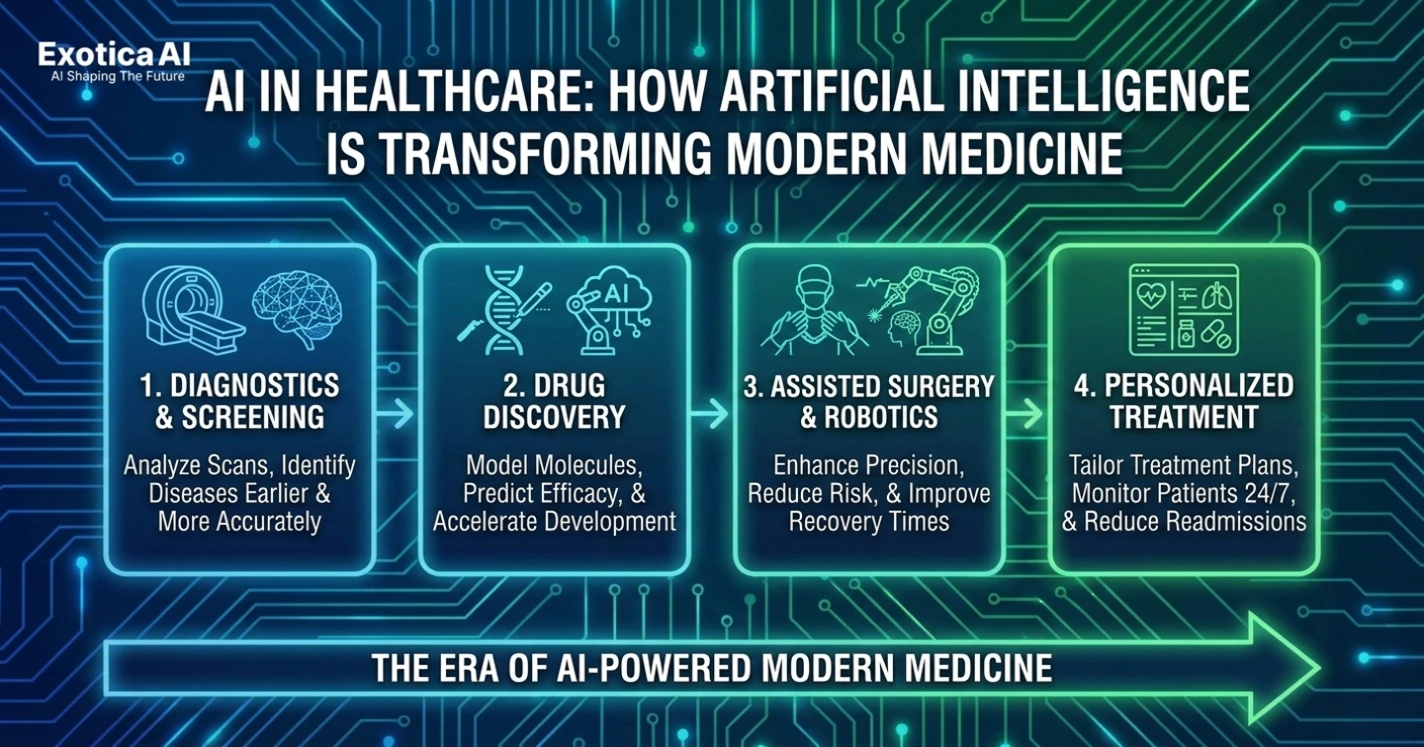
Artificial intelligence can analyze X-rays, MRIs, CT scans, and pathology slides to detect abnormalities and identify diseases such as cancer, neurological disorders, and cardiovascular conditions.
Predictive Healthcare Analytics
AI models analyze patient data to predict health risks, hospital readmissions, and disease progression, allowing doctors to intervene earlier.
Operational Efficiency
Healthcare providers use AI healthcare software to automate administrative processes, including scheduling, billing, insurance verification, and documentation.
Drug Discovery and Medical Research
Artificial intelligence accelerates pharmaceutical research by identifying potential drug candidates and analyzing clinical trial data more efficiently.
How AI Is Used in Healthcare Today
A common question many people ask is: How is AI used in healthcare?
Artificial intelligence is already widely implemented across several areas of healthcare.
AI-Powered Disease Detection
AI systems analyze medical images and clinical data to detect diseases earlier than traditional diagnostic methods.
Early detection significantly improves treatment success rates.
Personalized Treatment Plans
Artificial intelligence in the medical field enables doctors to develop personalized care plans based on a patient’s genetic profile, medical history, and lifestyle factors.
Remote Patient Monitoring
Wearable devices connected to AI platforms track health metrics such as heart rate, blood pressure, and oxygen levels in real time.
These systems alert healthcare providers when abnormal patterns appear.
Clinical Documentation Automation
AI tools analyze physician notes and automatically update electronic health records, reducing documentation workload.
Intelligent Healthcare Data Analysis
Machine learning models analyze large datasets to identify trends in disease patterns and population health.
Conversational AI in Healthcare
One of the fastest-growing technologies within healthcare AI is conversational AI in healthcare. Conversational systems allow patients and healthcare providers to interact with virtual assistants through text or voice interfaces.
Healthcare organizations use conversational AI for several purposes:
- Patient appointment scheduling
- Symptom assessment tools
- Medication reminders
- Patient education and support
- Hospital information services
These systems improve communication between patients and healthcare providers while reducing the workload on medical staff.
AI Voice Agents in Healthcare
Voice technology is also transforming patient engagement. An AI voice agent in healthcare allows hospitals and clinics to automate patient support through voice-based interactions.
Voice agents can assist with:
- Appointment booking and confirmations
- Patient triage and symptom inquiries
- Prescription refill reminders
- Call center automation
- Patient follow-up communication
Voice-enabled healthcare assistants provide 24-hour accessibility, improving patient experience and operational efficiency.
Key Benefits of AI in Healthcare
The adoption of artificial intelligence in healthcare offers numerous advantages for healthcare providers and patients.
Improved Diagnostic Accuracy
AI models trained on extensive medical datasets can detect subtle patterns in diagnostic images and clinical data, improving accuracy.
Faster Medical Analysis
Artificial intelligence processes medical information faster than manual analysis, allowing doctors to make quicker treatment decisions.
Cost Reduction in Healthcare Operations
Automation reduces administrative workload and operational expenses for hospitals and healthcare organizations.
Better Patient Outcomes
AI-driven predictive analytics help identify health risks earlier, allowing physicians to implement preventive treatment strategies.
Enhanced Patient Engagement
Technologies such as conversational AI and voice assistants provide patients with faster access to healthcare information and services.
Pros and Cons of AI in Healthcare
While the benefits are significant, healthcare organizations must also address certain challenges associated with AI adoption.
Advantages
- Faster medical data processing
- Improved disease detection
- Enhanced treatment personalization
- Increased operational efficiency
- Support for clinical decision-making
Challenges
- Data privacy and security concerns
- High development and implementation costs
- Regulatory compliance requirements
- Dependence on high-quality medical datasets
- Ethical considerations regarding automated decisions
Despite these challenges, the long-term impact of AI used in healthcare is expected to remain highly positive.
AI Healthcare Software and Intelligent Health Platforms
Healthcare providers increasingly rely on advanced AI healthcare software to integrate patient data, diagnostic tools, and operational systems into unified digital platforms.
Modern healthcare AI platforms typically include:
- Machine learning algorithms
- Natural language processing tools
- Clinical decision support systems
- Predictive healthcare analytics
- Automated documentation solutions
- Patient engagement platforms
Innovative technology providers such as Exotica AI Solutions are helping healthcare organizations implement scalable AI solutions in healthcare that improve clinical workflows, data management, and patient communication.
AI in Healthcare Marketing and Patient Engagement
Healthcare organizations are also adopting AI in healthcare marketing to improve how they communicate with patients and deliver personalized healthcare information.
AI-driven marketing tools help healthcare providers:
- personalize patient communication
- automate follow-up messages
- optimize appointment reminders
- analyze patient behavior patterns
- improve digital health campaigns
These technologies allow hospitals and healthcare systems to build stronger relationships with patients while improving service accessibility.
The Future of Artificial Intelligence in Healthcare
The future of artificial intelligence in the medical field is expected to bring even more transformative innovations.
Predictive Preventive Medicine
AI will analyze large datasets to identify disease risks years before symptoms appear, enabling preventive care.
AI-Assisted Robotic Surgery
Advanced robotic systems guided by AI will assist surgeons with highly precise and minimally invasive procedures.
AI-Assisted Robotic Surgery
Advanced robotic systems guided by AI will assist surgeons with highly precise and minimally invasive procedures.
Virtual Patient Models
Digital simulations of patients may allow doctors to test treatment strategies before applying them in real life.
Accelerated Drug Discovery
Pharmaceutical companies will continue using AI to identify new drug candidates faster and reduce research timelines.
Smart Hospitals
Future hospitals will integrate AI-driven monitoring systems, predictive analytics, and automated workflows to create fully intelligent healthcare environments.
Technology innovators, including Exotica AI Solutions, are contributing to this transformation by developing advanced AI platforms that support digital healthcare ecosystems.
Frequently Asked Questions
Conclusion
Artificial intelligence is revolutionizing modern healthcare systems. From diagnostic support and predictive analytics to intelligent healthcare software and automated patient engagement tools, AI in healthcare is enabling medical professionals to deliver more efficient and personalized care.
As healthcare systems continue to digitize and adopt advanced technologies, the integration of AI solutions in healthcare will become increasingly important for improving patient outcomes and operational efficiency. With ongoing innovation and responsible implementation, artificial intelligence will continue to transform the future of medicine and healthcare delivery.