

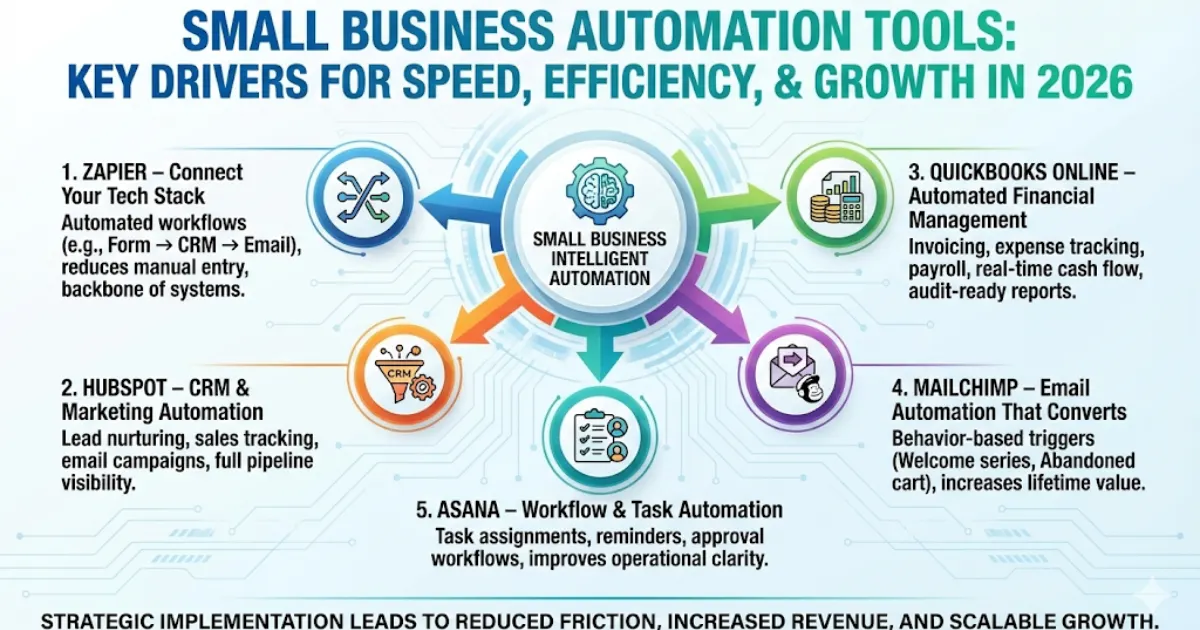
Small businesses in 2026 operate in a digital-first economy where speed, efficiency, and accuracy directly impact profitability. Manual processes no longer scale. Teams are leaner, customer expectations are higher, and competition is global. The solution is intelligent automation.
From marketing workflows to accounting systems and customer service platforms, automation tools help small businesses reduce operational friction and increase revenue without increasing headcount. This guide explores the top automation tools every small business should consider in 2026, along with practical insights on implementation and ROI.
1. Zapier – Connect Your Entire Tech Stack
Zapier allows businesses to connect thousands of apps without writing code. It creates automated workflows between tools like CRM platforms, payment processors, email marketing software, and project management systems.
Common automations:
- Website form submission → CRM lead entry → email follow-up
- New payment → invoice generation → Slack notification
- Ecommerce order → inventory update → shipping confirmation
By eliminating repetitive data entry, Zapier reduces human error and ensures seamless system communication. For small businesses managing multiple tools, this platform becomes the automation backbone.
2. HubSpot – CRM and Marketing Automation in One
HubSpot combines customer relationship management with advanced marketing automation. It tracks customer behavior, automates lead nurturing, and provides full sales visibility.
Key capabilities:
- Email drip campaigns
- Lead scoring
- Automated task creation
- Sales pipeline tracking
- Integrated reporting
For service businesses and B2B companies, automated lead nurturing increases close rates while maintaining a personalized customer experience.
3. QuickBooks Online – Automated Financial Management
Financial automation is essential for stability and compliance. QuickBooks Online automates invoicing, expense tracking, payroll, and bank reconciliation.
Benefits include:
- Real-time cash flow visibility
- Recurring billing
- Tax-ready financial reports
- Reduced bookkeeping errors
In 2026, digital accounting systems are standard practice, especially for businesses that want clean financial records and audit-ready documentation.
4. Mailchimp – Email Automation That Converts
Email marketing remains one of the highest ROI digital channels. Mailchimp automates customer journeys using behavior-based triggers.
Popular sequences:
- Welcome series
- Abandoned cart recovery
- Re-engagement campaigns
- Post-purchase follow-ups
Automation ensures consistent communication without manual follow-up, increasing lifetime customer value.
5. Asana – Workflow and Task Automation
Asana streamlines project management through automated task assignments, due-date reminders, and approval workflows.
Small teams benefit from:
- Reduced meeting overload
- Clear accountability
- Automated recurring processes
- Real-time status tracking
Automation within project management improves operational clarity and team productivity.
6. Calendly – Smart Appointment Automation
Scheduling inefficiencies waste valuable time. Calendly automates booking, confirmation emails, reminders, and time-zone coordination.
Service providers, consultants, and agencies use it to:
- Eliminate scheduling back-and-forth
- Collect payments during booking
- Reduce no-shows with reminders
Simple automation creates a smoother client experience.
7. Shopify – Ecommerce Process Automation
Shopify automates online store management, from order fulfillment to inventory control and customer notifications.
Key features include:
- Automated shipping updates
- Abandoned cart recovery
- Sales performance tracking
- Integrated payment processing
For product-based small businesses, ecommerce automation protects margins and enhances customer satisfaction.
8. Slack – Automated Team Communication
Slack integrates with CRM systems, marketing tools, and customer support platforms to deliver real-time alerts.
Businesses automate:
- Lead notifications
- Payment confirmations
- Support ticket alerts
- Internal approvals
Streamlined communication reduces response times and improves internal coordination.
9. Trello – Visual Workflow Automation
Trello offers visual task tracking with built-in automation called Butler. It triggers actions based on deadlines, labels, or card movements.
This tool is ideal for:
- Marketing calendars
- Content planning
- Sales tracking
- Client onboarding workflows
Its simplicity makes it accessible for startups and small teams.
10. Freshdesk – Customer Service Automation
Freshdesk automates support ticket routing, SLA management, and response templates.
Benefits include:
- Faster response times
- Organized ticket prioritization
- Improved customer satisfaction
- Performance analytics for support teams
Why Automation Matters More Than Ever
Small businesses in 2026 must compete with digitally optimized enterprises. Automation improves:
- Operational efficiency
- Revenue growth
- Customer retention
- Data accuracy
- Scalability
When implemented strategically, automation tools free business owners from repetitive tasks so they can focus on innovation and strategy. Companies like Exotica AI Solutions help businesses design intelligent automation ecosystems that integrate CRM systems, marketing platforms, accounting tools, and AI-powered workflows into a unified infrastructure. Strategic implementation ensures measurable ROI rather than fragmented tool adoption.
Frequently Asked Questions
Key Concepts in Small Business Automation
- Workflow automation
- CRM automation
- Marketing automation software
- Business process automation
- Accounting automation
- AI-powered customer support
- Ecommerce automation
- Sales pipeline automation
- Task management automation
- Digital transformation for small businesses
These concepts represent the core pillars of modern small business growth in 2026.
Final Thoughts
Automation is no longer optional for small businesses aiming to compete in a technology-driven economy. The right combination of workflow automation, CRM systems, accounting software, and customer support tools creates a scalable foundation for growth.
By strategically implementing platforms like Zapier, HubSpot, QuickBooks Online, and Shopify, small businesses can operate with enterprise-level efficiency while maintaining personalized service.
Forward-thinking companies, including Exotica AI Solutions, are helping organizations transition from manual operations to intelligent, AI-powered ecosystems. Businesses that adopt automation today position themselves for sustained success in 2026 and beyond.

Mohit Thakur is an experienced Digital Marketing Expert, SEO Team Leader, and Content Writer with over 6 years of expertise in search engine optimization, content strategy, and digital growth. He specializes in research-driven SEO and crafting high-quality, compelling content that helps businesses improve their online visibility, organic traffic, and lead generation.
With hands-on experience across multiple industries, Mohit focuses on creating user-focused, well-researched content aligned with the latest Google algorithms and AI search trends. His approach combines technical SEO, content writing, content optimization, and data analysis to deliver consistent and measurable results.