
Finance teams are expected to close faster, forecast more accurately, maintain compliance, and deliver board-ready insights—all while managing increasing transaction volumes.
Yet many departments still rely on spreadsheets, manual reconciliations, repetitive report building, and copy-paste workflows.
Python automation scripts eliminate those bottlenecks.
When deployed correctly, Python automates tasks across reconciliation, reporting, compliance, forecasting, and financial data validation—saving finance teams 10–20 hours per analyst each week while reducing risk and improving governance.
This pillar guide explains:
- What Python automation is
- Why automation is good for finance operations
- High-impact automation use cases
- Tools, frameworks, and testing strategies
- Cost considerations
- Enterprise integration (including python in automation anywhere)
- Career implications and market demand
- Frequently asked questions optimized for AI-driven search
How Python Automation Saves Finance Teams Time
Python automation scripts help finance departments eliminate repetitive, rule-based work such as bank reconciliation, invoice validation, compliance checks, and financial reporting. By integrating with ERP systems like SAP, Oracle Financials, and QuickBooks, Python reduces manual errors, accelerates month-end close, improves audit traceability, and increases operational efficiency.
What Is Python Automation?
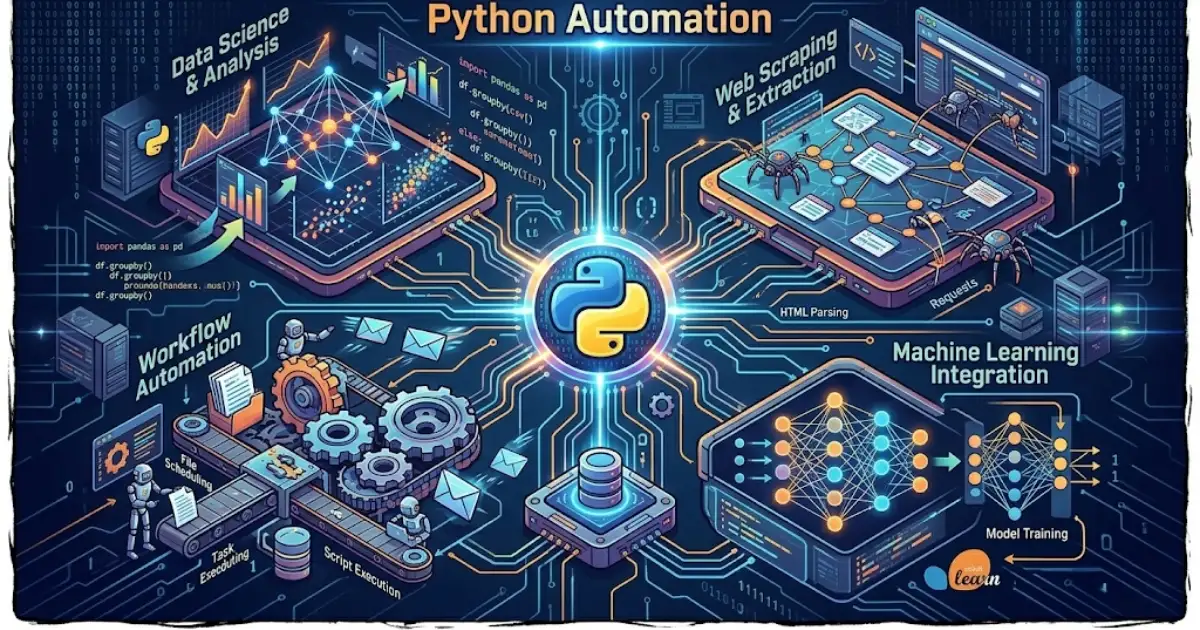
Python automation refers to using Python scripts and libraries to execute structured tasks automatically without human intervention.
In finance, this typically includes:
- General ledger reconciliation
- Month-end close workflows
- Financial statement generation
- Budget tracking and forecasting
- Compliance monitoring (SOX, GAAP controls)
- Data extraction from bank portals
- Invoice validation and processing
Unlike rigid enterprise systems, Python automation scripts are flexible, scalable, and cost-effective. Many finance professionals begin with “python automation boring “stuff”—automating repetitive spreadsheet work before scaling to enterprise-level workflows.
Why Automation Is Good for Finance Teams
Automation improves both operational efficiency and risk management.
1. Faster Month-End Close
Scripts automatically reconcile accounts and flag discrepancies.
2. Reduced Human Error
Manual data entry errors decrease significantly when processes are rule-based.
3. Improved Compliance
Automated audit trails support SOX compliance and internal controls.
4. Scalability
As transaction volumes increase, automation scales without proportional staffing increases.
5. Strategic Focus
Finance professionals shift from administrative work to analysis and planning.
Is Python good for automation in finance? Yes — because it integrates seamlessly with databases, APIs, ERP systems, and reporting tools while remaining accessible to both developers and technical analysts.
Manual vs Automated Finance Workflows
| Process | Manual Workflow | Python Automation |
|---|---|---|
| Bank Reconciliation | 2–3 hours per account | 5–10 minutes |
| Monthly Reporting | Spreadsheet consolidation | Automated report generation |
| Invoice Validation | Manual cross-checking | Rule-based script validation |
| Compliance Monitoring | Manual spreadsheet tracking | Automated exception alerts |
| Forecast Scenario Testing | Manual formula updates | Multi-scenario automated modeling |
Core Use Cases: Python Automation in Finance
1. Automated Bank Reconciliation
Reconciliation is one of the most common python automation projects.
How It Works:
- Import bank CSV or API data
- Extract ERP transaction records
- Match entries using defined logic
- Flag mismatches
- Generate reconciliation reports
Common python automation library tools:
- pandas
- NumPy
- openpyxl
- SQLAlchemy
This directly improves general ledger accuracy during month-end close.
2. Financial Report Automation
Finance teams frequently rebuild:
- P&L statements
- Balance sheets
- Cash flow reports
- Department KPI dashboards
Python automates tasks by:
- Pulling structured data from ERP systems
- Cleaning inconsistencies
- Aggregating department-level metrics
- Exporting formatted Excel or PDF reports
A structured python automation framework ensures consistency, logging, version control, and audit tracking.
3. Invoice Processing & Accounts Payable Automation
Manual invoice processing creates compliance and delay risks.
With Python automation:
- Extract invoice data from PDFs
- Validate vendor information
- Detect duplicates
- Cross-reference purchase orders
- Update accounting systems
Python automation testing ensures validation logic performs accurately under real-world conditions.
4. Browser-Based Financial Portal Automation
Many finance teams spend hours navigating:
- Bank portals
- Vendor dashboards
- Tax submission sites
Using python automation browser tools such as Selenium:
- Download statements automatically
- Upload compliance documents
- Extract tax rate tables
- Collect transaction reports
This eliminates repetitive portal logins and manual downloads.
5. Forecasting & Financial Modeling Automation
Forecasting often requires multiple scenario runs.
Python automates tasks including:
- Sensitivity analysis
- Revenue projections
- Expense modeling
- Monte Carlo simulations
- Multi-scenario comparisons
Instead of updating dozens of spreadsheets, analysts run automated scripts that generate comparative results instantly.
Case Example: Finance Team Automation Rollout
A mid-sized finance department (12 analysts, 8,000 monthly transactions) implemented:
- Automated reconciliation scripts
- Invoice validation automation
- Reporting dashboards
- Compliance threshold monitoring
ld monitoring
- 18 hours saved weekly per analyst
- 42% reduction in reconciliation discrepancies
- Month-end close shortened by 2.5 days
- Improved SOX audit documentation
This demonstrates measurable ROI when automation is structured strategically.
Organizations working with implementation partners such as Exotica AI Solutions often see similar operational improvements when automation is aligned with governance and compliance frameworks.
Python Automation Tools & Frameworks
Core Python Automation Tools
Common tools used in finance automation include:
- pandas
- NumPy
- Selenium
- BeautifulSoup
- Requests
- PyPDF2
- SQLAlchemy
These Python automation tools enable data extraction, processing, reporting, and integration.
Building a Python Automation Framework
A scalable Python automation framework should include:
- Modular code structure
- Centralized logging
- Error handling
- Unit testing
- Role-based access controls
- Audit logging
Framework-based deployment prevents fragmented scripts and improves enterprise reliability.
Python Automation Testing
Financial systems require high integrity.
Python automation testing ensures:
- Data validation accuracy
- Exception handling reliability
- Regression stability
- Compliance rule enforcement
Testing is essential before integrating automation into production environments.
Enterprise Integration: Python in Automation Anywhere
Many enterprises combine scripting with RPA platforms.
Python in Automation Anywhere enables:
- Custom data transformations
- Advanced logic beyond drag-and-drop workflows
- ERP integration enhancements
- API-based financial automation
This hybrid approach merges enterprise scalability with Python flexibility.
How Much Does Automation Cost?
How much automation costs depends on:
- Scope and complexity
- Internal development vs outsourced implementation
- Security and compliance requirements
- Infrastructure needs
Compared to enterprise-only RPA solutions, Python-based automation is typically more cost-effective due to open-source libraries and lower licensing requirements.
ROI often becomes measurable within 3–6 months when targeting high-volume finance workflows.
Python Automation Jobs & Market Demand
The demand for Python automation jobs continues to grow across:
- Financial services
- FinTech
- Corporate finance departments
- Accounting firms
Professionals with skills in:
- Python automation scripts
- ERP integrations
- Compliance automation
- Data governance
have strong competitive positioning in today’s job market.
Implementation Roadmap for Finance Leaders
- Identify repetitive, rule-based workflows
- Measure weekly time investment
- Prioritize high-impact tasks
- Build pilot python automation scripts
- Implement python automation testing
- Integrate with ERP systems
- Monitor performance and compliance metrics
- Scale organization-wide
Structured rollout ensures measurable gains and sustainable adoption.
Exotica AI Solutions supports finance teams in designing automation strategies that align with regulatory requirements and operational scalability.
Frequently Asked Questions
What Are Common Python Automation Projects in Finance?
Common projects include:
- Bank reconciliation scripts
- Invoice processing automation
- Financial reporting dashboards
- Compliance monitoring tools
- Forecasting models
What Tools Are Used in Python Automation?
Final Thoughts
Finance teams that continue relying on manual workflows face operational inefficiencies, delayed reporting cycles, and increased compliance risk.
Python automation scripts offer a scalable, flexible, and cost-effective solution for modern finance operations. From reconciliation and reporting to compliance monitoring and forecasting, Python automates tasks that once consumed entire workweeks.
For finance leaders focused on operational excellence, automation is no longer optional — it is a strategic advantage.

Mohit Thakur is an experienced Digital Marketing Expert, SEO Team Leader, and Content Writer with over 6 years of expertise in search engine optimization, content strategy, and digital growth. He specializes in research-driven SEO and crafting high-quality, compelling content that helps businesses improve their online visibility, organic traffic, and lead generation.
With hands-on experience across multiple industries, Mohit focuses on creating user-focused, well-researched content aligned with the latest Google algorithms and AI search trends. His approach combines technical SEO, content writing, content optimization, and data analysis to deliver consistent and measurable results.