
Telecommunications is one of the most complex and data-intensive industries in the world. Networks must operate without interruption, customer expectations continue to rise, and operational costs remain under constant scrutiny. To meet these demands, telecom providers are increasingly turning to artificial intelligence to automate critical functions across their ecosystems.
AI in telecom is no longer experimental. It has become a practical, scalable approach to managing networks, improving customer support, and optimizing operations around the clock. As telecom is automated at every layer, service providers gain speed, accuracy, and resilience that manual processes simply cannot deliver.
Understanding AI in Telecom
AI in telecom refers to the use of machine learning, data analytics, and intelligent automation to manage, predict, and optimize telecom systems and services.
Instead of relying on manual monitoring or reactive decision-making, AI enables telecom operators to:
- Analyze massive volumes of network data in real time
- Predict issues before they impact users
- Automate responses to faults and service requests
- Improve customer interactions without human intervention
This shift allows telecom networks and operations to function continuously, even as complexity increases.
Why Telecom Needs Automation More Than Ever
Telecom environments generate enormous amounts of data every second. Traditional systems struggle to keep up with this scale, leading to inefficiencies and service disruptions.
Key challenges driving telecom automation include:
- Growing network complexity due to 5G and IoT
- Rising customer expectations for instant support
- High operational and maintenance costs
- Pressure to reduce downtime and service outages
- Shortage of skilled technical resources
When telecom is automated using AI, these challenges become manageable rather than overwhelming.
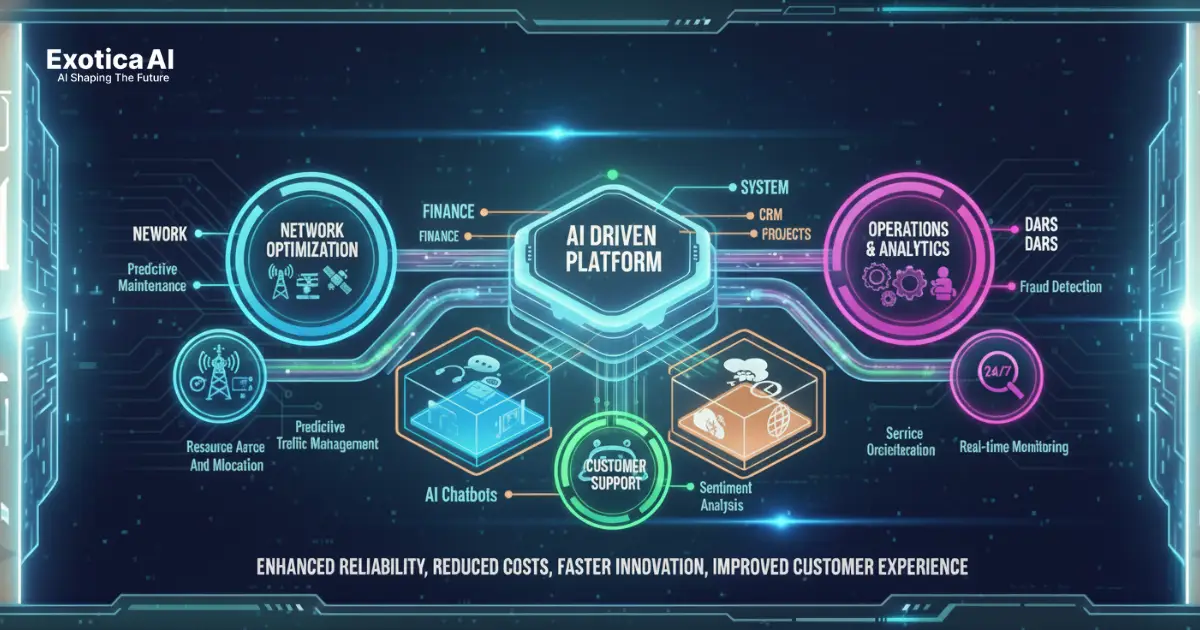
How AI Is Automating Telecom Networks
Network automation is one of the most impactful areas of AI adoption in telecom.
Real-Time Network Monitoring
AI continuously analyzes network traffic and performance metrics.
- Detects anomalies instantly
- Identifies congestion points
- Monitors service quality across regions
- Reduces dependency on manual checks
This ensures networks remain stable even during peak usage.
Predictive Maintenance
Rather than waiting for failures, AI anticipates them.
- Predicts equipment degradation
- Schedules maintenance proactively
- Minimizes unplanned outages
- Extends infrastructure lifespan
- Schedules maintenance proactively
Predictive models help operators reduce downtime while controlling costs.
Self-Healing Networks
Workflow automation services integrate tools that normally operate in silos.
This includes:
AI enables networks to respond automatically to issues.
- Reroutes traffic during failures
- Adjusts configurations in real time
- Resolves faults without human intervention
These self-healing capabilities are a core reason telecom automation is accelerating globally.
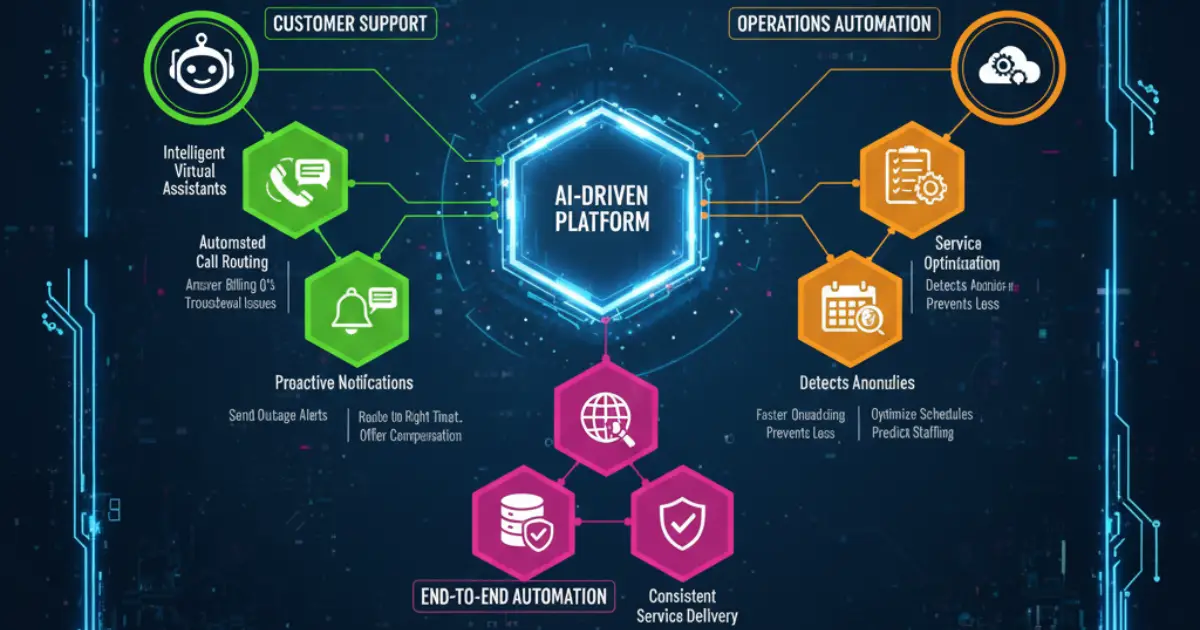
AI in Telecom Customer Support
Customer experience has become a key differentiator in telecom. AI-driven automation allows providers to deliver faster, more consistent support.
Intelligent Virtual Assistants
AI-powered voice and chat systems handle customer queries instantly.
- Answer billing and plan questions
- Troubleshoot common issues
- Guide users through self-service options
- Operate 24/7 without delays
These systems reduce call volumes while improving response times.
Automated Call Routing
AI understands customer intent and routes calls efficiently.
- Directs customers to the right department
- Reduces wait times
- Improves first-call resolution
This results in smoother support journeys.
Proactive Customer Notifications
AI identifies issues before customers complain.
- Sends outage alerts
- Provides resolution timelines
- Offers compensation or alternatives
Proactive communication builds trust and reduces inbound support pressure.
Automating Telecom Operations With AI
Beyond networks and support, AI is transforming internal telecom operations
Service Provisioning
AI automates the activation of services.
- Faster onboarding
- Fewer configuration errors
- Reduced manual approvals
This accelerates time to revenue.
Billing and Revenue Assurance
AI monitors billing systems for accuracy.
- Detects anomalies and leakage
- Prevents revenue loss
- Ensures compliance
Automation improves financial reliability at scale.
Workforce Optimization
AI analyzes operational workloads.
- Predicts staffing needs
- Optimizes field service schedules
- Improves resource utilization
This leads to leaner, more efficient operations.
When Telecom Is Automated End-to-End
True telecom automation connects networks, support, and operations into a unified system.
End-to-end automation enables:
- Seamless data flow between systems
- Faster decision-making
- Reduced operational silos
- Consistent service delivery
This integrated approach ensures that automation delivers business impact, not just technical upgrades.
The Role of AI in Scaling Telecom Services
As subscriber bases grow and technologies evolve, scalability becomes critical.
AI-driven telecom automation supports growth by:
- Adapting to new technologies like 5G and edge computing
- Supporting global operations across regions
- Reducing reliance on manual scaling efforts
Scalability is no longer limited by human capacity.
Security and Reliability in AI-Powered Telecom
Automation does not mean sacrificing control or security.
AI enhances telecom security by:
- Detecting unusual activity patterns
- Identifying potential threats in real time
- Automating incident response
- Supporting compliance and auditing
This proactive approach strengthens network resilience.
Choosing the Right AI Partner for Telecom Automation
Successful AI adoption requires industry expertise and strategic execution.
A reliable partner will:
- Understand telecom-specific challenges
- Design automation aligned with operational goals
- Integrate AI across networks, support, and operations
- Ensure scalability and compliance
Companies like Exotica AI Solutions focus on delivering AI-driven telecom automation that produces measurable improvements rather than isolated implementations.
Common Myths About AI in Telecom
Several misconceptions slow down adoption.
- AI replaces human teams
- Automation reduces service quality
- AI is only for large telecom operators
In reality, AI supports human expertise, improves consistency, and benefits telecom providers of all sizes.
Frequently Asked Questions
AI in telecom involves using intelligent systems to automate network management, customer support, and operational processes for improved efficiency and reliability
Automation enables faster responses, proactive issue resolution, and consistent service availability, leading to higher customer satisfaction.
Yes. AI enhances security by monitoring networks continuously, detecting threats early, and automating incident responses.
Yes. Scalable AI solutions allow smaller providers to automate critical functions without large infrastructure investments.
No. AI reduces repetitive manual work, allowing teams to focus on strategic, high-value tasks.
Final Thoughts
AI in telecom is redefining how networks operate, how customers are supported, and how businesses scale. As telecom is automated end-to-end, providers gain the ability to operate continuously, respond instantly, and adapt quickly to change.
By embracing telecom automation powered by AI, organizations move from reactive operations to intelligent, always-on systems that support long-term growth and customer trust.

Mohit Thakur is an experienced Digital Marketing Expert, SEO Team Leader, and Content Writer with over 6 years of expertise in search engine optimization, content strategy, and digital growth. He specializes in research-driven SEO and crafting high-quality, compelling content that helps businesses improve their online visibility, organic traffic, and lead generation.
With hands-on experience across multiple industries, Mohit focuses on creating user-focused, well-researched content aligned with the latest Google algorithms and AI search trends. His approach combines technical SEO, content writing, content optimization, and data analysis to deliver consistent and measurable results.