
What is a marketing automation agency?
A marketing automation agency is a specialist firm that designs, implements, and optimizes automated marketing systems for businesses — replacing manual, repetitive marketing tasks with intelligent workflows that operate without constant human involvement. These agencies combine email marketing automation, CRM integration, lead nurturing, omnichannel campaign orchestration, and real-time analytics to help organizations reduce acquisition costs, accelerate conversions, and scale marketing output without adding headcount.
The result: measurable ROI on your highest-friction marketing processes — typically within 60–90 days of deployment.
Right Marketing Automation Agency
In this guide
- What is a marketing automation agency?
- What marketing automation agencies actually do
- Core marketing automation agency services
- B2B vs. B2C marketing automation
- Comparing marketing automation software and tools
- Marketing automation agency pricing
- How to choose the right marketing automation agency
- Enterprise and SaaS marketing automation
- Frequently asked questions
Your competitors are not winning because they have a bigger team or a larger budget. They are winning because their marketing automation agency has already replaced every manual process that slows yours down.
In 2026, the gap between businesses running intelligent marketing agency automation and those still managing campaigns by hand is no longer a competitive edge — it is a structural cost disadvantage. Every hour your team spends manually sending follow-up emails, segmenting lists, updating CRM records, or chasing down lead status is an hour a competitor’s digital marketing automation agency has systematically eliminated from their operation.
This guide is for business owners and marketing leaders who are past the “should we automate?” conversation. What you need now is a clear, honest picture of what marketing automation agencies actually deliver, how to compare them intelligently, and how to choose the right automation marketing agency for your specific business context. According to McKinsey’s marketing personalization research, organizations that deploy marketing automation correctly reduce customer acquisition costs by 30–50% and lift revenue by 10–15% within 12 months — but only when they partner with agencies that start with the right strategy, not the most impressive-sounding platform.
What Is a Marketing Automation Agency?
A marketing automation agency is a specialist firm that combines marketing strategy, automation engineering, and systems integration to build self-running marketing systems for business clients. Unlike a general digital marketing automation agency that manages campaigns or a software vendor that sells platform licenses, a true marketing automation implementation agency redesigns how your marketing function works — then automates the redesigned system end-to-end.
The deliverable is not a campaign report or a dashboard login. It is a running infrastructure that systematically generates, qualifies, nurtures, and converts leads without manual intervention at every step. The distinction between marketing automation agencies and traditional digital agencies is simple: one runs marketing for you, the other builds marketing systems that run by themselves.
What separates qualified agencies from vendors selling software access: the best marketing automation agency partners start with your highest-friction marketing process, map the complete customer journey, identify exactly where automation creates leverage, and build the system around your specific business reality — not a template from their last client. For a detailed breakdown of how workflow automation powers these systems at the technical level, our workflow automation services guide covers the complete architecture.
What Marketing Automation Agencies Actually Do — Beyond the Pitch Deck
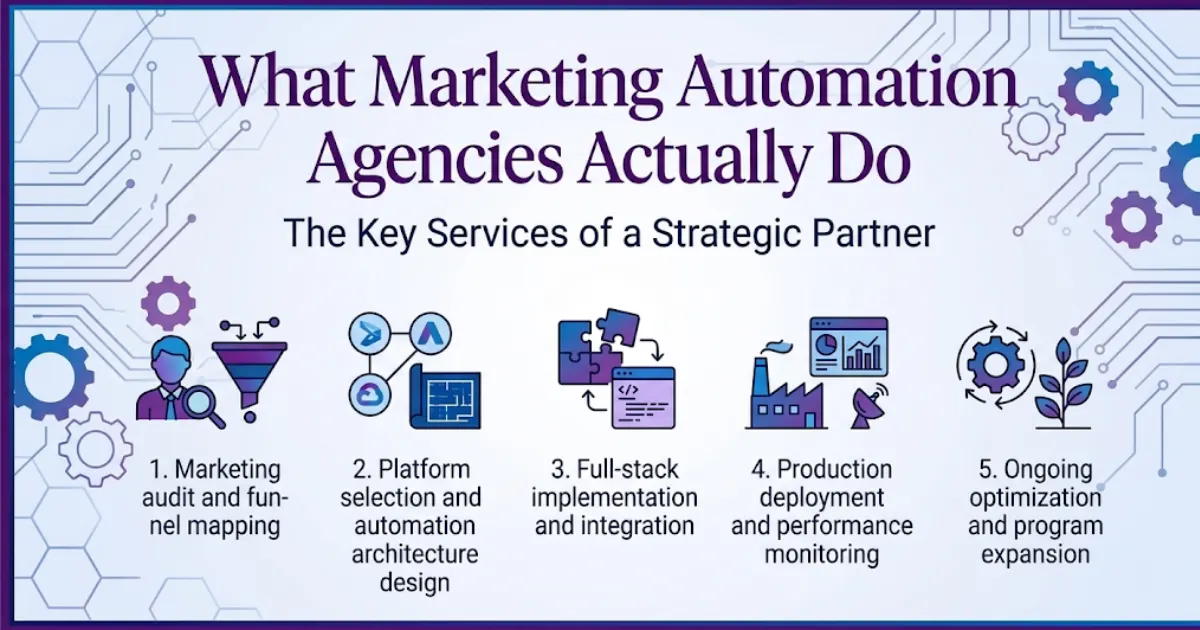
Most business owners who search for a marketing automation agency have already seen vendor presentations. The challenge is that every agency claims to offer “full-funnel marketing automation” — but the actual scope of work, strategic depth, and post-launch support vary enormously. Here is what a qualified marketing software as a service implementation partner genuinely delivers:
- Marketing audit and funnel mapping. Before any automation is built, the agency documents your complete customer acquisition funnel — every touchpoint, decision point, system dependency, and conversion drop-off. This is where the ROI case is built or exposed as wishful thinking. The business process automation tools guide covers how to audit your existing processes before any agency engagement begins.
- Platform selection and automation architecture design. Selecting which technology handles which layer — workflow automation for campaign orchestration, email marketing automation agency platforms for nurture sequences, AI scoring models for lead qualification, and CRM integration for seamless sales handoffs. This is where comparing marketing automation software matters most — platform fit determines everything downstream.
- Full-stack implementation and integration. Connecting automation to your CRM, website, ad platforms, and communication channels so the system runs inside your existing infrastructure. Our CRM automation service handles this bidirectional integration layer for every marketing automation program.
- Production deployment and performance monitoring. Launching the automation with exception handling, deliverability management, performance dashboards, and A/B testing frameworks — not just handing over a workflow diagram. This is the line that separates agencies from consultants.
- Ongoing optimization and program expansion. Audience behavior shifts. Algorithms evolve. The best marketing automation agencies offer structured ongoing management — continuous monitoring, sequence refinement, list hygiene, and workflow expansion — as a core part of their long-term engagement. This is how how agencies assist with marketing automation implementation properly: they stay in the engine room after launch.
Core Marketing Automation Agency Services in 2026
Understanding the specific services a marketing automation agency offers helps you match the right capability to your actual business problem — and avoid buying services you will not use for the next 12 months.
Email marketing automation
Email remains the highest-ROI channel in marketing — but only when sequences are built around behavioral triggers, not send calendars. A qualified email marketing automation agency designs triggered sequences for every stage of your funnel: welcome series, lead nurture, trial conversion, onboarding, win-back, and re-engagement. Platforms like HubSpot, ActiveCampaign, Klaviyo, and Mailchimp all support sophisticated behavioral automation — the agency’s job is to configure them around your specific audience segments and conversion goals. Our email automation service handles end-to-end sequence design and deployment across all major platforms.
Lead generation automation — how agencies assist with marketing automation for lead generation
Automated lead generation connects your content, advertising, and conversion infrastructure into a self-running acquisition machine. A capable marketing automation agency builds systems that capture leads across multiple channels, qualify them automatically through lead scoring models, route high-intent prospects to sales within minutes, and nurture lower-intent leads through content journeys until they are ready to convert. This is precisely how agencies assist with marketing automation for lead generation — by eliminating the manual steps between interest and opportunity without losing the personalization that drives conversion. For social media lead flows specifically, platforms like n8n workflow automation provide flexible orchestration connecting social platforms, CRMs, and email systems without vendor lock-in.
CRM automation and sales handoff
Marketing automation without CRM integration is a pipeline that leaks. The best B2B marketing automation agency partners ensure that every qualified lead arrives in your CRM with complete context — source, engagement history, content consumed, lead score, and recommended next action — so your sales team converts from context, not cold records. Our CRM automation service and CRM integration service handle the full bidirectional sync between marketing automation platforms and CRM systems. Businesses asking are there agencies that can help automate HubSpot marketing processes — yes, this is exactly the service: full HubSpot workflow automation from lead capture through pipeline management and closed-won reporting.
Omnichannel campaign automation
Modern customers move across email, SMS, social, paid media, and web without following a predictable path. A marketing automation agency that only manages email leaves the majority of customer interactions unaddressed. The best omnichannel marketing automation for B2C connects every channel into a unified customer journey — so a prospect who clicks a Facebook ad, visits your pricing page, and abandons a free trial receives a coordinated, personalized response across all three channels simultaneously without a single manual action. The best omnichannel messaging tools for marketing automation — including ActiveCampaign, Klaviyo, and HubSpot — all require expert configuration to function as true omnichannel systems rather than parallel single-channel tools. Our AI chatbot service extends omnichannel capability into real-time conversational engagement across your website and messaging channels.
Marketing automation implementation and platform migration
Many businesses have already invested in a marketing automation platform — but are using less than 20% of its capability. A specialist marketing automation implementation agency conducts a platform audit, maps the gap between current usage and full potential, and systematically builds the missing infrastructure. This is frequently the highest-ROI engagement available — unlocking value from tools you are already paying for. Businesses asking how to automate their digital marketing agency internally should start here: audit what your existing marketing automation software for agencies can do that you have not yet configured. Platforms including Make.com and Zapier are consistently underutilized until a qualified implementation partner builds the correct automation architecture on top of them.
B2B vs. B2C Marketing Automation: Why the Distinction Matters When Choosing an Agency
One of the most critical — and most commonly overlooked — questions to ask any marketing automation agency: Do you specialize in B2B, B2C, or both? The strategy, platform selection, workflow logic, and KPIs differ fundamentally between the two models.
B2B marketing automation
B2B marketing automation is defined by longer sales cycles, multiple decision-makers, and a heavy emphasis on content-driven lead nurturing. A strong B2B marketing automation agency prioritizes account-based marketing workflows, lead scoring models tied to CRM pipeline stages, multi-touch nurture sequences built around educational content, and deep HubSpot, Marketo, or Salesforce implementation expertise. If you are evaluating a B2B marketing automation consultant, ask specifically about their experience with lead qualification workflows, CRM sync, MQL-to-SQL handoff design, and multi-touch attribution — these are the core mechanics of effective B2B marketing automation software deployment. According to Salesforce’s marketing automation research, B2B companies using sophisticated lead scoring and nurture automation convert prospects at 2–3× the rate of those relying on manual follow-up.
B2C marketing automation
Business to consumer marketing automation — also referred to as B to C marketing automation — operates in an entirely different environment. B2C marketing automation demands speed, hyper-personalization, and real-time omnichannel response at scale. Marketing automation for B2C focuses on behavioral triggers based on purchase history and real-time browsing patterns, abandoned cart and browse abandonment sequences, SMS and push notification integration, dynamic product recommendations, and post-purchase loyalty flows. The best B2C marketing automation platforms — Klaviyo, Omnisend, Drip — are built specifically for this high-velocity, purchase-data-intensive environment. The right B2C marketing automation software must connect natively to your e-commerce platform or the behavioral data required for effective personalization will always be one step behind. When evaluating how to choose omnichannel marketing automation for B2C, prioritize platform-to-store data sync depth and real-time trigger capability above every other feature. B2C email marketing alone — without behavioral triggers, SMS integration, and personalization at the product level — delivers a fraction of the revenue a properly configured B2C marketing automation tools stack can generate.
SaaS marketing automation
SaaS marketing automation is a distinct discipline combining B2B strategy with product usage data that most agencies are not equipped to handle. SaaS marketing automation tools must integrate with in-product analytics — triggering relevant lifecycle emails based on feature adoption, trial activity, and engagement drop-off signals — not just demographic or behavioral data from external touchpoints. If you operate a SaaS business, verify that any agency you evaluate has direct experience connecting marketing software as a service platforms to product analytics tools like Mixpanel, Amplitude, or Segment before the engagement begins.
Comparing Marketing Automation Software and Tools: A Feature Framework
One of the most common requests from business owners evaluating agencies is: help me with marketing automation comparisons so I know we are on the right platform. Here is a practical marketing automation feature comparison framework across the primary use cases and business sizes.
| Business type | Best platform fit | Key features to prioritize | Avoid if… |
|---|---|---|---|
| B2B / Inbound SaaS | HubSpot, Marketo, Pardot | Lead scoring, CRM sync, multi-touch attribution, ABM workflows | You need real-time e-commerce behavioral triggers |
| E-commerce / B2C retail | Klaviyo, Omnisend, Drip | Purchase-triggered flows, cart abandonment, predictive LTV, SMS + email | Your store is not on Shopify, WooCommerce, or BigCommerce |
| Small business / local services | ActiveCampaign, GoHighLevel, Mailchimp | Visual automation builder, CRM-lite, appointment booking, SMS | You need enterprise-grade compliance or multi-brand management |
| Enterprise / multi-brand | Salesforce Marketing Cloud, Adobe Marketo | Enterprise ad campaign automation, multi-brand governance, BI integration | Your team does not have dedicated marketing ops resources |
| Agency / multi-client | ActiveCampaign, GoHighLevel, Make.com | White-label capability, client account separation, automation templates | You need a single unified data warehouse across all clients |
| Grocery / local retail | Klaviyo, Omnisend, custom n8n builds | Loyalty program automation, local offer triggers, SMS re-engagement | You rely solely on in-store POS data with no digital integration |
When comparing marketing automation software for e-commerce specifically, the critical variable is not feature count — it is data sync depth. The best marketing automation for e-commerce is the platform with the deepest, most real-time connection to your store’s purchase and browsing data. For businesses looking to compare the prices of marketing automation platforms for e-commerce, Klaviyo’s revenue-based pricing scales with results rather than contact list size — making it the most ROI-aligned option for growing stores. The best tools for grocery marketing automation and tools for automating local store marketing prioritize SMS-first flows, loyalty trigger automation, and point-of-sale integrations that most general platforms do not support natively.
For best small business marketing automation, the criteria shift: ease of setup, visual workflow builders, built-in CRM functionality, and affordable marketing automation pricing tiers matter more than enterprise compliance features that small teams will never configure. For small agency marketing automation specifically — agencies managing multiple clients from one platform — GoHighLevel’s white-label architecture and GoHighLevel automation setup is the strongest option in the market today.
Marketing Automation Agency Pricing and Engagement Models
Understanding how marketing automation agencies structure their engagements helps you evaluate proposals accurately and avoid commitments that look affordable upfront and become expensive when your program needs to scale.
| Engagement model | What it includes | Typical cost range | Best for |
|---|---|---|---|
| Strategy + implementation | Full audit, platform setup, workflow build, CRM integration, and launch | $5,000–$30,000 | Businesses launching marketing automation for the first time with a defined scope |
| Retainer / managed service | Ongoing optimization, A/B testing, list hygiene, reporting, and workflow expansion | $1,500–$8,000/month | Organizations building a systematic automation program over 6–18 months |
| Platform implementation only | Agency configures and deploys a specific platform (HubSpot, Klaviyo, ActiveCampaign) for your operation | $2,500–$15,000 setup | Businesses that have chosen a platform but need expert configuration and full integration |
| Enterprise marketing automation | Discovery, multi-platform architecture, enterprise ad campaign automation, custom integration, and managed deployment | $20,000–$150,000+ | Mid-market and enterprise organizations running complex, multi-brand or multi-channel marketing infrastructure |
On affordable marketing automation: the right question is never “how much does this cost?” — it is “what does a 30% lift in lead conversion deliver in annual revenue for my business?” A $10,000 implementation that improves lead-to-customer conversion by 25% on a $2M pipeline pays for itself within weeks and compounds in value every month it runs. According to Forrester’s marketing automation research, organizations that frame automation investments around documented conversion lift consistently achieve 4–6× ROI within the first year. Evaluate ROI first, price second — always.
How to Choose the Right Marketing Automation Agency: A 5-Step Framework
The market for marketing automation agency services has expanded significantly in 2026 — and quality varies enormously. Here is the evaluation framework experienced operators use when selecting a marketing automation implementation agency or digital marketing automation agency:
-
They start with your funnel, not their platform stack. Any qualified marketing automation agency conducts a full audit of your existing customer acquisition process before recommending any solution. If the first conversation is about their preferred platform, they are selling — not solving. The right agency maps your highest-friction marketing workflow first, then selects the technology to automate it. This is the defining characteristic separating a genuine marketing automation implementation agency from a platform reseller.
-
They show production results — not portfolio screenshots. Ask for specific performance metrics from live client programs: baseline conversion rate before automation, workflows built, and the measured outcome at 60 and 90 days. Any agency that cannot produce documented results from production deployments is selling aspiration, not experience. Visit the Exotica IT Solutions digital marketing portfolio to review verified outcomes from real automation programs across multiple industries and business models.
-
They understand your industry’s specific buyer journey. A tactic that works for a B2B SaaS company will fail completely for a B2C e-commerce brand. A lead nurture sequence built for a healthcare practice will be wrong for a financial services firm. Industry-specific experience determines whether the automation strategy reflects how your actual buyers think and behave — or just how the agency’s last client’s buyers did. See how this applies across verticals at Exotica IT Solutions’ marketing automation service page.
-
Their post-launch support model is explicitly defined before you sign. Automation programs are never fire-and-forget. Deliverability fluctuates, audience behavior shifts, platform APIs update, and campaign performance always needs tuning. An agency with no structured post-launch offering is a project vendor, not a marketing partner. Ask specifically: what are the reporting cadences, how are underperforming sequences identified and addressed, and what is the pricing model for expanding the automation program as your business grows?
-
They require a phased pilot before committing to a full program. The best top marketing automation tools for agencies and the agencies that deploy them follow a phased approach — deploy Phase 1 on one clearly defined workflow, validate performance at 30 and 60 days, and use those results to build the business case for a broader program. According to Gartner’s marketing technology research, phased automation programs consistently outperform full-stack deployments by delivering faster time-to-ROI and significantly lower implementation risk. Any agency that wants to automate your entire funnel simultaneously is prioritizing their own project scope, not your results.
Enterprise and SaaS Marketing Automation: What Larger Programs Require
Enterprise marketing automation software and enterprise marketing automation platforms operate at a fundamentally different scale than SMB tools — and the agency experience required to deploy them correctly reflects that difference. Marketing automation enterprise programs involve multi-brand governance, advanced audience segmentation across millions of contacts, enterprise ad campaign automation across paid channels, real-time BI integration, and compliance requirements that most small agencies are not equipped to handle.
For enterprise organizations, the right marketing automation agency brings three specific capabilities that smaller agencies cannot replicate: first, experience with enterprise data architecture — connecting your marketing automation platform to data warehouses, CDPs, and BI tools without creating data quality issues downstream. Second, multi-brand workflow governance — ensuring that automation rules, brand standards, and compliance requirements are enforced across every campaign and every business unit simultaneously. Third, enterprise ad campaign automation expertise — connecting paid media platforms to your CRM and automation system so ad audiences update in real time based on funnel position, not manual exports.
For SaaS marketing automation programs specifically, the agency must understand product-led growth mechanics. The most effective SaaS marketing automation tools trigger communications based on in-product behavior — feature adoption milestones, usage drop-off patterns, and expansion signals — not just external engagement metrics. Agencies without direct SaaS product experience consistently underperform on this dimension because they apply B2B nurture logic to what is fundamentally a product adoption challenge.
How to match the right agency to your business size: Small businesses and growing e-commerce brands need an agency skilled in best small business marketing automation platforms — fast setup, visual workflow builders, and affordable pricing models. Mid-market B2B companies need a B2B marketing automation consultant or agency with deep CRM integration experience and proven lead scoring frameworks. Enterprise organizations need a partner with documented enterprise marketing automation software deployment experience, multi-system data architecture capability, and a structured compliance review process built into their implementation methodology.
Common mistake across all segments: Selecting a platform before selecting an agency — then discovering the agency does not have genuine expertise on the platform you have already purchased. Select the agency first. Let their platform recommendation follow from a proper funnel audit and business requirements analysis.
The fastest path to marketing automation ROI at any scale: Identify your single highest-volume, most repetitive marketing touchpoint. Automate that workflow first with a clearly defined baseline measurement. Validate the performance delta at 30 and 60 days. Then expand the program from that documented foundation.
Full-service providers like Exotica IT Solutions bring certified expertise across Make.com, Zapier, n8n, and native CRM platforms — building platform-agnostic automation programs designed to grow with your business rather than lock you into a single vendor’s ecosystem. According to IBM’s automation research, businesses combining workflow orchestration with AI-driven personalization achieve 2–3× higher marketing ROI than those running single-platform automation in isolation. The automation expert team at Exotica IT Solutions brings this multi-platform capability to every engagement — from startup-scale email automation through enterprise ad campaign automation programs.
Frequently Asked Questions
Conclusion
The right marketing automation agency does not sell you software. It sells you the outcome of what automation makes possible: more qualified leads generated automatically, faster conversion cycles, lower cost per acquisition, and a marketing operation that scales without proportional headcount growth.
The best marketing automation agencies in 2026 — whether you need a B2B marketing automation consultant, a B2C email marketing specialist, an enterprise marketing automation software implementation partner, or small agency marketing automation support — all share one characteristic: they start with your highest-friction marketing process, not their preferred platform. They pilot on a single well-defined workflow, validate ROI against a documented baseline, and build a systematic marketing agency automation program from there — one workflow at a time, with every expansion justified by measured performance from the phase before it.
Start with your highest-friction marketing process. Find a partner who starts with your problem, not their product stack. Then build from a proven, measured foundation.
Talk to Exotica IT Solutions about your marketing automation strategy today.

Mohit Thakur is an experienced Digital Marketing Expert, SEO Team Leader, and Content Writer with over 6 years of expertise in search engine optimization, content strategy, and digital growth. He specializes in research-driven SEO and crafting high-quality, compelling content that helps businesses improve their online visibility, organic traffic, and lead generation.
With hands-on experience across multiple industries, Mohit focuses on creating user-focused, well-researched content aligned with the latest Google algorithms and AI search trends. His approach combines technical SEO, content writing, content optimization, and data analysis to deliver consistent and measurable results.