
Is Go High Level worth it?
Go High Level is worth it for small businesses currently paying for multiple separate tools — CRM, email, SMS, funnels, booking, and automation. It replaces all of them under one login, one dashboard, and one monthly bill. The honest caveat: it has a steep learning curve and takes 2–4 weeks to configure properly before it delivers real results.
Let’s be direct about something most Go High Level reviews won’t tell you.
The platform has a near-perfect rating on G2. It has thousands of raving fans inside Facebook groups. And it also has a graveyard of small business owners who signed up, got overwhelmed, did nothing with it for 90 days, and quietly canceled.
Both groups are telling the truth. Go High Level is genuinely powerful — and genuinely demanding. Whether it’s worth it for your business depends on three things: what you’re currently paying for, how much of that money is going to waste, and whether you have the capacity to configure the platform properly.
This review gives you the honest answer — no affiliate spin, no hype, no holding back on the parts that actually frustrate users.
What Is Go High Level?
Go High Level — also called GHL or GoHighLevel — is an all-in-one marketing and CRM platform. The core idea is simple: instead of paying for five separate tools that barely integrate with each other, you pay one monthly fee for a single platform that does all of it.
Here is what that actually means in practice. Right now, the average service-based small business is running:
- A CRM — HubSpot, Pipedrive, or a spreadsheet that is technically a CRM
- An email tool — Mailchimp, ActiveCampaign, or Klaviyo
- An SMS tool — Twilio, SimpleTexting, or a Zapier workaround
- A funnel or landing page builder — ClickFunnels, Leadpages, or a website plugin
- A booking tool — Calendly, Acuity, or something baked into their website
- An automation connector — Zapier to make all of the above talk to each other
Go High Level replaces all of it. CRM, email, SMS, funnels, booking, automation, reputation management, and in 2026, a built-in AI voice and chat employee — under one login, one dashboard, one monthly bill.
It was originally built for marketing agencies managing multiple client accounts. But today a large share of its users are small businesses — real estate agents, coaches, home service companies, healthcare practices, insurance brokers, and consultants — running their own operations from it.
Go High Level is used to manage leads, automate multi-channel follow-up via email, SMS, and voice, build funnels and websites, schedule appointments, collect reviews, and deploy AI agents that handle inbound enquiries 24/7. Small businesses use it to consolidate 4–7 separate tools. Agencies use it to manage multiple client sub-accounts from a single dashboard.
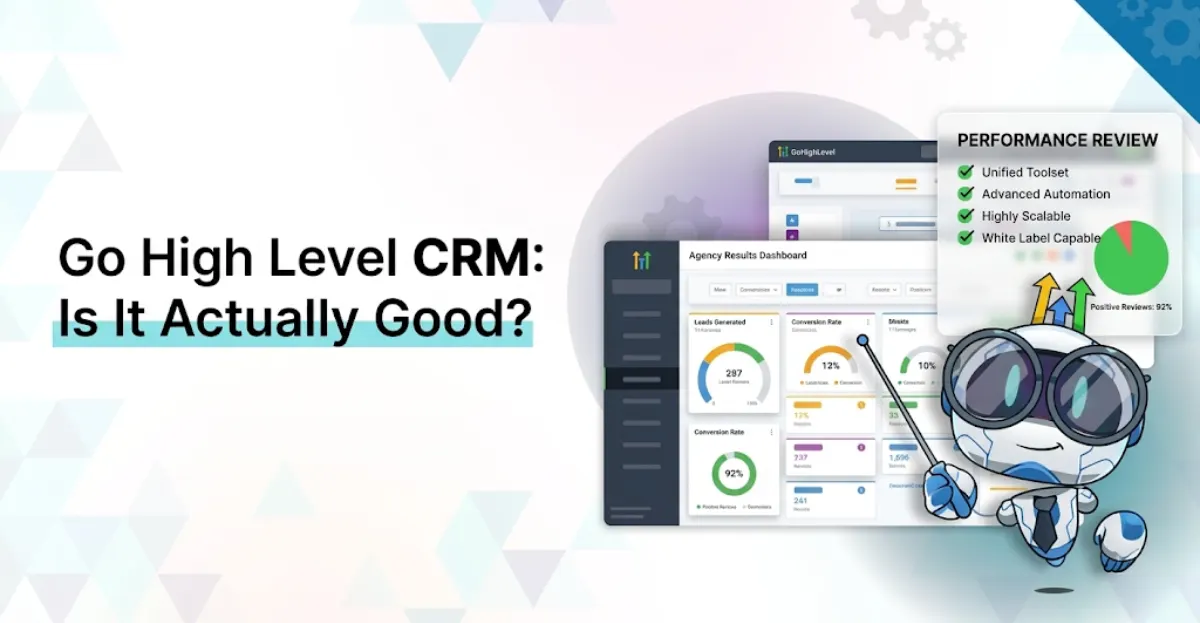
Go High Level CRM: Is It Actually Good?
The CRM is the foundation everything else is built on — and for most small businesses, it is the part of Go High Level that delivers the most immediate value.
The pipeline view is visual and intuitive. You drag leads through stages — New Enquiry, Contacted, Proposal Sent, Won, Lost — and every touchpoint logs automatically. A call made from GHL, an SMS sent, an email opened, a form submitted — all of it appears in a single contact timeline. No more jumping between your inbox, your phone, and a spreadsheet to piece together what happened with a lead.
What makes it genuinely different from standalone CRMs is the native connection to automation. When a lead moves to a specific pipeline stage, a workflow fires automatically — send a follow-up email, create a task, send a Slack notification, trigger an SMS. That level of integration costs significantly more in tools like HubSpot or Salesforce.
According to G2, Go High Level scores 4.4 out of 5 overall, with users consistently praising the all-in-one value and flagging the learning curve as the primary friction point. Capterra mirrors that sentiment — strong satisfaction scores with setup complexity as the most common concern.
Where the GHL CRM falls short
- Reporting is functional but not sophisticated — building custom reports requires workarounds
- The mobile app has fewer features than the desktop version — not ideal for field-based teams who need full functionality on the go
- QuickBooks integration exists but is limited — not a full bidirectional accounting sync
- The initial setup — custom fields, pipeline stages, tags, contact segmentation — takes real time to configure correctly for your specific business
Go High Level Automation: Where It Earns Its Place
If the CRM is the foundation, the automation engine — called Workflows — is what makes Go High Level genuinely worth it for most small businesses.
Here is a real-world example. A home services company gets 60 inbound enquiries a month. Before Go High Level, this is what happens:
Someone submits the contact form. It lands in Gmail. Someone checks Gmail at 9am and sends a manual reply. By then it has been 8 hours. The lead has already called two competitors who responded faster.
After Go High Level, this is what happens:
- Lead submits the form
- Within 60 seconds, an SMS fires: “Hi [Name], thanks for reaching out — we will call you back within 15 minutes. Click here to book a time: [link]”
- Lead is added to the CRM pipeline, tagged by service type
- Owner gets a Slack notification with the lead’s full details
- If no booking in 24 hours, a follow-up email goes out automatically
- If no response in 48 hours, a second SMS fires with a different angle
- After the job is completed, a review request goes out automatically 3 days later
That entire sequence runs itself, 24/7, without anyone managing it manually. For businesses where lead response speed directly determines revenue — home services, real estate, coaching, consulting, healthcare — this single workflow transforms conversion rates.
Research from Harvard Business Review and Lead Response Management consistently shows that leads contacted within 5 minutes are 9x more likely to convert than those contacted after an hour. Go High Level is built specifically to close that gap automatically.
Go High Level AI Features in 2026
Go High Level has invested heavily in AI capabilities and it shows. The platform now includes:
- AI Employee — a voice and chat AI that answers inbound calls, handles website chat, responds to SMS conversations, and books appointments automatically — 24/7, in your business’s voice
- AI Conversation Intelligence — automatically reviews call recordings and conversation transcripts, scores leads, and flags action items for your team
- AI Content Generator — creates email copy, SMS messages, and social posts from a brief prompt directly inside the platform
- Workflow AI nodes — embed GPT-4 decisions directly into automation sequences for intelligent lead classification and routing
For a small business without a dedicated receptionist or sales team, the AI Employee feature is genuinely useful. Enquiries that come in at 11pm on a Saturday get responded to within seconds, leads get qualified, and appointments get booked — before your team even starts Monday morning.
According to Gartner, hyperautomation — combining workflow automation with AI — is among the top strategic technology priorities for businesses through 2027. Go High Level’s native AI integration positions it well ahead of most alternatives on this front.
Go High Level vs. The Competition
| Platform | CRM | SMS built-in | Funnels | AI features | Best for |
|---|---|---|---|---|---|
| Go High Level | Strong | Yes — native | Strong | Strong | All-in-one service businesses |
| HubSpot | Very strong | Paid add-on | Strong | Growing | B2B teams needing deep reporting |
| ActiveCampaign | Medium | Paid add-on | Basic | Limited | Email-first automation |
| ClickFunnels 2.0 | Basic | No | Very strong | Limited | Funnel-focused businesses |
| Keap | Strong | Paid add-on | Medium | Basic | Small service businesses |
The core Go High Level advantage is breadth under one subscription. No competitor gives you a full CRM, funnel builder, multi-channel automation, built-in SMS, and AI features in a single platform at this level of integration.
The core weakness relative to HubSpot and Salesforce is reporting depth and integration maturity. For businesses with complex data requirements or enterprise-level analytics needs, HubSpot’s ecosystem is more capable. For the vast majority of small businesses, Go High Level’s reporting is more than sufficient.
Who Should — and Shouldn’t — Use Go High Level
Go High Level is the right choice if you:
- Currently run 3 or more separate tools that don’t integrate cleanly with each other
- Operate a service business where lead response speed directly affects revenue
- Need automated booking, SMS follow-up, and CRM without hiring additional staff
- Are a marketing agency managing multiple client accounts from one place
- Want AI voice and chat capability without building or buying custom software
- Need reputation management — automated review requests — built into your workflow
Go High Level is probably not the right choice if you:
- Only need one specific function — a standalone email tool or just a CRM
- Run an e-commerce business — Shopify and Klaviyo will serve you better
- Have a very small contact list and minimal automation needs
- Have no capacity or support to invest time in proper platform configuration
- Need deep accounting integration — GHL’s financial sync is limited
The GHL Decision Framework:
- Running 3+ tools that don’t sync → Go High Level replaces all of them
- Need results in under 30 days → Engage a GHL setup specialist
- E-commerce focused business → Shopify + Klaviyo is a better fit
- Need enterprise reporting depth → HubSpot or Salesforce
What Getting Set Up Actually Looks Like
Here is the part most GHL reviews skip entirely — and it is the most important section for a small business owner making this decision.
Go High Level is not plug-and-play. Out of the box, it is a blank platform. You need to:
- Connect your domain and configure your sub-account
- Build your CRM pipeline stages to match your actual sales process
- Set up custom fields for the contact data your business tracks
- Build your first workflow — lead capture trigger, SMS response, follow-up sequence
- Connect your calendar and configure booking logic
- Import your existing contacts
- Set up your SMS number and verify for A2P 10DLC compliance
The businesses that do this properly — either themselves over 2–4 weeks, or with a setup partner who does it in days — consistently report strong results. The businesses that skip this phase or do it halfway consistently underuse the platform and cancel within 90 days wondering what all the hype was about.
For businesses that want the results without the learning curve, working with a specialist like Exotica AI Solutions — who handles full Go High Level setup, CRM configuration, workflow builds, and team training — compresses that entire onboarding into days, with everything built correctly for your specific business from the start.
The Honest Verdict: Is Go High Level Worth It?
Yes — for the right business, configured properly.
Go High Level earns its place every month when it is used by a service business that needs multi-channel follow-up, CRM pipeline management, automated booking, and reputation management working together seamlessly. The businesses getting the most value are those where lead response speed and systematic follow-up directly determine revenue — real estate, home services, healthcare, coaching, insurance, consulting.
For those businesses, Go High Level frequently pays for itself in the first month through leads that would otherwise have gone cold, reviews that would never have been requested, and appointments that would never have been booked automatically.
The businesses that don’t get value are those that subscribe, get overwhelmed by feature depth, configure nothing properly, and cancel after 60 days. That outcome is entirely avoidable with the right setup support — but it does happen, and it explains the mixed reviews you’ll find online.
If you are evaluating Go High Level right now, the most important question is not “is it a good platform?” — it is “do I have the time and support to configure it properly?” If yes, it is one of the best operational investments a service business can make in 2026.
Frequently Asked Questions
Go High Level is not a magic solution. It is a powerful platform that rewards businesses willing to configure it around their actual sales process. The ones who treat it as plug-and-play consistently underdeliver on its potential. The ones who build their entire customer journey into it — pipeline, automation, AI follow-up, review generation — consistently report it as one of the strongest operational decisions they have made.
Ready to set it up the right way from day one? Talk to the Exotica AI Solutions team today.

Mohit Thakur is an experienced Digital Marketing Expert, SEO Team Leader, and Content Writer with over 6 years of expertise in search engine optimization, content strategy, and digital growth. He specializes in research-driven SEO and crafting high-quality, compelling content that helps businesses improve their online visibility, organic traffic, and lead generation.
With hands-on experience across multiple industries, Mohit focuses on creating user-focused, well-researched content aligned with the latest Google algorithms and AI search trends. His approach combines technical SEO, content writing, content optimization, and data analysis to deliver consistent and measurable results.