
What are RPA development services?
RPA development services are end-to-end offerings that design, build, deploy, and maintain software bots to automate repetitive, rule-based business processes — without replacing your existing systems or requiring your team to write code.
The result: faster operations, near-zero error rates, significant cost reduction, and staff freed for higher-value work.
You hired people to solve problems, build relationships, and drive growth. Not to copy data between spreadsheets, re-enter invoice details into three different systems, or manually run the same compliance report every Monday morning. Yet that is exactly how most organizations spend a staggering portion of their operational budget.
RPA development services exist to close that gap. Robotic process automation deploys software bots that perform these exact repetitive, rule-based tasks — faster, more accurately, and 24 hours a day — without touching your existing infrastructure. In 2026, the question is no longer whether to invest in RPA. It is how to find the right development partner, scope the right processes, and deploy in a way that actually delivers the ROI your business needs.
This guide covers everything a business owner or operations leader needs to make that decision with confidence.
What Is RPA Development and Why Does It Matter in 2026?
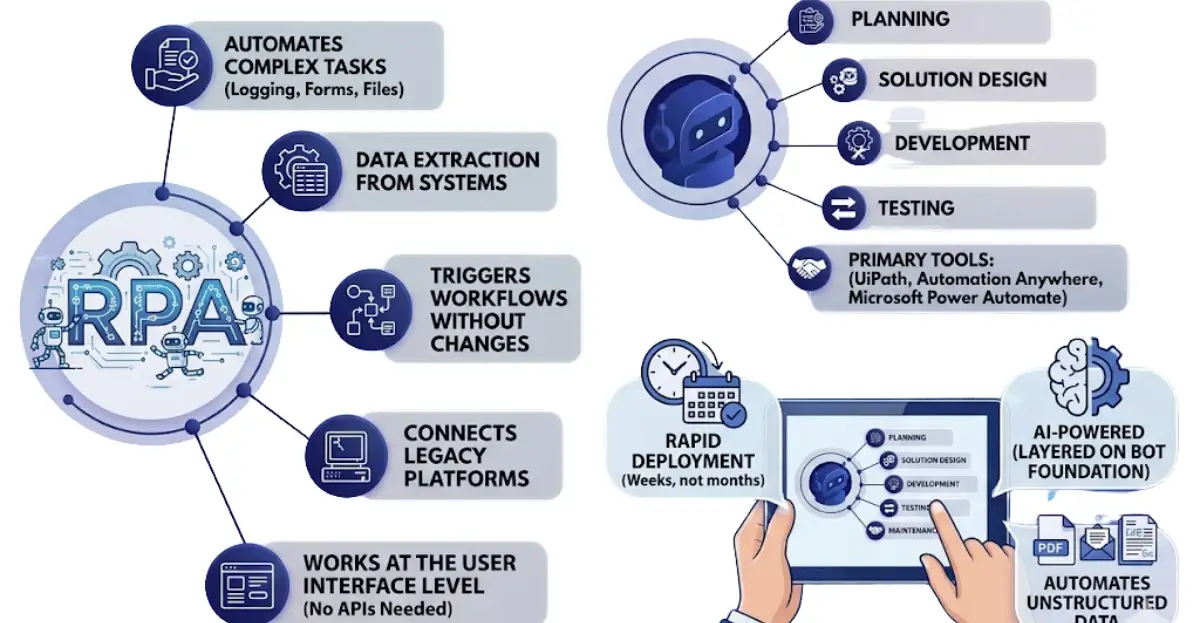
Robotic process automation is the use of software bots to replicate human interactions with digital systems — logging into applications, extracting data, filling forms, moving files, triggering workflows — without any changes to the underlying systems. Unlike traditional software integration, RPA works at the user interface level, which means it can connect legacy platforms that have no APIs and no integration capability.
An RPA developer designs and builds these bots using specialized platforms — primarily UiPath, Automation Anywhere, and Microsoft Power Automate. They map the exact sequence of human actions in a given process, translate those actions into bot logic, integrate the bot with relevant systems, test it thoroughly, and deploy it into production.
What has changed in 2026 is the maturity and accessibility of these tools. What once required a team of enterprise developers and a six-month implementation timeline can now be deployed in weeks. And critically, modern RPA automation services now layer AI capabilities on top of the rule-based bot foundation — enabling automation of processes that involve unstructured data like PDFs, emails, and scanned documents.
Quick Answer — What does an RPA developer do?
An RPA developer analyzes business processes, designs automation workflows, builds software bots on platforms like UiPath or Automation Anywhere, integrates them with enterprise systems, and tests deployments to ensure accuracy. They translate manual human tasks into automated bot logic that runs reliably at scale.
RPA vs. Intelligent Automation: Know the Difference Before You Buy
One of the most common sources of confusion when evaluating robotic process automation consulting services is the distinction between RPA and intelligent automation. Getting this wrong leads to either underinvesting — deploying basic bots when the process demands AI judgment — or overinvesting in capabilities you do not yet need.
What RPA handles well
- Structured, predictable, rule-based tasks with consistent inputs
- High-volume processes where the same steps repeat without variation
- Legacy system integration where API connections are unavailable
- Processes requiring speed and accuracy but no judgment calls
Where intelligent automation extends RPA
- Unstructured documents — invoices, contracts, medical records, emails
- Natural language queries and customer communications
- Variable exception handling requiring contextual decision-making
- Processes that improve continuously as more data accumulates
For most organizations beginning their automation journey, RPA delivers the fastest, most measurable ROI on structured back-office processes. Intelligent automation — combining RPA with AI — becomes the right investment once the RPA foundation is stable and you have identified processes with meaningful unstructured data components. Our Retrieval-Augmented Generation (RAG) service is one example of how AI capabilities layer directly onto automation workflows to handle document-heavy exception cases that rule-based bots cannot process.
| Capability | RPA | Intelligent Automation |
|---|---|---|
| Structured data tasks | Strong | Strong |
| Unstructured documents | Limited | Strong — AI-powered |
| Legacy system integration | Strong — UI level | Strong |
| Exception handling | Rule-based only | AI-driven judgment |
| Improves over time | No | Yes — continuous learning |
| Time to first deployment | 2–6 weeks | 6–16 weeks |
What RPA Development Services Actually Include
When you engage a professional RPA services provider, you are not buying software. You are buying a structured delivery capability. Here is what a full-service RPA engagement should include at every stage.
1. Process Discovery and Assessment
Before any bot is built, a qualified provider conducts a process audit — identifying which workflows are suitable for automation, quantifying the manual cost, and scoring each process by automation feasibility and ROI potential. This step prevents the most expensive mistake in RPA: automating the wrong process first.
2. Process Design and Workflow Mapping
Every process to be automated is documented in detail — inputs, outputs, decision points, exception rules, and system interactions. This becomes the blueprint the RPA developer works from. A provider that skips this step produces fragile bots that break when real-world edge cases arise.
3. Bot Development and Configuration
The actual build phase. RPA developers configure bots on your chosen platform — UiPath, Automation Anywhere, Power Automate, or an open-source stack like n8n for workflow-heavy environments — coding the automation logic, connecting to relevant systems, and building exception handling that keeps bots running when inputs vary.
4. Testing and Quality Assurance
RPA testing services validate that bots perform correctly under all expected inputs, including edge cases and error conditions. User Acceptance Testing (UAT) with your operations team confirms the bot matches real-world process requirements before go-live.
5. Deployment and Integration
Go-live support, monitoring setup, and integration with your orchestration layer — the control system that manages bot scheduling, load balancing, and error alerting. For RPA implementation services, this phase determines whether bots run reliably at production volume or become a maintenance burden.
6. Managed Services and Ongoing Optimization
Processes change. Systems get updated. Bots need maintenance. The best RPA managed services providers offer ongoing monitoring, error resolution, bot updates as underlying systems evolve, and continuous optimization as additional automation opportunities are identified.
Industries Where RPA Services Deliver the Fastest ROI
Finance and Banking — Account reconciliation, loan processing, KYC document verification, regulatory reporting, and fraud alert triage are among the highest-volume, most error-sensitive processes in financial services. RPA reduces processing times from days to hours and cuts error rates to near zero on rule-based tasks.
Healthcare — Patient intake, insurance eligibility verification, prior authorization, claims processing, and EHR data migration are prime RPA targets. Our healthcare AI solutions combine RPA with intelligent document processing to handle the full range of administrative workflows in HIPAA-compliant environments.
Insurance — Claims triage, policy administration, endorsements, renewals, and document validation generate enormous manual workload. RPA reduces per-claim handling costs by 40–60% in well-scoped deployments.
Manufacturing and Logistics — Purchase order processing, inventory reconciliation, supplier communications, shipment tracking, and quality control reporting are all high-frequency, low-variation processes ideal for RPA. See how we serve manufacturing operations and logistics and supply chain businesses.
E-commerce and Retail — Returns processing, inventory updates, order fulfillment notifications, and customer data synchronization between platforms. Our e-commerce AI solutions extend RPA with AI-driven customer communication and demand forecasting.
Professional Services — Proposal generation, time and billing, client onboarding, document assembly, and CRM data hygiene are all processes where RPA recovers significant billable capacity from administrative overhead.
How to Evaluate RPA Service Providers: The Five Questions That Matter
The market for robotic process automation consulting is crowded. Technology integrators, boutique RPA shops, offshore development firms, and full-service AI automation agencies all compete for the same budget. Here is how to cut through the noise.
1. Can they show documented ROI from past deployments?
Ask for case studies with specific metrics — process cycle time before and after, error rate reduction, headcount equivalent recovered, time to positive ROI. Any credible RPA development company should have multiple examples. Review our client case studies for real deployment benchmarks.
2. Do they start with process assessment or jump straight to build?
A provider that wants to start building before understanding your processes is optimizing for their own speed, not your ROI. Process discovery is the foundation of every successful RPA engagement — not an optional add-on.
3. What happens when the bot breaks?
Bots break when the underlying application changes its interface, when an unanticipated exception arises, or when data quality degrades. Ask specifically about SLAs for error response, monitoring tools, and how the provider handles bot maintenance as your systems evolve.
4. Do they understand your industry?
A provider with deep experience in financial services will have pre-built knowledge of regulatory constraints, common exception patterns, and integration requirements that a generalist shop simply cannot match. Industry-specific experience materially reduces implementation risk.
5. Can they scale with you?
An RPA engagement that starts with one process should be designed to scale to twenty. Ask whether the provider’s architecture supports an enterprise orchestration layer, whether they offer a Center of Excellence model, and whether their team can grow with your automation program over time.
RPA Development Services: Build In-House or Outsource?
Some organizations consider hiring internal RPA developers rather than engaging an external RPA services company. The decision hinges on three factors: speed to value, ongoing maintenance burden, and total cost.
Building an internal RPA capability from scratch — hiring certified developers, purchasing platform licenses, establishing a development environment, and building deployment processes — typically takes 6–12 months and significant upfront investment before a single bot goes into production.
Engaging a professional robotic process automation services company compresses that timeline to weeks. More importantly, a specialized provider brings pre-built accelerators, proven methodologies, and cross-industry pattern knowledge that an internal team builds only over years of practice.
The most effective model for most mid-market and enterprise organizations is a hybrid approach: engage a provider for the initial build and first wave of deployments, run a parallel internal enablement program to develop Center of Excellence capability, and transition ownership of the automation portfolio over 12–18 months.
Build vs. Outsource — The Decision Framework:
- Need automation running within 90 days → Engage an RPA services provider
- Long-term goal of internal capability → Hybrid model with knowledge transfer
- Single, simple process with stable inputs → No-code tool or internal build
- Complex, multi-system, regulated environment → Specialist RPA development company
The Benefits of RPA Automation: What Production Data Shows
The business case for RPA automation services is well-established across industries. Here is what consistently shows up in production deployments:
- 40–80% reduction in processing time for targeted workflows
- Near-zero error rates on structured data tasks versus a 2–5% human error baseline
- 24/7 operation without overtime, sick leave, or attention degradation
- Full audit trail for every bot action — critical for regulated industries
- 6–12 month payback period on well-scoped implementations
- Staff redeployment to higher-value activities, improving both productivity and retention
According to Forrester Research, organizations with mature automation programs generate significantly higher operational output at lower per-transaction cost than those relying on manual processing. Gartner consistently lists hyperautomation — combining RPA with AI — among the top strategic technology priorities for enterprises through 2027.
Building Your RPA Program: The Right Starting Point
The most common failure mode in RPA is not technical — it is strategic. Organizations that launch RPA programs without a structured process discovery phase, without clear success metrics, and without a scalability roadmap consistently underdeliver on the technology’s potential.
The right starting point is a structured process audit that identifies your top three automation candidates, quantifies the manual cost of each, and produces a prioritized deployment roadmap. From there, a disciplined Phase 1 deployment on your highest-ROI process establishes both the technical foundation and the organizational confidence to scale.
Exotica AI Solutions approaches every RPA engagement this way — not as an isolated bot deployment, but as the first step in a compounding automation program. Our RPA services and solutions span process discovery, bot development, AI augmentation via our RAG-as-a-Service platform, and ongoing managed services. We integrate with your existing CRM and business systems, and every deployment is designed to generate the data that makes the next deployment faster and more accurate.
If you are ready to move from evaluating RPA to deploying it, talk to our team today and get a scoped assessment of your highest-value automation candidates within 24 hours.
Frequently Asked Questions
RPA development is not a technology purchase. It is an operational transformation decision. The organizations winning in 2026 are not those with the most sophisticated bots — they are those that chose the right partner, scoped the right processes, and built automation programs designed to compound in value over time. Whether you are evaluating your first RPA pilot or scaling an existing program, the foundation is always the same: start with process clarity, choose a provider who earns trust with evidence, and deploy in a way that generates clean data for the next wave of automation.
Ready to scope your first deployment? Talk to the Exotica AI Solutions team today.

Mohit Thakur is an experienced Digital Marketing Expert, SEO Team Leader, and Content Writer with over 6 years of expertise in search engine optimization, content strategy, and digital growth. He specializes in research-driven SEO and crafting high-quality, compelling content that helps businesses improve their online visibility, organic traffic, and lead generation.
With hands-on experience across multiple industries, Mohit focuses on creating user-focused, well-researched content aligned with the latest Google algorithms and AI search trends. His approach combines technical SEO, content writing, content optimization, and data analysis to deliver consistent and measurable results.