
End-to-end business process automation with AI has moved from an emerging concept to an operational necessity. In 2026, organizations that outperform their competitors are not automating isolated tasks—they are redesigning entire workflows so systems, data, and decisions work together as one intelligent operation.
Rising operational complexity, growing customer expectations, and pressure to scale without increasing headcount have accelerated this shift. AI-powered automation enables businesses to streamline operations, reduce friction, and build processes that continuously adapt and improve.
This guide explains how end-to-end business process automation with AI works, how to implement it effectively, and how organizations can use it to drive long-term operational efficiency and resilience.
Key Takeaways
- End-to-end automation connects workflows from start to finish across systems and teams
- AI enables automation to handle decisions, exceptions, and unstructured data
- Process optimization must come before automation for sustainable results
- Orchestrated automation delivers greater ROI than isolated task automation
- Continuous monitoring turns automation into a long-term growth engine
What End-to-End Business Process Automation Really Means
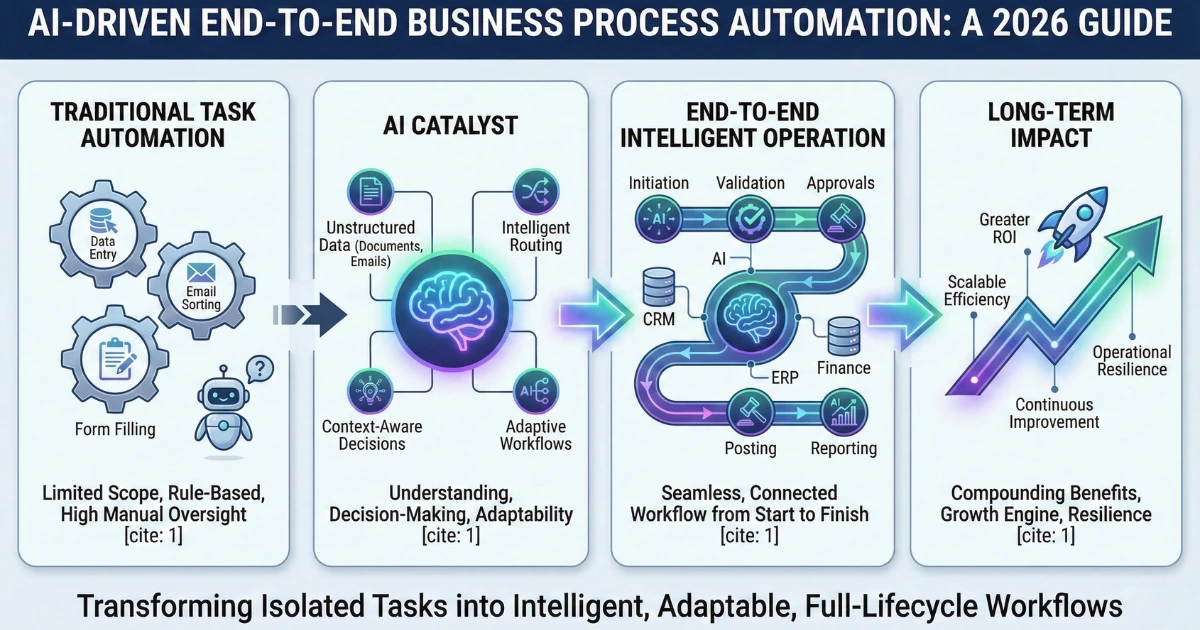
End-to-end business process automation refers to automating an entire workflow from initiation to completion, including every system interaction, decision point, and handoff along the way. Rather than focusing on individual tasks, this approach treats the process as a connected lifecycle.
For example, instead of automating only data entry in finance, an end-to-end approach automates document intake, validation, approvals, exception handling, posting, and reporting—while integrating with finance systems, analytics tools, and dashboards.
AI plays a central role by enabling automation to adapt to variability, manage unstructured inputs, and make informed decisions in real time.
Why AI Is Essential for Automation in 2026
Traditional automation relies on fixed rules and predictable inputs. While effective for simple tasks, it struggles when workflows involve judgment, exceptions, or multiple systems.
AI expands automation capabilities by allowing systems to:
- Understand emails, documents, forms, and messages
- Classify and route requests intelligently
- Make context-aware decisions
- Adapt workflows based on performance data
This transforms automation from static execution into a dynamic operational capability.
Task Automation vs End-to-End Automation
| Task Automation | End-to-End Automation |
|---|---|
| Automates individual actions | Automates full workflows |
| Limited to one system | Connects multiple systems |
| Rule-based execution | AI-supported decisions |
| High manual oversight | Minimal human intervention |
| Short-term efficiency gains | Scalable operational impact |
End-to-end automation delivers compounding benefits because improvements apply across the entire workflow rather than a single step.
Core Components of AI-Driven End-to-End Automation
Process Discovery and Intelligence
Successful automation starts with understanding how work actually flows. Process intelligence analyzes system data to uncover bottlenecks, rework loops, delays, and manual workarounds that are often invisible in documentation.
Workflow Orchestration
Workflow orchestration coordinates tasks, AI decisions, approvals, and integrations across the entire process. It ensures seamless transitions between systems and people.
AI Decision Automation
AI models enable automated decisions such as prioritization, routing, risk-based approvals, and exception handling, reducing manual intervention while improving consistency.
AI Decision Automation
AI models enable automated decisions such as prioritization, routing, risk-based approvals, and exception handling, reducing manual intervention while improving consistency.
System and Data Integration
End-to-end automation depends on real-time integration with platforms such as CRM, ERP, finance systems, and customer support tools. Integration ensures data flows without delays or duplication.
Monitoring and Optimization
Analytics provide visibility into performance, enabling continuous improvement of automation logic and outcomes.
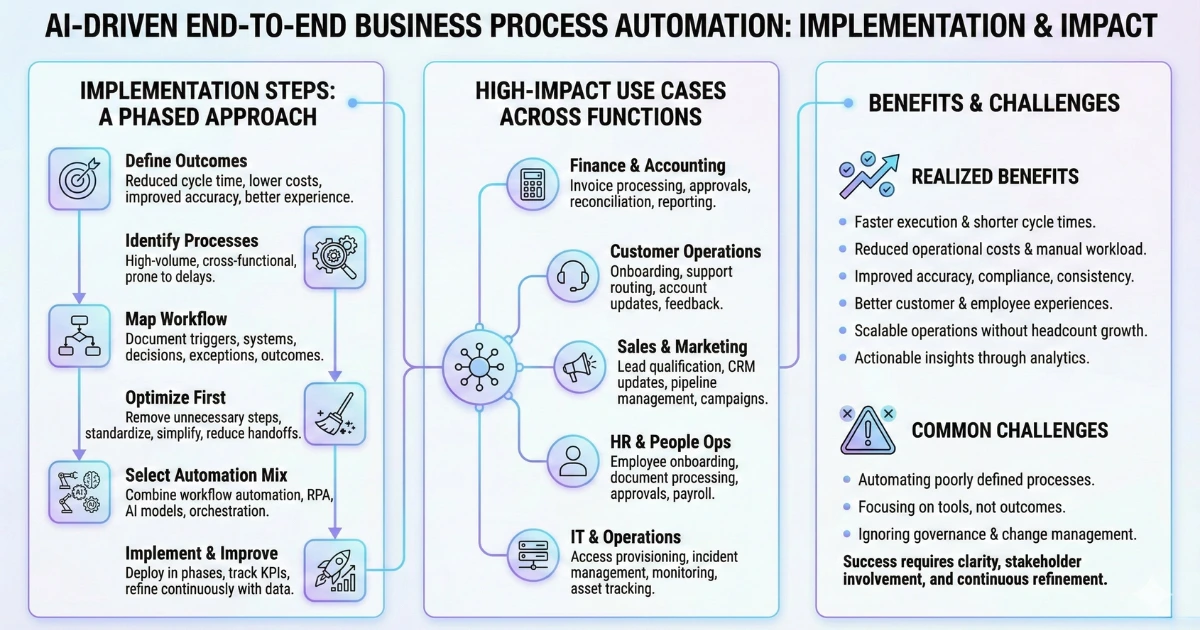
How to Implement End-to-End Business Process Automation with AI
Step 1: Define Clear Business Outcomes
Automation should be driven by measurable outcomes such as reduced cycle time, lower costs, improved accuracy, or better customer experience.
Step 2: Identify High-Impact Processes
Processes that are high-volume, cross-functional, and prone to delays or errors are ideal candidates for end-to-end automation.
Step 3: Map the Entire Workflow
Document triggers, systems, decisions, handoffs, exceptions, and outcomes to ensure full visibility across the process.
Step 4: Optimize Before Automating
Remove unnecessary steps, standardize rules, simplify approvals, and reduce handoffs. Automation should amplify efficiency, not encode inefficiency.
Step 5: Select the Right Automation Mix
Combine workflow automation, robotic process automation, AI models, and orchestration platforms based on process needs.
Step 6: Implement, Measure, and Improve
Deploy automation in phases, track performance using defined KPIs, and refine continuously using real-world data.
High-Impact Use Cases Across Business Functions
Finance and Accounting
Invoice processing, approvals, reconciliation, and reporting become faster, more accurate, and easier to scale.
Customer Operations
Onboarding, support routing, account updates, and feedback management benefit from consistent, AI-driven workflows.
Sales and Marketing
Lead qualification, CRM updates, pipeline management, and campaign orchestration are executed with greater speed and accuracy.
HR and People Operations
Employee onboarding, document processing, approvals, and payroll workflows are streamlined end to end.
IT and Operations
Access provisioning, incident management, monitoring, and asset tracking are coordinated through unified automation.
Benefits of End-to-End Automation with AI
Organizations that adopt AI-driven end-to-end automation experience:
- Faster execution and shorter cycle times
- Reduced operational costs and manual workload
- Improved accuracy, compliance, and consistency
- Better customer and employee experiences
- Scalable operations without proportional headcount growth
- Actionable insights through process analytics
These benefits grow over time as automation systems learn and adapt.
Common Challenges and How to Avoid Them
Automation initiatives often fail when organizations automate poorly defined processes, focus on tools instead of outcomes, or ignore governance and change management.
The most successful organizations treat automation as an ongoing operational capability, starting with clarity, involving stakeholders early, and continuously refining workflows.
Frequently Asked Questions
Final Thoughts
End-to-end business process automation with AI is a practical, achievable strategy for operational excellence in 2026. Organizations that succeed focus on outcomes, optimize processes before automating, and build connected systems that evolve with their business.
With the right strategy and experienced partners such as Exotica AI Solutions, businesses can move beyond fragmented automation and create intelligent operations that deliver efficiency, resilience, and long-term competitive advantage across every layer of the organization.

Mohit Thakur is an experienced Digital Marketing Expert, SEO Team Leader, and Content Writer with over 6 years of expertise in search engine optimization, content strategy, and digital growth. He specializes in research-driven SEO and crafting high-quality, compelling content that helps businesses improve their online visibility, organic traffic, and lead generation.
With hands-on experience across multiple industries, Mohit focuses on creating user-focused, well-researched content aligned with the latest Google algorithms and AI search trends. His approach combines technical SEO, content writing, content optimization, and data analysis to deliver consistent and measurable results.