

Retrieval-augmented generation has become a widely adopted approach for connecting large language models with external data sources. While generic RAG implementations often work for basic document search or question answering, enterprises quickly encounter limitations once accuracy, security, and scalability become critical requirements.
As AI systems transition from experimentation into production, organizations are increasingly adopting custom RAGs—tailored retrieval architectures designed around domain knowledge, governance needs, and real operational constraints. This evolution is not about unnecessary complexity, but about building AI systems that can be trusted in high-stakes business environments.
Why Generic RAG Falls Short in Enterprise AI
Most off-the-shelf RAG implementations follow a standard workflow: documents are chunked, embedded, stored in vector databases, retrieved based on similarity, and injected into prompts. While effective for prototyping, this approach introduces challenges at scale.
Enterprises commonly encounter:
- Inconsistent retrieval quality across complex or technical domains
- Security risks from unfiltered or unrestricted data access
- Latency issues as data volume and usage grow
- Limited control over relevance, ranking, and context selection
- Minimal observability and auditability
In regulated or mission-critical environments, these gaps can lead to incorrect outputs, compliance risks, and loss of stakeholder trust.
What Makes Custom RAGs Different
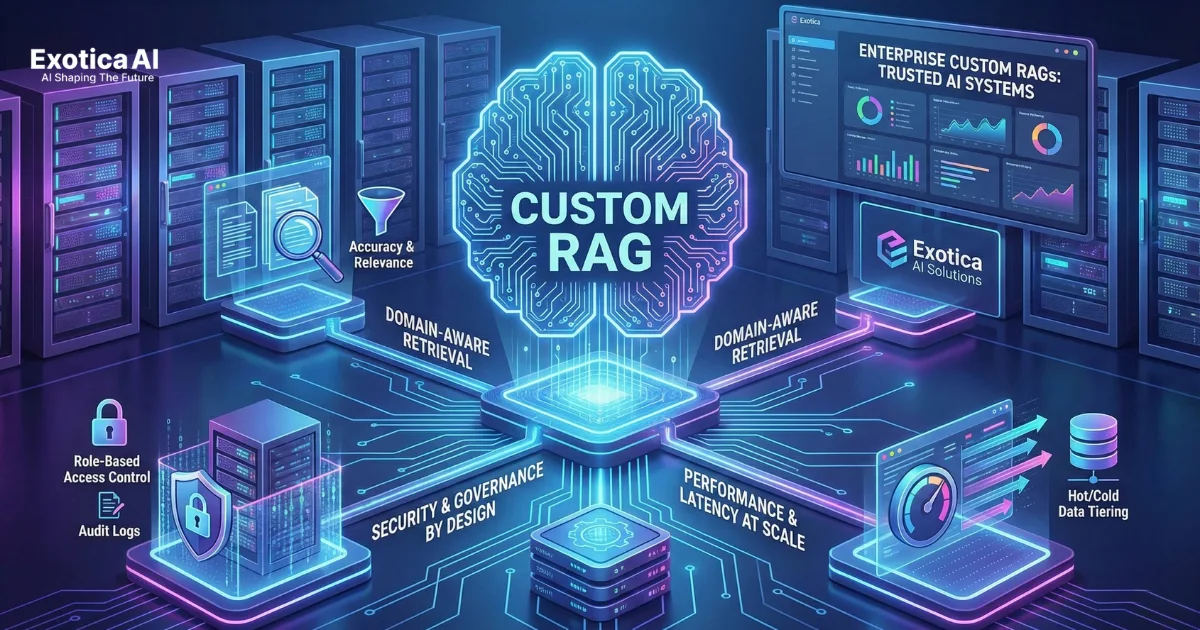
Custom RAGs are not defined by a single tool or framework. They are shaped by intentional architectural decisions that align retrieval systems with business objectives.
Core characteristics include:
- Domain-specific indexing strategies
- Controlled data access and permission layers
- Advanced retrieval and re-ranking logic
- Context-aware prompt construction
- Monitoring and feedback loops for continuous improvement
Rather than treating retrieval as a generic add-on, custom RAGs make it a foundational component of the AI system.
Accuracy Starts With Domain-Aware Retrieval
Enterprise knowledge is rarely uniform. Legal documents, technical manuals, medical guidelines, and internal policies each require different retrieval strategies.
Custom RAGs improve accuracy by:
- Designing chunking strategies based on semantic meaning rather than arbitrary token limits
- Using domain-trained embeddings instead of general-purpose vectors
- Applying hybrid retrieval methods that combine semantic search with keyword or structured filters
- Introducing re-ranking layers that evaluate relevance beyond vector similarity
These techniques significantly reduce irrelevant context and hallucinated responses.
Security and Governance by Design
Generic RAG as a Service typically retrieve data solely based on similarity, without enforcing access controls. In enterprise environments, this creates serious risks.
Custom RAGs address governance by:
- Enforcing role-based and attribute-based access control during retrieval
- Segmenting vector stores by data sensitivity
- Logging retrieval decisions for audit and compliance purposes
- Supporting data residency and regulatory requirements
This ensures AI systems follow the same governance standards as other enterprise software.
Teams building enterprise AI platforms—such as those working with Exotica AI Solutions—often prioritize these controls early rather than attempting to retrofit them after deployment.
Performance and Latency at Scale
As AI usage grows, retrieval latency becomes a major bottleneck. Generic pipelines rarely account for real-world traffic patterns.
Custom RAGs improve performance through:
- Pre-filtered retrieval using metadata constraints
- Tiered storage for frequently accessed versus archival data
- Intelligent caching of common queries
- Asynchronous retrieval for multi-step workflows
These optimizations keep AI systems responsive even under heavy demand.
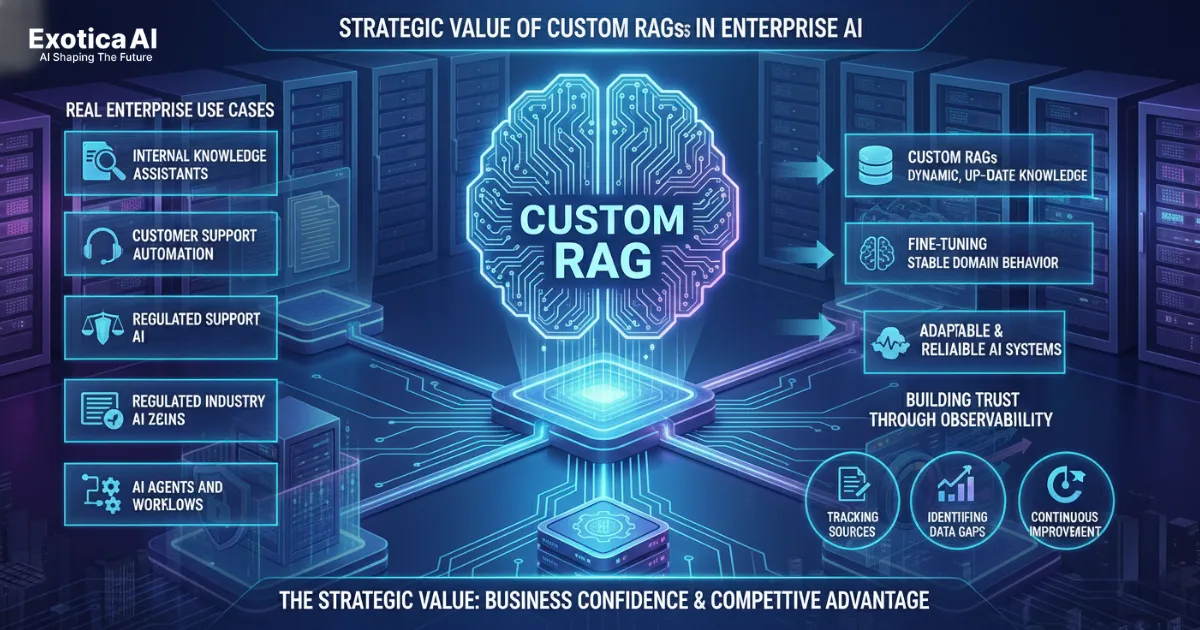
Custom RAGs in Real Enterprise Use Cases
Internal Knowledge Assistants
Employees rely on fast, accurate answers from internal documentation. Custom RAGs ensure responses reflect current policies and user permissions.
Customer Support Automation
Support teams depend on precise, context-aware information. Custom retrieval reduces incorrect responses and unnecessary escalations.
Regulated Industry AI
In healthcare, finance, and legal sectors, traceability is essential. Custom RAGs enable explainable retrieval paths and compliance reporting.
AI Agents and Workflows
For multi-step AI agents, retrieval must be selective and consistent. Custom RAGs prevent context overload and conflicting instructions.
Custom RAGs vs Fine-Tuning: A Practical View
Custom RAGs do not replace fine-tuning. Enterprises increasingly use both approaches together:
- Fine-tuning encodes stable domain behavior into the model
- Custom RAGs provide dynamic, up-to-date external knowledge
Combined, they create AI systems that are adaptable, accurate, and reliable.
Building Trust Through Observability
Enterprise AI success depends on transparency, not just outputs.
Custom RAGs support trust by:
- Tracking which sources are retrieved
- Measuring retrieval relevance over time
- Identifying data gaps and drift
- Supporting continuous optimization cycles
The Strategic Value of Custom RAGs
The true value of custom RAGs lies in business confidence. When retrieval is accurate, secure, and observable, AI systems can move from experimentation into core operations.
Organizations that invest early in tailored retrieval architectures are better positioned to scale AI responsibly, reduce risk, and maintain competitive advantage.
Frequently Asked Questions

Mohit Thakur is an experienced Digital Marketing Expert, SEO Team Leader, and Content Writer with over 6 years of expertise in search engine optimization, content strategy, and digital growth. He specializes in research-driven SEO and crafting high-quality, compelling content that helps businesses improve their online visibility, organic traffic, and lead generation.
With hands-on experience across multiple industries, Mohit focuses on creating user-focused, well-researched content aligned with the latest Google algorithms and AI search trends. His approach combines technical SEO, content writing, content optimization, and data analysis to deliver consistent and measurable results.