What Is AI Agent Orchestration?
AI agent orchestration is the system that coordinates multiple AI agents — each built for a specific task — so they work together as one connected workflow. Instead of running separate AI tools that don’t talk to each other, orchestration lets agents share data, pass tasks between themselves, make decisions, and complete complex multi-step processes automatically. Think of it as a conductor directing an orchestra: each agent plays its part, and the agentic AI orchestration layer keeps everything synchronized, on time, and producing the right output.
Key Takeaways
- AI agent orchestration connects multiple specialized AI agents into one coordinated system that handles complex, multi-step workflows automatically.
- Orchestrated agents can plan, delegate, and adapt — making them far more capable than any single AI tool working alone.
- Businesses use orchestration to automate end-to-end processes across sales, operations, customer service, and marketing without constant human intervention.
- The right AI agent orchestration platform manages memory, context, tool access, and decision-making — so agents stay aligned with your business goals.
- Starting with a single, well-defined use case delivers faster results than building a large multi-agent system from scratch.
Most businesses already use AI in some form. A chatbot here. An email tool there. Maybe a report generator someone set up six months ago. But these tools work in silos — and that’s the problem.
AI agent orchestration solves that. It connects specialized AI agents into a system that can handle complex, multi-step work on your behalf — end to end, without you managing every handoff manually. This is where AI stops being a productivity tool and starts becoming a genuine operational layer for your business.
At Exotica IT Solutions, we build custom AI agent systems for businesses across Canada and the US — helping teams replace fragmented workflows with intelligent, connected automation.
How Agentic AI Orchestration Works — and Why It’s Different from Basic Automation
A single AI agent is good at one thing. It can answer questions, generate content, or analyze data. But business workflows rarely involve just one thing.
Take a sales inquiry. Processing it properly involves lead capture, qualification, CRM entry, scheduling, follow-up, and reporting. That’s six distinct tasks — each requiring different logic, different data, and different tools.
A multi-agent AI system assigns each task to a specialized agent. The agentic AI orchestration layer manages the flow. One agent qualifies the lead. Another updates your CRM. A third sends the follow-up email. They work in sequence — or in parallel — depending on what the workflow needs.
Industry Data
According to McKinsey’s 2024 State of AI report, 65% of organizations are now using generative AI in at least one business function — nearly double the adoption rate from the year before. Gartner predicts that by 2028, at least 15% of day-to-day business decisions will be made autonomously through agentic AI systems. These aren’t distant projections. The infrastructure for orchestrated AI agents is being built right now, across industries at every scale.
The key difference between basic automation and agent orchestration is adaptability. Traditional automation follows a fixed script. If something unexpected happens, it breaks. Orchestrated AI agents can reason, adjust, and reroute — without a human stepping in to fix the flow.
To understand how this fits into a broader operational strategy, see how AI consulting services in Canada help organizations design scalable, future-ready automation frameworks from the ground up.
Core Components of an AI Agent Orchestration Platform
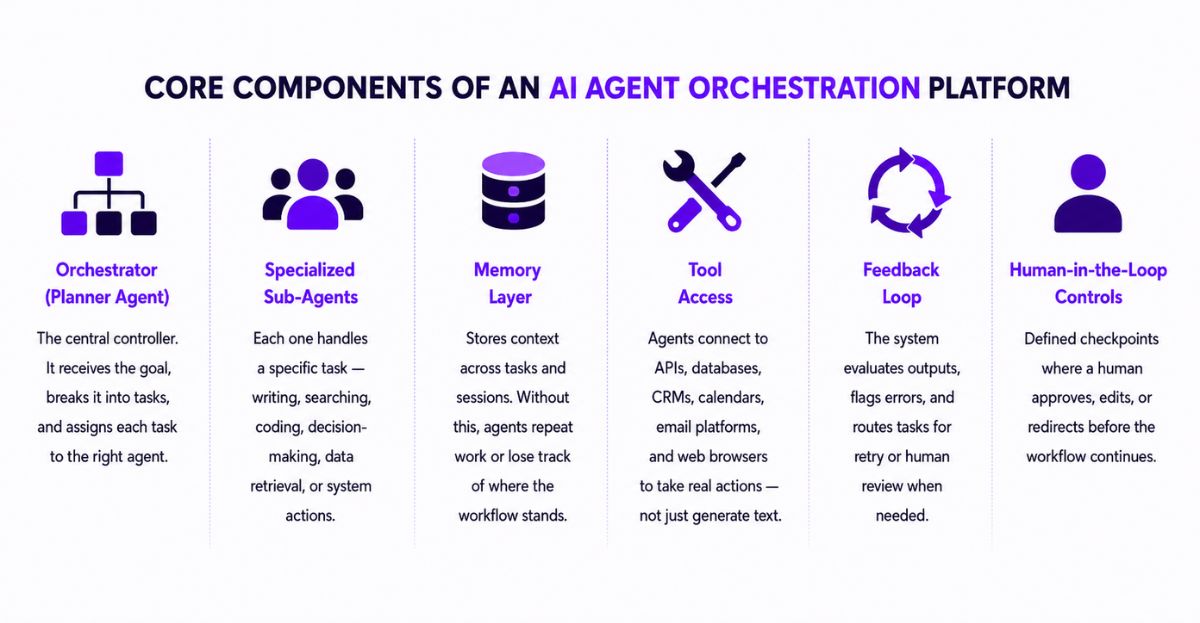
Understanding the parts helps you evaluate what you actually need. Every AI agent orchestration platform — regardless of vendor — includes these building blocks.
- ▸Orchestrator (Planner Agent): The central controller. It receives the goal, breaks it into tasks, and assigns each task to the right agent.
- ▸Specialized Sub-Agents: Each one handles a specific task — writing, searching, coding, decision-making, data retrieval, or system actions.
- ▸Memory Layer: Stores context across tasks and sessions. Without this, agents repeat work or lose track of where the workflow stands.
- ▸Tool Access: Agents connect to APIs, databases, CRMs, calendars, email platforms, and web browsers to take real actions — not just generate text.
- ▸Feedback Loop: The system evaluates outputs, flags errors, and routes tasks for retry or human review when needed.
- ▸Human-in-the-Loop Controls: Defined checkpoints where a human approves, edits, or redirects before the workflow continues.
The orchestration layer is what ties all of this together. Without it, you just have a collection of AI tools — not a system. Learn more about how AI workflow automation works in practice for Canadian businesses.
How AI Agent Orchestration Works — Step by Step
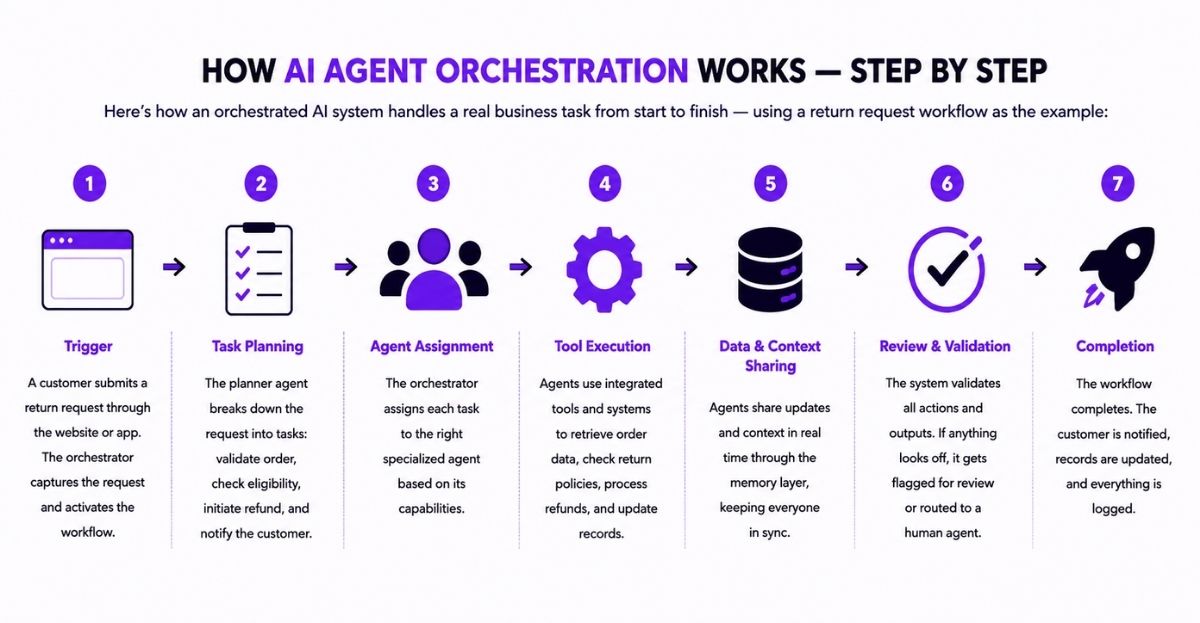
Here’s how an orchestrated AI system handles a real business task from start to finish — using a client intake process as the example:
- ▸Step 1 — Trigger: A prospect submits an inquiry form on your website. The orchestrator receives the input and activates the workflow.
- ▸Step 2 — Task Planning: The planner agent breaks down what needs to happen: qualify the lead, update the CRM, send a confirmation, assign to a team member, schedule a call.
- ▸Step 3 — Agent Assignment: The orchestrator sends each task to the right sub-agent. The qualification agent reviews the form data. The CRM agent creates the contact record.
- ▸Step 4 — Tool Execution: Agents use real tools to take actions. The scheduling agent checks your calendar and books a call. The email agent sends a personalized confirmation.
- ▸Step 5 — Context Sharing: Each agent passes its output to the next. The qualification result informs how the email is written. The CRM record is updated with the call details.
- ▸Step 6 — Review Gate: If the lead is flagged as high-value, a human-in-the-loop alert notifies your sales manager before the workflow continues.
- ▸Step 7 — Completion and Logging: The workflow completes. Every action is logged. The orchestrator marks the task as done and updates the reporting dashboard.
The entire sequence — from inquiry to booked call — runs in minutes. No manual handoffs. No missed steps. No one watching it happen.
Real-World Example: E-Commerce Operations Team
A mid-sized e-commerce business processing 400+ daily orders faced mounting pressure on their customer service and operations teams. Returns, refund requests, and shipping queries consumed hours of manual work every day.
After deploying an orchestrated AI agent system, the business automated the full return request workflow — intake, eligibility check, approval, refund initiation, and customer notification — without a single human touching routine cases. Complex cases were routed automatically for human review. Processing time dropped from 48 hours to under 20 minutes for standard requests. The support team shifted focus to high-priority issues that genuinely needed human judgment.
Key Factors to Consider When Choosing AI Agent Orchestration Frameworks and Platforms
Not every business is ready for multi-agent orchestration straight away — and that’s fine. These are the factors that determine whether your project will succeed or stall.
1. Workflow Complexity
Orchestration delivers the most value for workflows with three or more sequential steps involving different systems. If your process is simple and linear, a single-agent setup or standard automation tool is a better starting point.
2. Choosing the Right AI Agent Orchestration Frameworks
Your framework choice shapes everything downstream — flexibility, cost, maintenance burden, and capability ceiling. The most widely adopted AI agent orchestration frameworks right now include:
| Framework | Best For | Technical Level |
|---|---|---|
| LangChain / LangGraph | Custom Python-based multi-step agent workflows | Developer |
| Microsoft AutoGen | Collaborative, conversational multi-agent systems | Developer |
| CrewAI | Role-based agent teams with defined responsibilities | Developer / Mid |
| n8n / Make | Business workflow automation with visual builders | Low-code |
| Service Now AI Agent Orchestrator | Enterprise IT, ITSM workflows, and service management at scale | Enterprise |
The Service Now AI Agent Orchestrator is particularly well-suited for large enterprises managing IT service workflows, employee onboarding, and cross-departmental approvals. It integrates directly into the ServiceNow platform and is built for organizations that already run enterprise-grade operations on it. For businesses not on ServiceNow, lighter frameworks like n8n or CrewAI often deliver faster time-to-value at lower cost.
3. Data Quality and System Integration
Agents are only as reliable as the data they work with. If your CRM has duplicate records, your forms collect inconsistent information, or your systems don’t share data cleanly — fix that first. Orchestration amplifies what’s already there, good or bad.
4. Guardrails and Human Oversight
Fully autonomous agents work well for low-risk, rule-bound tasks. For anything touching client relationships, financial decisions, or sensitive data — build in review gates. The system should escalate when it hits ambiguity rather than proceeding blindly.
5. Privacy and Data Governance
When agents access and process personal data — customer names, emails, financial records — compliance matters. Canadian businesses must align with PIPEDA requirements. Businesses in Quebec face additional requirements under Law 25. European-facing operations need GDPR alignment. Agents that handle personal data should operate within clearly defined data retention and access policies from day one.
Cost, Timeline, and What to Realistically Expect
Costs vary significantly based on the number of agents, integrations required, and how much custom logic the workflows involve. Here’s a general framework to help you plan.
| Project Type | What’s Included | Typical Timeline |
|---|---|---|
| Single-Agent Workflow | One agent, one tool, one task automated (e.g., lead qualification) | 3–7 days |
| Small Multi-Agent System | 2–4 agents, CRM + email integration, basic orchestration | 2–4 weeks |
| Advanced Orchestration | 5+ agents, multiple integrations, custom logic, human-in-the-loop controls | 6–12 weeks |
| Enterprise AI Agent Platform | Full-scale deployment, security controls, monitoring dashboards, ongoing optimization | 3–6 months |
ROI Benchmarks to Track
According to a 2024 Salesforce State of AI report, businesses using AI agents for customer service automation reported average handle-time reductions of 35% and first-contact resolution improvements of 28%. IBM research found that organizations deploying autonomous AI workflows saw an average 40% reduction in manual processing costs within the first year. These figures vary by industry and implementation quality — but they point to the scale of return that’s possible when orchestration is designed around actual business outcomes, not just technology.
The most important thing to track isn’t the tool cost — it’s the time value recovered. If your team spends 15 hours per week on tasks that agents can handle, that number is your baseline for calculating ROI.
Common AI Agent Orchestration Mistakes to Avoid
Most orchestration projects that underdeliver don’t fail because of the technology. They fail because of how they’re scoped, built, and launched. These are the patterns to avoid.
- ▸Building too many agents at once. Start with the one workflow that causes the most friction. Get it working well before expanding. Complexity introduced too early makes debugging nearly impossible.
- ▸Skipping the workflow design phase. Agents need clear task definitions, success criteria, and handoff points. Without proper design, you end up automating confusion — not fixing it.
- ▸Picking the wrong framework for your stack. Choosing an AI agent orchestration framework based on popularity rather than fit leads to expensive rework later. Match the tool to your existing systems and team’s capabilities — not to what’s trending.
- ▸Removing humans too quickly. Fully autonomous systems need time to prove reliability before you pull human review out of the loop. Start with approval checkpoints. Remove them incrementally as trust builds.
- ▸Ignoring agent memory and context. Agents without proper memory lose context between tasks and sessions. This produces disjointed outputs and errors that compound across the workflow.
- ▸No monitoring after launch. Orchestrated systems need ongoing observation. Agent outputs drift over time. Models update. APIs change. Build in regular performance reviews from the start.
- Hire Exotica IT Solutions
Frequently Asked Questions: AI Agent Orchestration
Final Thoughts
AI agent orchestration is not a distant concept. It’s a practical, deployable approach to handling the complex, multi-step workflows that consume your team’s time every day. The businesses that move on this now will operate with a structural efficiency advantage that’s difficult to close later.
You don’t need to automate everything to get started. Pick the workflow that costs you the most time. Build one agent system around it. Measure what changes. Then expand from there.
The organizations winning with AI aren’t deploying the most tools. They’re building the most connected systems — where every agent, every workflow, and every data point works together toward a clear business outcome. Whether you’re evaluating a lightweight AI agent orchestration platform or an enterprise solution like Service Now AI Agent Orchestrator, the right first step is a clear-eyed assessment of where your operations lose the most time.

About the Author
Mohit Thakur is a Digital Marketing Expert and SEO Team Leader at Exotica IT Solutions, with hands-on experience helping Canadian and US businesses plan and implement AI automation strategies — from initial agent design through full multi-agent orchestration and ongoing optimization. Mohit focuses on translating complex AI frameworks into practical, business-first solutions for organizations at every stage of their automation journey. Note: This content is for informational purposes only. Tool recommendations and figures referenced are general guidance accurate as of publication date and subject to change.
Last Updated: June 24, 2026
Sources:
McKinsey — The State of AI 2024 ·
Gartner — Agentic AI Predictions 2028 ·
Salesforce — State of AI Report 2024 ·
IBM — Global AI Adoption Index ·
Office of the Privacy Commissioner of Canada — PIPEDA ·
LégisQuébec — Quebec Law 25

Mohit Thakur is an experienced Digital Marketing Expert, SEO Team Leader, and Content Writer with over 6 years of expertise in search engine optimization, content strategy, and digital growth. He specializes in research-driven SEO and crafting high-quality, compelling content that helps businesses improve their online visibility, organic traffic, and lead generation.
With hands-on experience across multiple industries, Mohit focuses on creating user-focused, well-researched content aligned with the latest Google algorithms and AI search trends. His approach combines technical SEO, content writing, content optimization, and data analysis to deliver consistent and measurable results.