
What is AI in Logistics?
AI in logistics uses machine learning and automation to optimize routes, automate dispatch, predict delays, manage warehouses, and power customer support — reducing operating costs and improving delivery performance at scale.
If you’re still dispatching drivers manually, estimating delivery windows by gut feel, or watching your customer support inbox pile up with ‘Where’s my package?’ tickets — you already know the problem is real. The question isn’t whether AI in logistics works. The question is how much longer you can afford to run without it.
The logistics industry moves trillions of dollars in goods every year, yet a significant portion of that value is consumed by inefficiency — missed routes, idle trucks, late deliveries, and human error. In 2026, AI in logistics has evolved from a boardroom buzzword into a measurable competitive advantage that mid-market and enterprise shippers simply cannot ignore.
This guide breaks down exactly how AI in logistics is transforming route optimization, dispatch automation, and customer support — and what your business needs to know to make a smart, ROI-focused decision.
What Is AI in Logistics — and Why Does It Matter Right Now?
AI in logistics refers to the application of machine learning, natural language processing, computer vision, and predictive analytics across the supply chain — from warehouse automation to last-mile delivery. It is not a single tool. It is an intelligence layer that learns from operational data and continuously improves decisions.
According to the latest AI logistics automation research, the global AI in logistics market is projected to surpass $46 billion by 2027, driven by surging e-commerce demand, persistent driver shortages, and fuel cost volatility. AI in logistics is no longer a pilot project — it’s production-grade infrastructure.
Here’s what separates AI-powered logistics from traditional software:
- Traditional software follows fixed rules. AI in logistics adapts to real-world conditions in real time.
- Traditional dispatch relies on planners. AI logistics automation software handles 80–90% of routine decisions automatically.
- Traditional customer service is reactive. AI-powered support is proactive, predictive, and available around the clock.
Route Optimization: How AI in Logistics Cuts Fuel Costs and Tightens Delivery Windows
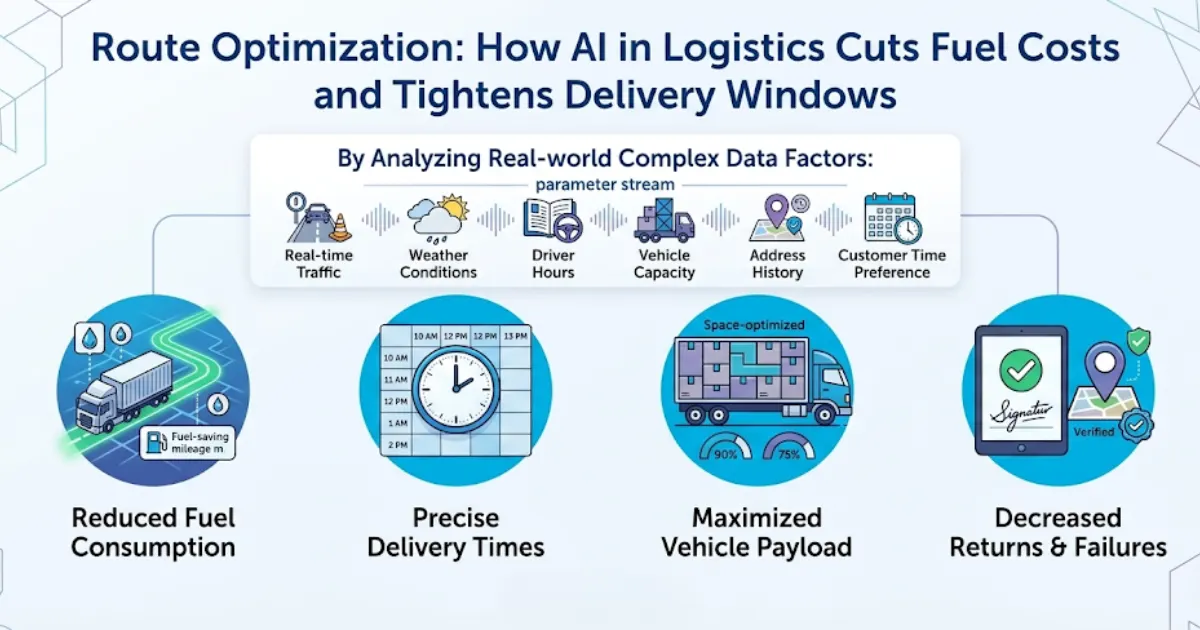
Route optimization is one of the highest-ROI applications of AI in logistics. A single percentage point improvement in route efficiency across a mid-size fleet can represent hundreds of thousands of dollars in annual savings. At enterprise scale, the numbers are transformational.
Traditional routing software calculates the shortest path between two points. AI in logistics does something fundamentally different — it runs continuous optimization loops that account for:
- Real-time traffic data and road closures
- Dynamic weather conditions affecting transit time
- Driver hours-of-service regulations and mandatory break schedules
- Vehicle load capacity and individual fuel consumption profiles
- Historical delivery performance at specific addresses and zip codes
- Customer time-window preferences and appointment commitments
Top approaches in intelligent automation, robotics, and AI logistics now combine computer vision at loading docks with AI-powered route planning — meaning the system knows precisely what is on each truck before it leaves the yard and plans routes accordingly. This is the kind of integrated logistics intelligence that modern operations require.
Real-World Impact of AI Route Optimization
Fleet operators deploying AI-based route planning consistently report:
- 15 to 25 percent reduction in fuel costs
- Up to 30 percent more deliveries per driver per day
- A 40 percent drop in late or missed deliveries
- Measurable reduction in carbon emissions — a growing priority in logistics business intelligence reporting
For businesses trying to optimize logistics while managing rising operating costs, AI route optimization is not a nice-to-have. It is the operational foundation. For a broader look at how automation fits into this picture, see our guide on Intelligent Automation Services: ROI, Use Cases & Getting Started.
AI Dispatch Automation: Eliminating the Most Error-Prone Step in Your Operation
Dispatch is where logistics breaks down most visibly. A dispatcher managing 30 drivers across multiple zones is processing thousands of micro-decisions every shift. Fatigue, inconsistent data, and communication gaps create compounding errors that cascade into missed SLAs and customer complaints that are expensive to recover from.
AI in logistics solves dispatch at the system level — not by replacing your people, but by eliminating the cognitive load that creates mistakes in the first place.
How AI Dispatch Works in Practice
- Job assignment: AI in logistics matches available drivers to jobs based on proximity, load, skill, and compliance rules in milliseconds — not minutes.
- Exception handling: When a breakdown, cancellation, or delay occurs, the system re-optimizes automatically without requiring human intervention.
- Predictive ETAs: Machine learning models trained on millions of historical trips generate accurate delivery windows — not dispatcher estimates.
- Compliance enforcement: Hours-of-service, vehicle inspection status, and licensing requirements are verified automatically before every assignment.
Modern logistics automation software integrates with your existing TMS, ERP, and telematics systems. That means AI in logistics augments your current technology stack rather than requiring a rip-and-replace. This is a critical consideration for operations managers evaluating total cost of implementation.
The result: your dispatchers shift from reactive firefighting to strategic oversight. Explore how Exotica AI Solutions approaches dispatch intelligence as part of a full AI in logistics automation stack.
AI-Powered Customer Support: Turning ‘Where’s My Order?’ Into a Competitive Advantage
Customer support is treated as a cost center in most logistics operations. AI in logistics flips that model entirely.
Today’s shippers, retailers, and end consumers expect real-time shipment visibility. They want to know where their freight is, when it will arrive, and what is being done about any delay — before they have to ask. That expectation is impossible to meet at scale with a human-only support team.
How AI in Logistics Changes the Customer Support Equation
- Proactive notifications: AI in logistics detects delivery exceptions and notifies customers automatically — before they call your support line.
- Conversational AI chatbots: NLP-powered bots handle tier-1 inquiries including status, ETAs, and claims initiation instantly, 24 hours a day, seven days a week.
- Sentiment analysis: AI identifies frustrated customers in real time and escalates to human agents exactly when intervention adds value.
- Predictive issue resolution: Machine learning models flag shipments at risk of delay before the event occurs — enabling proactive resolution instead of reactive apology.
Shipping AI integrated into your CRM and TMS does not just answer questions — it generates operational data that improves future performance. Every customer interaction becomes a training signal. This is a feedback loop that traditional support cannot create, and it is one of the most underappreciated compounding advantages of AI in logistics. Learn more about how AI chatbot solutions power this kind of support at scale.
AI Logistics Security: Protecting Your Supply Chain From Modern Threats
Logistics security technology powered by AI has become a board-level concern. Supply chains are high-value targets — cargo theft, identity fraud, and cyber intrusion represent growing risks that legacy security systems were simply not designed to address.
AI-powered security in logistics now includes:
- Computer vision at warehouse entry points and loading docks for unauthorized access detection
- AI gun detection software integrated with surveillance systems for real-time physical threat identification
- Anomaly detection in freight documentation to flag fraudulent manifests or identity spoofing attempts
- Real-time behavioral analysis across driver and carrier networks to surface suspicious patterns before incidents occur
Logistics security technology AI gun software platforms now integrate directly with access control and law enforcement alert systems — providing automated threat response that is faster and more consistent than any manual security operation. This is an area where leading AI supply chain companies are investing heavily in 2026.
Machine Learning in Logistics: The Intelligence Engine Behind Automation
Machine learning in logistics industry applications are no longer confined to academic pilots. They are running live in warehouse automation systems, demand forecasting engines, and carrier procurement platforms across North America and globally.
Key machine learning capabilities driving AI in logistics today:
- Demand forecasting: Predict volume spikes before they happen, enabling pre-positioned inventory and pre-planned capacity that eliminates reactive scrambling.
- Predictive maintenance: Identify vehicles and equipment approaching failure before breakdown — reducing fleet downtime by up to 35 percent.
- Carrier performance scoring: Rank carriers on actual delivery performance data, not just quoted service levels.
- Dynamic pricing: Adjust freight rates in real time based on lane demand, capacity availability, and fuel index movements.
- Warehouse slotting: Optimize product placement inside distribution centers based on pick frequency and live order patterns.
Business intelligence in logistics industry platforms now embed machine learning directly into their operational dashboards — meaning your team gets predictive insights, not just historical reports. This is the defining difference between logistics business intelligence that tells you what happened and intelligence that tells you what to do next. For more on how intelligent automation drives these outcomes, see our Best Business Process Automation Tools in 2026 guide.
Logistics Warehouse Automation: Where AI in Logistics Meets the Physical Supply Chain
Logistics warehouse automation in 2026 reflects a dramatic acceleration. Autonomous mobile robots, AI-powered picking systems, and computer vision quality control are no longer experimental. They are being deployed in fulfillment centers of all sizes, from regional 3PLs to global enterprise networks.
Leading AI warehouse automation capabilities in active deployment:
- Goods-to-person robotic systems that eliminate picker travel time entirely
- AI vision systems for real-time inventory counting and damage detection without human intervention
- Automated sortation powered by machine learning address recognition
- Digital twin modeling for continuous warehouse layout optimization
How technology reduces errors in fulfillment and logistics is no longer a philosophical question. AI-automated pick-and-pack operations reduce mis-picks by up to 99.9 percent, compared to 1 to 3 percent error rates in manual operations. At high volume, that difference translates directly into customer retention, reduced returns processing costs, and improved carrier relationships.
Learn more about integrated AI in logistics solutions at ai.exoticaitsolutions.com.
How AI Enhances Sustainability in Supply Chains
How can AI enhance sustainability in supply chains? This is one of the most-searched questions from logistics executives in 2026 — and for good reason. ESG commitments and mandatory carbon reporting requirements are making sustainability a bottom-line issue, not just a communications strategy.
AI in logistics contributes directly to sustainability performance through:
- Route optimization that minimizes empty miles and reduces fuel burn per delivery cycle
- Predictive load optimization that maximizes truck fill rates, reducing total trips and total emissions
- AI-powered modal shift analysis identifying when rail or intermodal is more efficient than over-the-road
- Demand forecasting that reduces overproduction, excess inventory build-up, and costly returns
- Carbon footprint tracking integrated into shipment-level logistics intelligence dashboards for regulatory reporting
How AI can make supply chains more sustainable is an operational question that AI in logistics answers with data. Companies implementing AI in logistics today are building the data infrastructure required to meet net-zero supply chain commitments on schedule. Those that delay are creating a compliance gap that compounds with every quarter.
Generative AI in Logistics: The Next Frontier for Supply Chain Transformation
How generative AI can drive supply chain transformation is a question every logistics technology leader should be actively exploring. Generative AI moves beyond pattern recognition into active problem-solving — drafting carrier contracts, generating exception resolution workflows, creating operational SOPs, and synthesizing cross-system data into executive-ready briefings.
Practical generative AI applications in AI in logistics in 2026:
- Auto-generating freight audit dispute responses based on contract terms and shipment data
- Creating customized carrier scorecards with narrative explanations for quarterly business reviews
- Drafting customer communication templates that adapt dynamically to real-time shipment context
- Synthesizing logistics intelligence dashboards into natural language summaries for non-technical stakeholders
What’s the leading tech in logistics right now?
The convergence of generative AI with operational AI — real-time decision-making enhanced by language model reasoning — is where the most significant competitive differentiation in AI in logistics is being built. The early movers in this space are establishing advantages that will be structurally difficult to overcome. Explore how RAG and AI document processing capabilities are powering these next-generation logistics applications today.
How to Implement AI in Logistics: A Practical Decision Framework
How to implement AI in supply chain management is the practical question that follows strategic conviction. Most AI in logistics implementations fail not because the technology does not work, but because organizations start in the wrong place with the wrong metrics.
A proven implementation sequence for AI in logistics:
- Step 1 — Data audit: AI in logistics is only as good as your underlying data. Before selecting a platform, assess the quality, completeness, and accessibility of your TMS, ERP, and telematics data.
- Step 2 — Use case prioritization: Identify the two or three areas where AI in logistics will generate the fastest, most measurable ROI for your specific operation and customer base.
- Step 3 — Integration planning: Confirm your selected AI logistics software connects to existing systems via API or pre-built connectors before committing to a platform.
- Step 4 — Pilot design: Run a 60 to 90 day pilot on a defined lane, region, or customer segment with clearly defined success metrics agreed upon in advance.
- Step 5 — Phased rollout: Scale AI in logistics based on pilot results, expanding use cases as your team’s data literacy and platform confidence grow in parallel.
The right AI logistics software partner will guide you through this process with operational experience — not just a product pitch. Hold every vendor to that standard.
| Implementation Step | Focus Area | Key Outcome |
|---|---|---|
| Step 1 — Data Audit | TMS, ERP, telematics data quality | Foundation for reliable AI decisions |
| Step 2 — Use Case Prioritization | Highest-ROI pain points | Fastest measurable return |
| Step 3 — Integration Planning | API and connector compatibility | No rip-and-replace required |
| Step 4 — Pilot Design | 60–90 day defined lane pilot | Proof before full commitment |
| Step 5 — Phased Rollout | Scale by results and data maturity | Compounding operational advantage |
Frequently Asked Questions: AI in Logistics
Final Takeaway: AI in Logistics Is a Business Decision, Not Just a Technology Choice
Every conversation about AI in logistics returns to the same core question: Is now the right time to act? The data in 2026 answers that question with clarity. The cost of delay — in fuel, in missed deliveries, in customer churn, in competitive position lost — now exceeds the cost of implementation for the vast majority of logistics operations.
Route optimization, AI dispatch, customer support automation, warehouse intelligence, security, and sustainability reporting are not isolated initiatives. They are interconnected capabilities that compound in value as your operational data matures. The businesses building that data infrastructure today will possess a structural advantage that is extraordinarily difficult to close in two or three years.
If you are evaluating AI in logistics for your operation, start with a clear-eyed assessment of where your current inefficiencies are most costly — then work with a technology partner who demonstrates exactly how AI in logistics addresses those specific problems, with real data from real deployments.
Visit Exotica AI Solutions or explore the full capabilities of AI in logistics at ai.exoticaitsolutions.com to start that conversation today.
Related Reading
- AI Solutions for Logistics & Supply Chain — Exotica AI Solutions
- AI Chatbot Services
- Workflow Automation Services
- CRM Integration Services
- RAG and AI Document Processing
- Intelligent Automation Services: ROI, Use Cases & Getting Started
- Best Business Process Automation Tools in 2026
- Statista — AI in Logistics Market Data
- McKinsey — Logistics & Supply Chain Insights

Mohit Thakur is an experienced Digital Marketing Expert, SEO Team Leader, and Content Writer with over 6 years of expertise in search engine optimization, content strategy, and digital growth. He specializes in research-driven SEO and crafting high-quality, compelling content that helps businesses improve their online visibility, organic traffic, and lead generation.
With hands-on experience across multiple industries, Mohit focuses on creating user-focused, well-researched content aligned with the latest Google algorithms and AI search trends. His approach combines technical SEO, content writing, content optimization, and data analysis to deliver consistent and measurable results.