
Customer communication plays a critical role in business growth. Sales teams rely on timely conversations with prospects, while support teams must quickly resolve customer issues. At the same time, businesses need accurate customer data to understand behavior and improve engagement.
This is where CRM integration VoIP become a powerful solution. By connecting a VoIP phone system with a customer relationship management platform, companies can centralize communication, automate workflows, and gain deeper insights into customer interactions.
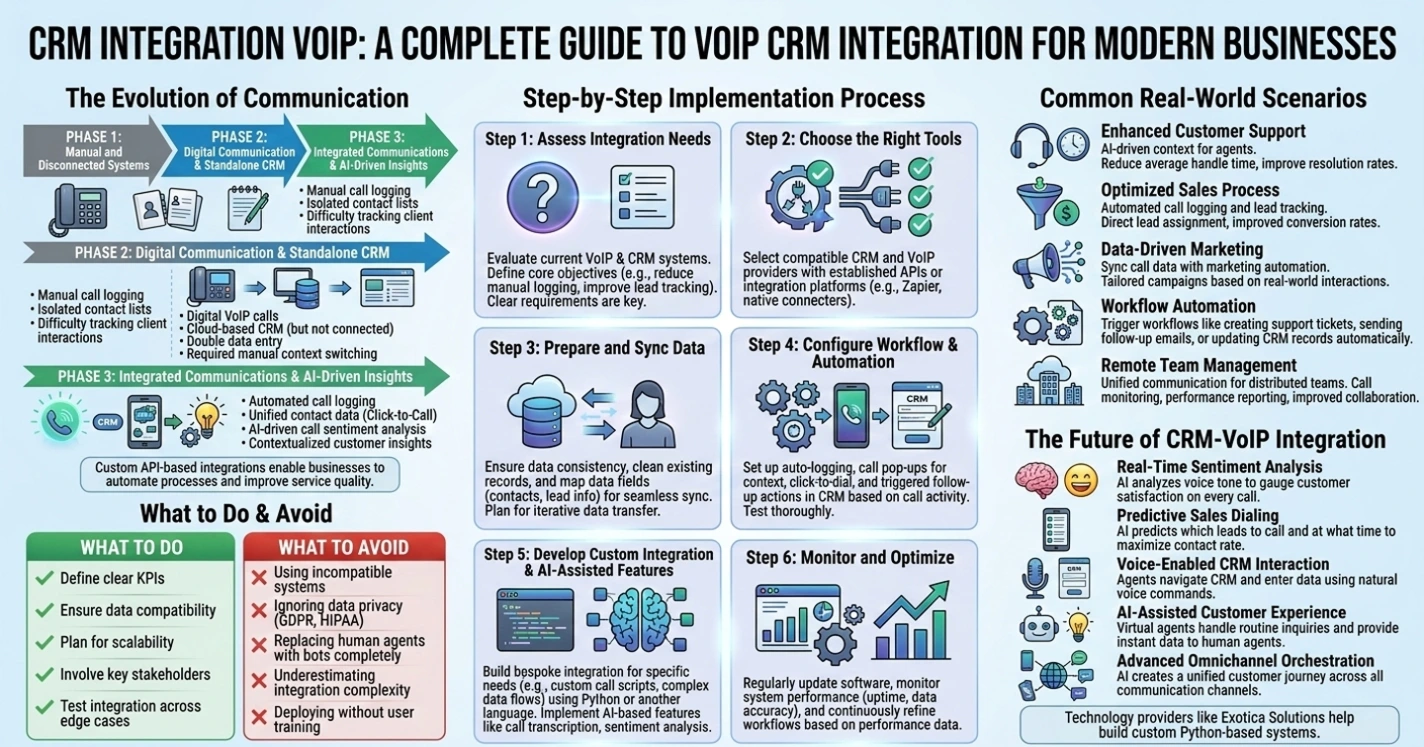
CRM integration VoIP refers to connecting a Voice over Internet Protocol phone system with CRM software so businesses can automatically log calls, access customer profiles during conversations, and analyze communication data in a single platform.
This guide explains how VoIP CRM integration works, the benefits for modern organizations, and how businesses can implement the best CRM VoIP integration strategy.
Why CRM Integration VoIP Matter for Businesses
Customer expectations have changed significantly. People expect fast responses, personalized interactions, and consistent communication across channels.
Without a connected system, businesses often face common challenges:
- Manual call logging
- Missing customer interaction history
- Disconnected communication tools
- Limited visibility into call performance
A well-designed CRM with VoIP integration solves these problems by combining communication systems with customer data.
According to industry research from Gartner, companies that integrate communication platforms with CRM systems can improve agent productivity by more than 20 percent while reducing manual administrative tasks. Organizations using VoIP integration with CRM also gain better visibility into customer interactions, helping teams respond faster and close deals more efficiently.
What Is VoIP CRM Integration?
VoIP CRM integration connects internet-based phone systems with CRM platforms to create a unified communication environment.
When a CRM and VoIP integration is implemented, customer call data automatically synchronizes with the CRM. Teams can view interaction history, track conversations, and manage communication workflows without switching between multiple tools.
This integration enables businesses to manage the following:
- Customer calls
- Contact information
- Call recordings
- Sales activities
- Communication analytics
The result is a centralized communication system that improves efficiency across sales, marketing, and customer support teams.
How VoIP Integration with CRM Works
Understanding how to integrate VoIP into CRM begins with the connection between communication platforms and customer databases.
Most CRM and VoIP system integration setups rely on APIs, built-in connectors, or cloud integrations.
Integration Workflow
- VoIP system connects to the CRM
The phone system communicates with the CRM through secure API connections. - Customer data is matched
When a call occurs, the system searches the CRM for the relevant contact record. - Screen pop appears
Customer information automatically appears on the agent’s screen. - Call activity is recorded
The CRM logs call details such as time, duration, and notes. - Analytics and reporting
Managers gain access to call insights, helping them evaluate team performance.
This automated process creates seamless integration of CRM with VoIP, enabling teams to focus more on conversations rather than manual data entry.
Key Features of CRM VoIP Integration
A strong CRM integration with phone system includes several features designed to improve communication workflows.
Click-to-Call
Employees can call customers directly from the CRM interface, eliminating manual dialing.
Automatic Call Logging
Every call is automatically recorded in the CRM database, including timestamps and conversation notes.
Screen Pop-Ups
When a customer calls, the CRM displays their profile instantly, allowing agents to access previous interaction history.
Call Recording
Many VoIP systems store recordings inside the CRM contact record, which helps with quality monitoring and training.
Call Analytics
Businesses gain insights into communication patterns, call volume, and response times through integrated analytics.
These capabilities make VoIP CRM integrations essential for companies that rely on customer communication.
Best CRM VoIP Integration Platforms
Selecting the best CRM VoIP integration depends on business needs, scalability requirements, and system compatibility.
| CRM Platform | VoIP Integration Capability | Best Use Case |
|---|---|---|
| Salesforce | Extensive API and telephony integrations | Large enterprises |
| HubSpot CRM | Built-in calling and VoIP integrations | Sales and marketing teams |
| Zoho CRM | Native telephony and cloud integrations | Small and mid-size businesses |
| Microsoft Dynamics | Advanced enterprise communication integration | Large organizations |
Zoho CRM VoIP Integration Explained
Many growing companies rely on Zoho CRM VoIP integration because of its flexibility and affordability.
With VoIP integration with Zoho CRM, businesses can:
- Make and receive calls directly from the CRM interface
- Automatically log call activities
- Track call outcomes and notes
- Analyze communication performance
This setup allows teams to maintain complete visibility into customer conversations.
Technology providers such as Exotica AI Solutions help businesses implement scalable CRM and VoIP integration environments that improve communication efficiency and data management.
Benefits of CRM and VoIP System Integration
Businesses adopting CRM with VoIP integration often experience significant improvements in productivity and customer engagement.
Improved Customer Experience
Agents have instant access to customer history, which allows them to respond faster and provide personalized service.
Increased Sales Productivity
Sales teams spend less time entering data and more time engaging with prospects.
Better Communication Tracking
Every call and interaction is recorded within the CRM platform.
Data-Driven Insights
Analytics from VoIP CRM integrations provide insights into customer behavior and communication patterns.
Workflow Automation
Tasks such as call logging and follow-up reminders happen automatically.
These advantages make CRM integration VoIP a valuable tool for businesses aiming to improve operational efficiency.
How to Integrate VoIP into CRM Systems
Organizations planning to integrate CRM with VoIP typically follow a structured implementation process.
Step 1: Select a Compatible VoIP Provider
Choose a provider that supports CRM integration or API connectivity.
Step 2: Enable CRM Integration
Most CRM platforms offer built-in connectors or marketplace applications for telephony integration.
Step 3: Configure API Connections
Developers establish secure API connections between the CRM and VoIP system.
Step 4: Test Communication Workflows
Test features such as call logging, screen pop-ups, and analytics reporting.
Step 5: Train Your Team
Ensure employees understand how to use the integrated communication system effectively.
Working with experienced technology partners like Exotica AI Solutions can simplify the process of implementing CRM integration with VoIP systems.
Common Challenges in CRM and VoIP Integration
Although CRM VoIP integration offers many benefits, businesses may encounter several challenges during implementation.
System Compatibility
Not all VoIP providers support every CRM platform.
Data Synchronization
Incorrect configurations may lead to incomplete or duplicate records.
Security Considerations
Organizations must ensure secure API connections and proper data protection measures.
User Adoption
Employees may require training to adapt to new communication workflows.
Proper planning and testing help minimize these challenges and ensure successful VoIP integration with CRM systems.
Expert Insight on CRM and VoIP Integration
Technology consultants often emphasize that integrating communication systems with customer data platforms is essential for modern organizations.
Companies that combine voice communication with CRM platforms gain a unified view of customer interactions. This approach improves sales follow-ups, enhances customer service quality, and provides valuable communication analytics.
Solutions implemented by providers such as Exotica AI Solutions help organizations unify voice technology, customer data management, and analytics in one scalable environment.
Frequently Asked Questions
Conclusion
Modern businesses rely on seamless communication and accurate customer data to deliver excellent service and drive growth. CRM integration VoIP provides a powerful way to unify communication systems with customer relationship management platforms.
By implementing CRM and VoIP integration, organizations can automate call tracking, improve team productivity, and gain valuable insights into customer interactions.
Whether businesses choose Zoho CRM VoIP integration, enterprise CRM platforms, or custom communication systems, VoIP CRM integration creates a scalable foundation for better customer engagement and long-term operational success

Mohit Thakur is an experienced Digital Marketing Expert, SEO Team Leader, and Content Writer with over 6 years of expertise in search engine optimization, content strategy, and digital growth. He specializes in research-driven SEO and crafting high-quality, compelling content that helps businesses improve their online visibility, organic traffic, and lead generation.
With hands-on experience across multiple industries, Mohit focuses on creating user-focused, well-researched content aligned with the latest Google algorithms and AI search trends. His approach combines technical SEO, content writing, content optimization, and data analysis to deliver consistent and measurable results.