
Executive Summary
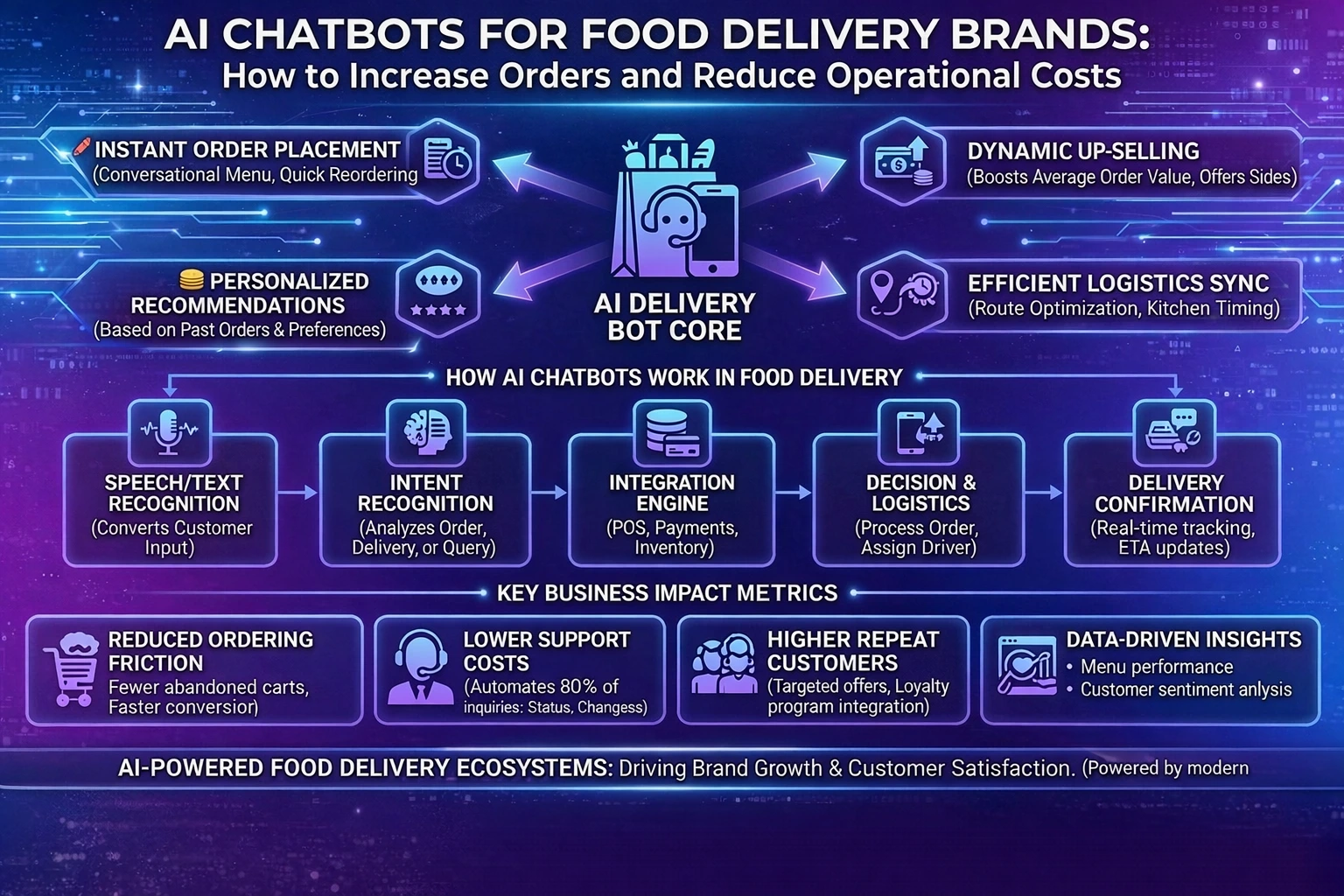
AI chatbots for food delivery brands help restaurants and virtual kitchens:
- Increase online orders through conversational commerce
- Reduce customer support costs
- Improve website conversion rates
- Decrease order errors and refunds
- Deliver 24/7 automated engagement
Food businesses implementing AI-powered customer engagement systems consistently see measurable improvements in revenue and operational efficiency.
What Are AI Chatbots for Food Delivery Brands?
AI chatbots are AI-powered conversational systems that automate ordering, customer service, and engagement across websites, apps, SMS, and messaging platforms.
Core Functions of AI Chatbots
- Digital ordering assistants
- Automated support agents
- Upsell and cross-sell engines
- Voice-enabled commerce tools
- Customer retention systems
Unlike traditional live chat, AI chatbots use natural language processing (NLP) to understand context, intent, and previous interactions.
Why AI Chatbots Are Critical for Modern Food Delivery
Platforms like Uber Eats and DoorDash have conditioned customers to expect instant service and seamless ordering.
Challenges Without Automation
- High payroll expenses
- Delayed response times
- Order inaccuracies
- Cart abandonment
- Inconsistent customer experience
AI chatbots eliminate these friction points while improving operational efficiency.
AI Chatbot vs Traditional Support: Performance Comparison
| Feature | Traditional Support | AI Chatbot |
|---|---|---|
| Availability | Limited hours | 24/7 |
| Response Time | Minutes | Seconds |
| Scalability | Expensive | Scalable |
| Error Rate | Human error | Structured confirmation |
| Cost | High payroll | Lower operational cost |
How AI Chatbots Increase Orders
1. 24/7 Conversational Ordering
Customers can:
- Browse menus
- Customize meals
- Ask allergy-related questions
- Reorder favorites
- Complete checkout instantly
Immediate engagement increases completed transactions.
2. Personalized Upselling and Cross-Selling
AI analyzes:
- Order history
- Popular combinations
- Time-of-day patterns
- Seasonal trends
Example: “Add fries to complete your meal?”
Strategic prompts increase average order value.
3. Reduced Cart Abandonment
AI chatbots answer questions such as:
- “How long is delivery?”
- “Is this gluten-free?”
- “Can I remove onions?”
Instant clarification improves checkout completion rates.
4. Voice Ordering Integration
Voice integrations through Google Assistant enable hands-free reordering and improve accessibility.
How AI Chatbots Reduce Operational Costs
1. Customer Support Automation
Up to 70% of delivery inquiries involve repetitive questions such as:
- Order tracking
- Refund status
- Address changes
- Delivery delays
AI chatbots automate these efficiently.
2. Reduced Order Errors
Structured confirmation prevents:
- Incorrect customizations
- Address mistakes
- Payment confusion
Fewer errors mean fewer refunds and improved customer satisfaction.
3. Faster Complaint Resolution
AI systems can:
- Automatically issue refunds
- Send compensation codes
- Escalate complex cases
Faster resolution increases retention.
Can AI Chatbots Make Mistakes?
Yes, AI systems may misinterpret unclear input.
How to Minimize Errors
- Train using a structured custom knowledge base
- Integrate with POS systems
- Continuously optimize performance
- Enable human escalation workflows
Accuracy improves as the system learns from data.
How AI Chatbots Improve Website Conversion
AI chatbots improve conversion rates by:
- Reducing friction
- Delivering instant responses
- Guiding customers through checkout
- Recommending complementary items
- Recovering abandoned carts
Conversational interfaces reduce decision fatigue and increase purchase likelihood.
How to Integrate AI Chatbots in an Online Food Store
Step-by-Step Integration
- Connect to POS system
- Sync real-time inventory and menu data
- Integrate payment gateways
- Connect CRM and loyalty programs
- Test checkout workflows
Platforms like Shopify support chatbot integration for online food ordering systems.
How to Train an AI Chatbot with a Custom Knowledge Base
What to Include in Training Data
- Menu details and pricing
- Allergen information
- Delivery policies
- FAQs
- Promotions
Training Process
- Intent classification
- Entity extraction
- Context handling
- Continuous learning updates
Structured training ensures higher accuracy and better customer experience.
Real-World Performance Benchmarks
Food delivery brands implementing AI chatbots commonly report:
- 10–25% increase in website conversion rates
- 15–30% higher average order value
- 30–50% reduction in support costs
- Faster resolution times
- Increased repeat purchases
Cross-Industry Example: Car Dealership AI Chatbot
Automation is not limited to restaurants. A car dealership AI chatbot helps automotive businesses capture leads, answer financing questions, and schedule test drives automatically. This demonstrates conversational AI scalability across industries.
Implementation Roadmap for Restaurants
Deployment Framework
- Identify repetitive customer queries
- Integrate with ordering systems
- Upload structured knowledge base
- Enable analytics tracking
- Continuously refine performance
Exotica AI Solutions supports restaurants in deploying scalable AI chatbot systems aligned with long-term growth strategies.
Frequently Asked Questions
Final Thoughts
AI chatbots for food delivery brands are strategic growth infrastructure. They increase order volume, reduce operational costs, enhance user experience, and improve digital performance across search and voice environments.
Restaurants that implement conversational AI today position themselves for sustainable growth in an increasingly automated marketplace.

Mohit Thakur is an experienced Digital Marketing Expert, SEO Team Leader, and Content Writer with over 6 years of expertise in search engine optimization, content strategy, and digital growth. He specializes in research-driven SEO and crafting high-quality, compelling content that helps businesses improve their online visibility, organic traffic, and lead generation.
With hands-on experience across multiple industries, Mohit focuses on creating user-focused, well-researched content aligned with the latest Google algorithms and AI search trends. His approach combines technical SEO, content writing, content optimization, and data analysis to deliver consistent and measurable results.