
Healthcare communication has traditionally depended on phone calls, in-person visits, and long administrative processes. Over time, digital portals and telehealth platforms improved access, but many patients still struggle to get quick answers or schedule appointments efficiently. I’ve seen this challenge across multiple healthcare systems, and one solution has consistently stood out: AI chatbots designed specifically for patient engagement.
These intelligent assistants are not just automation tools. When implemented responsibly, they improve access to care, strengthen communication, and help both patients and providers navigate the healthcare journey more smoothly.
What Are AI Chatbots in Healthcare?
AI chatbots in healthcare are conversational software systems powered by artificial intelligence, natural language processing (NLP), and machine learning. They are designed to understand patient questions and respond in a human-like way.
Healthcare chatbots are typically integrated into:
- Hospital or clinic websites
- Patient portals
- Telehealth platforms
- Mobile health applications
- Messaging services
Their primary goal is to provide fast, accurate, and helpful responses without requiring staff intervention for every interaction.
How Patient Engagement Has Evolved
In the past, patient engagement mostly occurred during appointments. Patients had limited access to information between visits. Over time, digital tools changed that.
The shift has followed a clear progression:
Phase 1: Traditional Communication
- Phone calls
- Paper reminders
- In-person visits
Phase 2: Digital Portals and Telehealth
- Online appointment booking
- Email reminders
- Video consultations
Phase 3: AI-Driven Engagement
- Instant chatbot responses
- Automated reminders
- Personalized health guidance
- Continuous patient interaction
According to the World Health Organization, digital health technologies are essential for improving access, efficiency, and patient outcomes worldwide. AI chatbots represent one of the fastest-growing tools in this transformation.
Key Ways AI Chatbots Improve Patient Engagement
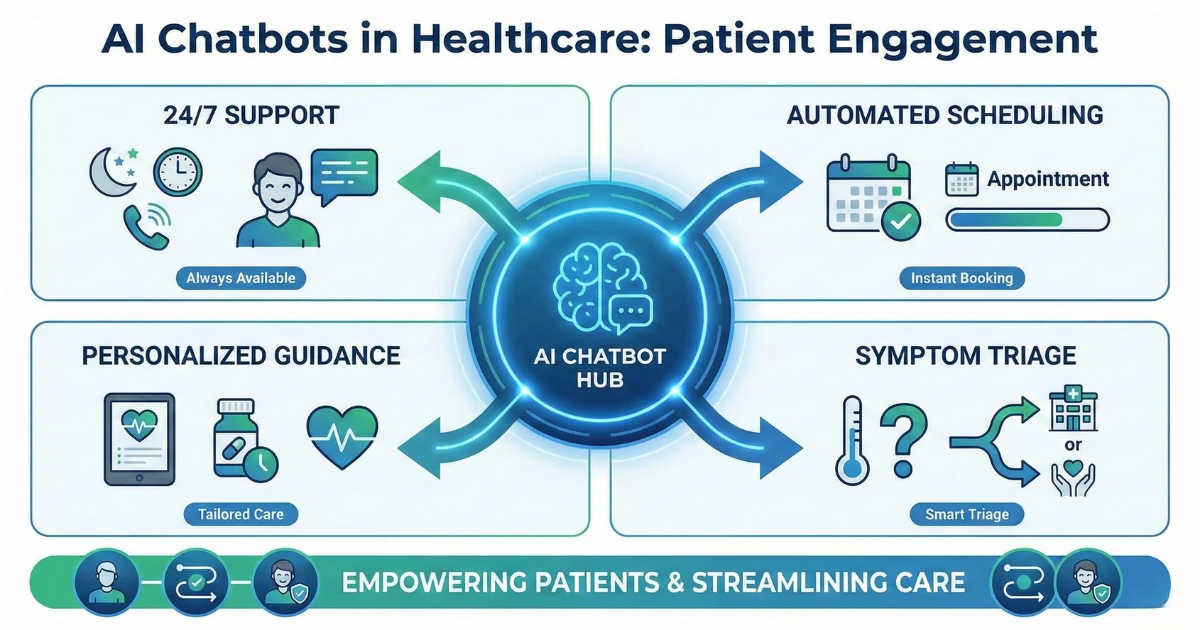
24/7 Patient Communication
Patients often need help outside regular office hours. AI chatbots provide support at any time.
They can:
- Answer common health questions
- Provide clinic hours and directions
- Send medication reminders
- Guide patients to the right services
This constant availability reduces frustration and improves trust.
Automated Appointment Scheduling
Scheduling is one of the most frequent patient interactions. Chatbots simplify the process by:
- Checking real-time availability
- Booking appointments instantly
- Sending confirmations and reminders
- Allowing quick rescheduling
Research from McKinsey & Company shows that automation in healthcare administration can significantly reduce operational costs and improve efficiency.
Personalized Health Guidance
AI chatbots can tailor responses based on patient inputs and behavior.
They may:
- Send medication reminders
- Offer lifestyle recommendations
- Provide post-treatment instructions
- Support chronic disease management
Personalized communication encourages patients to follow care plans more consistently.
Symptom Checking and Digital Triage
Symptom-checking chatbots ask structured questions to understand patient concerns. Based on responses, they may:
- Suggest self-care
- Recommend scheduling a visit
- Direct patients to urgent care
Research discussed by Harvard Medical School indicates that digital triage tools can help guide patients to appropriate care when used as support systems.
Continuous Patient Education
Patient education improves long-term outcomes. Chatbots help by providing:
- Procedure explanations
- Preventive care guidance
- Recovery instructions
- Healthy lifestyle tips
Accessible information empowers patients to make better decisions.
Step-by-Step: How to Implement AI Chatbots in Healthcare
From my experience working with healthcare AI initiatives, a structured rollout leads to the best results.
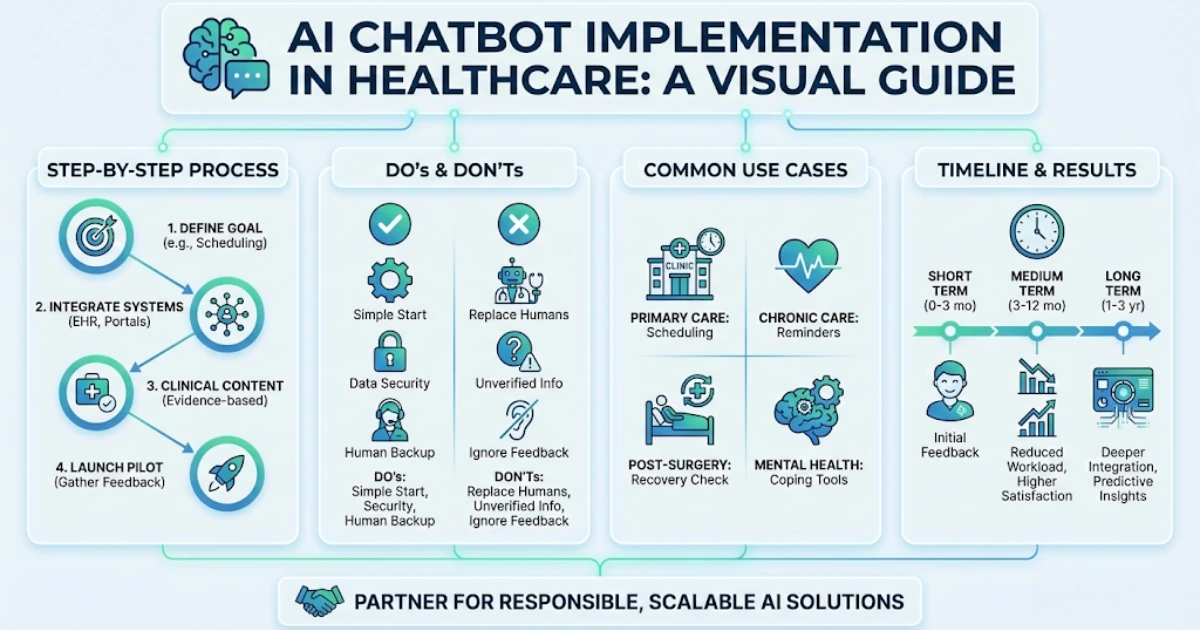
Step 1: Identify the Primary Use Case
Start with a focused goal, such as:
- Appointment scheduling
- Patient FAQs
- Medication reminders
Avoid trying to automate everything at once.
Step 2: Integrate with Existing Systems
Connect the chatbot to:
- Appointment calendars
- Patient portals
- Electronic health records when appropriate
This ensures accurate responses.
Step 3: Use Clinically Reviewed Content
All health information should be:
- Evidence-based
- Reviewed by medical professionals
- Updated regularly
Step 4: Launch a Pilot Program
Test the chatbot with a small group of patients. Gather feedback and improve the experience.
What to Do and What to Avoid
What to Do
- Start with simple, high-impact use cases
- Maintain strong data security
- Keep human support available
- Monitor chatbot performance regularly
What to Avoid
- Replacing human care completely
- Launching without clinical oversight
- Using unverified medical information
- Ignoring patient feedback
You’re Not Alone in Feeling Overwhelmed by AI in Healthcare
I often hear concerns from both patients and healthcare staff about artificial intelligence. It can feel confusing or even intimidating at first. Many people worry that technology will replace human interaction.
In reality, the most successful healthcare chatbots do the opposite. They remove small frustrations, like long hold times or repetitive questions, so healthcare professionals can spend more time on meaningful patient care.
Common Use-Case Scenarios
Busy Primary Care Clinics
Chatbots handle scheduling, reminders, and common questions. This reduces call volume and administrative strain.
Chronic Disease Management
Patients receive daily reminders, symptom tracking, and lifestyle guidance.
Post-Surgery Follow-Ups
Chatbots check on recovery progress and alert providers if issues appear.
Mental Health Support
Some chatbots provide coping exercises, mood tracking, and resources between therapy sessions.
Healthcare technology providers such as Exotica AI Solutions are working with organizations to deploy these patient engagement systems responsibly and at scale.
When NOT to Google: Seek Medical Help Immediately
Digital tools are helpful, but they should never replace emergency care.
Stop searching online and contact a healthcare provider immediately if you experience:
- Chest pain
- Difficulty breathing
- Sudden weakness or numbness
- Severe bleeding
- High fever in vulnerable patients
- Any life-threatening symptoms
AI chatbots are support tools, not emergency medical services.
Realistic Timeline for Adoption and Results
Short Term (0–3 Months)
- Chatbot deployment
- Staff training
- Initial patient interactions
- Early feedback
Medium Term (3–12 Months)
- Reduced call center workload
- Improved appointment attendance
- Higher patient satisfaction
Long Term (1–3 Years)
- Deeper system integration
- Predictive care insights
- Expanded virtual care services
If healthcare organizations ignore digital engagement tools, they may face:
- Rising administrative costs
- Lower patient satisfaction
- Reduced competitiveness
The Future of AI Chatbots in Healthcare
AI chatbots are expected to become more advanced through:
- Voice-enabled assistants
- Multilingual communication
- Predictive health analytics
- Integration with wearable devices
Organizations such as Exotica AI Solutions are developing scalable AI systems that connect patients, providers, and digital health platforms into a unified experience.
Frequently Asked Questions

Mohit Thakur is an experienced Digital Marketing Expert, SEO Team Leader, and Content Writer with over 6 years of expertise in search engine optimization, content strategy, and digital growth. He specializes in research-driven SEO and crafting high-quality, compelling content that helps businesses improve their online visibility, organic traffic, and lead generation.
With hands-on experience across multiple industries, Mohit focuses on creating user-focused, well-researched content aligned with the latest Google algorithms and AI search trends. His approach combines technical SEO, content writing, content optimization, and data analysis to deliver consistent and measurable results.