
What is an LLM development company?
An LLM development company is a specialist AI firm that designs, builds, fine-tunes, and deploys large language models for specific business applications — replacing generic AI tools with custom-trained systems that understand your data, your industry, and your operational requirements. The result is AI that performs like a domain expert rather than a general-purpose assistant.
Every business evaluating AI in 2026 eventually hits the same decision point.
You have tested ChatGPT. You have run a pilot with an off-the-shelf AI tool. The results were promising in a demo and disappointing in production. The model does not know your products. It misinterprets your terminology. It generates outputs your compliance team cannot approve.
What went wrong was not AI. What went wrong was using a general-purpose model for a domain-specific problem — and then expecting it to perform like a specialist.
That is the gap that LLM development companies exist to close. Rather than forcing your business to work around the limitations of off-the-shelf models, specialist large language model development companies build AI systems trained on your data, aligned to your workflows, and deployed inside your infrastructure.
This guide covers what an LLM development company actually does, how to evaluate them, what types of LLM development deliver the strongest ROI, and how to choose the right partner for your specific business problem.
Table of Contents
- What Does an LLM Development Company Do?
- Types of LLM Development Services
- LLM Types and Model Architectures: What Matters for Business
- What Separates Top LLM Companies from the Rest
- LLM Development Use Cases That Deliver Measurable ROI
- LLM Automation: Building AI Into Your Business Workflows
- How to Choose an LLM Development Company
- Frequently Asked Questions
What Does an LLM Development Company Do?
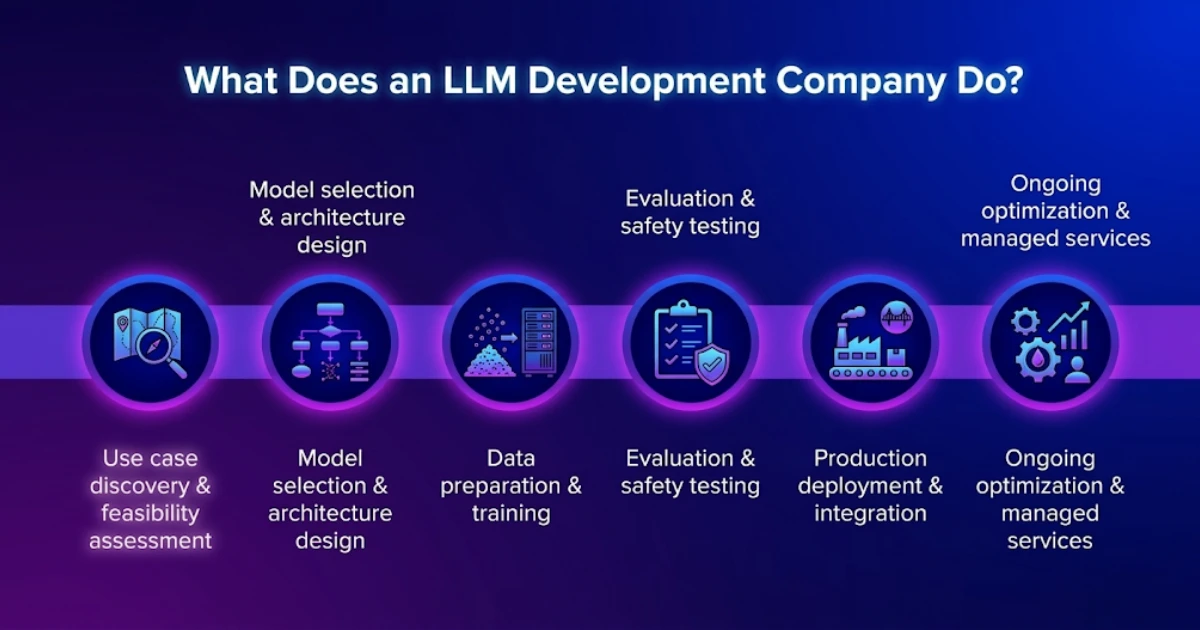
A large language model development company provides end-to-end services for building, adapting, and deploying AI language systems for specific business use cases. This is not prompt engineering. This is not API integration. This is fundamental model work — selecting the right architecture, training or fine-tuning on your proprietary data, building the infrastructure to run the model in production, and integrating it into your existing systems.
The full scope of what a qualified LLM development company delivers includes:
- Use case discovery and feasibility assessment — identifying which business problems AI can solve, which data assets support that solution, and what the ROI case looks like before any development budget is committed
- Model selection and architecture design — choosing between fine-tuning existing models (GPT-4, Claude, Llama 3, Mistral), building RAG pipelines, or developing custom architectures based on your specific requirements
- Data preparation and training — cleaning, labeling, and structuring your proprietary data for model training or retrieval, including synthetic data generation where necessary
- Evaluation and safety testing — benchmarking model outputs against ground truth, testing edge cases, implementing guardrails against hallucination, and validating accuracy across your domain’s terminology
- Production deployment and integration — connecting the model to your CRM, ERP, support platform, or customer-facing interface and setting up monitoring infrastructure
- Ongoing optimization and managed services — retraining cycles, performance monitoring, accuracy improvement, and model updates as your business data evolves
The distinction between a qualified large language model development company and a vendor selling AI wrappers is this: a real development partner starts with your business problem and works backward to the technology. A vendor starts with their technology and works forward to a justification for why your business needs it.
What does an LLM development company build?
An LLM development company builds custom AI language systems for specific business applications — including fine-tuned models trained on proprietary data, RAG pipelines that ground AI responses in your knowledge base, LLM agents that automate multi-step reasoning tasks, and full production infrastructure for deploying, monitoring, and maintaining AI in enterprise environments.
Types of LLM Development Services
Understanding the different service types helps you match the right development approach to your actual business problem — and avoid paying for complexity you do not need.
Fine-tuning services
Fine-tuning takes a pre-trained foundation model — GPT-4, Llama 3, Mistral, or another open-source base — and continues training it on your domain-specific dataset. The model learns your terminology, your style, your policies, and your domain’s edge cases. A legal firm fine-tuning on ten years of case files produces an AI that reasons like a paralegal. A healthcare system fine-tuning on clinical documentation produces an AI that understands medical terminology the way your staff does.
Fine-tuning is the right approach when your business has a substantial proprietary dataset, requires domain-specific language understanding, or needs the model to behave in ways that differ from its general-purpose training.
RAG development services
Retrieval-Augmented Generation combines a language model with a real-time retrieval system. Rather than baking knowledge into the model through training, RAG gives the model access to a searchable knowledge base — your documentation, your policies, your product catalog — at the moment of inference. The model retrieves the relevant content and generates a response grounded in your actual information.
Our RAG-as-a-Service platform delivers this architecture for businesses that need AI to answer questions accurately from a defined knowledge base — customer support, internal knowledge management, document search, and compliance Q&A. RAG is typically faster to deploy than fine-tuning and requires less data preparation, making it the right starting point for most business AI applications.
LLM agent development
LLM agents are AI systems that go beyond question-answering to perform multi-step tasks autonomously. An LLM agent can research a prospect, draft outreach, qualify a lead through conversation, update your CRM, and schedule a follow-up — without a human managing each step. LLM automation through agent development is one of the fastest-growing service categories among specialist LLM companies in 2026.
Agent development requires deeper engineering than RAG or fine-tuning — defining the agent’s tool access, action space, memory architecture, and guardrails — and is the right investment when your use case involves multi-step reasoning and action across multiple systems.
Custom LLM development
Custom LLM development builds a model architecture from scratch or significantly modifies an open-source foundation for highly specialized requirements. This is the right approach for organizations in regulated industries where data cannot leave your infrastructure, where proprietary model architecture provides competitive advantage, or where no existing model serves your domain adequately.
The complete LLM development services buyer’s guide covers the full decision framework for choosing between these approaches — including cost ranges, timelines, and data requirements for each.
LLM Types and Model Architectures: What Matters for Business
When evaluating LLM development services, understanding the broad categories of available models helps you have more informed conversations with potential development partners — and makes it harder for vendors to obscure poor architectural choices with impressive-sounding technical language.
| LLM type | Examples | Strengths | Business fit |
|---|---|---|---|
| General-purpose (closed) | GPT-4, Claude 3, Gemini | Broad capability, strong reasoning | RAG, agent development, API integration |
| Open-source foundation | Llama 3, Mistral, Falcon | Self-hosted, customizable, lower cost | Fine-tuning, data-sensitive industries |
| Domain-specific | Med-PaLM, BloombergGPT | Deep domain knowledge pre-trained | Healthcare, finance, legal starting points |
| Instruction-tuned | Llama 3 Instruct, Mistral Instruct | Follows directions reliably | Customer-facing applications, chatbots |
| Multimodal | GPT-4V, Gemini Ultra | Processes text, images, and documents | Document processing, visual inspection |
For most business applications, the choice is not between building your own model from scratch and using a closed API — it is between fine-tuning an open-source foundation model, building a RAG pipeline on top of a closed model, or combining both. A qualified development partner selects the architecture based on your data, your compliance requirements, and your performance targets — not on what is easiest for them to build.
What Separates Top LLM Companies from the Rest
The top LLM companies providing development services share a set of characteristics that are easy to verify before you sign a contract — and that consistently distinguish successful engagements from expensive failures.
They start with your business problem, not their preferred technology
A qualified development partner conducts structured discovery before recommending any architecture. If a vendor recommends fine-tuning in the first conversation — before understanding your data, your use case, or your compliance requirements — they are optimizing for their delivery speed, not your outcome.
They can show production deployments, not just demos
Ask specifically for case studies with measurable outcomes: accuracy rates on domain-specific test sets, volume of queries handled in production, latency performance under load, and hallucination rates before and after guardrail implementation. Demos are easy to stage. Production systems that run reliably at enterprise scale are hard to build and rare to see in a vendor portfolio.
They have a documented approach to hallucination management
Hallucination — the tendency of language models to generate confident but incorrect outputs — is not a solved problem. It is an actively managed one. Any LLM development company that cannot clearly explain their evaluation methodology, guardrail architecture, and ongoing monitoring approach is not ready for production deployment in a business environment where incorrect outputs have real consequences.
They understand your industry’s regulatory environment
Healthcare, financial services, legal, and insurance all have compliance requirements that directly constrain what data can be used for training, where models can be hosted, and how outputs must be handled. Industry-specific experience is not a differentiator — it is a prerequisite for regulated industries. A partner without it will discover the constraints during implementation, not before.
They offer post-deployment support with defined SLAs
Models require ongoing maintenance. Data drifts. Business requirements evolve. A development company with no post-deployment support offering is treating delivery as the end of the relationship. The best LLM companies offer structured managed services — retraining cadence, performance monitoring, accuracy reporting, and escalation paths — as a standard part of their service model.
LLM Development Use Cases That Deliver Measurable ROI
Customer support automation
LLMs fine-tuned on product documentation, support history, and policy documents handle tier-1 and tier-2 support enquiries automatically — resolving 60–75% of inbound volume without human intervention. Combined with our AI chatbot service, the remaining complex cases are routed to your team with full context already summarized. Customer service teams consistently report the fastest payback period of any LLM deployment category.
Internal knowledge management
Enterprises with large document repositories — legal contracts, HR policies, technical manuals, compliance documentation — deploy LLMs as internal search and Q&A systems. Employees get accurate, cited answers in seconds rather than spending 20 minutes searching SharePoint. Accuracy is grounded through RAG — every response references the source document.
LLM automation for sales operations
AI calling agents and LLM-powered outreach tools research prospects, draft personalized communications, qualify inbound leads through conversation, and update CRM records automatically. These are not simple chatbots — they are autonomous systems capable of multi-step reasoning and action across multiple tools. Organizations deploying LLM automation in sales consistently report 40–60% reduction in SDR administrative workload within the first 90 days.
Document processing and analysis
LLMs extract, classify, and summarize information from unstructured documents at scale. Invoice processing, contract review, medical record summarization, insurance claims triage — workflows that previously required teams of analysts now run in minutes. Multimodal LLMs extend this capability to documents that include images, tables, and mixed-format content.
AI automation: building LLM apps for operations
The fastest-growing application category in 2026 is AI automation: build LLM apps that integrate directly into existing operational workflows. Organizations are using n8n workflow automation combined with LLM API nodes to build intelligent automation pipelines that classify inputs, make routing decisions, generate outputs, and update downstream systems — all without human intervention at each step.
LLM Automation: Building AI Into Your Business Workflows
LLM automation is the integration of large language model capabilities directly into business workflow infrastructure — not as a standalone AI product, but as the intelligence layer inside your operational processes.
The practical architecture looks like this: a trigger event fires (a support ticket arrives, a document is uploaded, a lead form is submitted), the LLM processes the input (classifies the issue, extracts the document data, scores the lead), the automation layer takes action (routes to the right queue, posts to the ERP, triggers the right follow-up sequence), and the outcome is logged automatically for reporting.
What makes this architecture powerful is that the LLM is not doing everything — it is doing the judgment work that previously required human review at each step. The automation layer handles the execution. The combination produces a system that processes complex, variable inputs at the speed and scale of pure automation, with the contextual understanding that only AI can provide.
For organizations building this architecture, the critical integration points are typically: CRM for customer data access and updates, document storage for knowledge retrieval, and the workflow automation layer that orchestrates the full sequence. Our CRM integration service ensures the AI layer connects cleanly to your customer data from day one.
How to Choose an LLM Development Company
The decision framework for selecting a development partner comes down to five questions that reveal more about a company’s actual capability than any portfolio or proposal:
- Do they conduct structured discovery before recommending an architecture? The right partner asks about your data, your use case, your compliance requirements, and your success metrics before discussing technology. If the first conversation is about their platform capabilities, treat that as a signal.
- Can they demonstrate production-grade deployments in your industry? Ask for specific metrics from live deployments — not staged demos, not pilot results, not theoretical performance projections. Accuracy rates, query volumes, latency, and hallucination rates from systems running in production.
- How do they handle hallucination in your specific use case? The answer should be specific: evaluation benchmarks, guardrail architecture, human-in-the-loop points, and monitoring cadence. Vague answers about “advanced safety measures” are not sufficient for enterprise deployment.
- What does post-deployment support look like? Retraining schedule, performance monitoring SLAs, escalation procedures, and how scope changes are priced. A company with no post-deployment offering is not a long-term partner.
- Do they understand your industry’s data and compliance requirements? Not in a general sense — specifically. Ask about HIPAA data handling, SOC 2 compliance, financial data residency requirements, or whatever applies to your industry. Industry experience is verifiable and non-negotiable in regulated sectors.
For businesses evaluating where to start — identifying the right use case, validating feasibility against your existing data, and building a deployment roadmap before any development budget is committed — a focused discovery engagement with an experienced partner like Exotica AI Solutions compresses months of internal evaluation into days of structured analysis.
Frequently Asked Questions
The difference between AI that works in a demo and AI that delivers measurable ROI in production comes down to one thing: the quality of the development partner you choose and the specificity of the business problem you ask them to solve.
General-purpose AI is a commodity. Custom-built LLM systems that understand your data, operate within your compliance requirements, and integrate with your existing infrastructure are a competitive asset — one that compounds in value as it processes more of your business data and improves over time.
The first step is identifying the right use case. The second is finding a development partner who starts with that problem, not with their technology.
Ready to identify your highest-value LLM development opportunity? Talk to the Exotica AI Solutions team today.
Related Reading
- LLM Development Services: The Complete Buyer’s Guide for Business Leaders
- RAG as a Service
- AI Chatbot Development
- AI Calling Agent
- n8n Workflow Automation
- CRM Integration Services

Mohit Thakur is an experienced Digital Marketing Expert, SEO Team Leader, and Content Writer with over 6 years of expertise in search engine optimization, content strategy, and digital growth. He specializes in research-driven SEO and crafting high-quality, compelling content that helps businesses improve their online visibility, organic traffic, and lead generation.
With hands-on experience across multiple industries, Mohit focuses on creating user-focused, well-researched content aligned with the latest Google algorithms and AI search trends. His approach combines technical SEO, content writing, content optimization, and data analysis to deliver consistent and measurable results.