
How to automate your business?
Learning how to automate your business starts with one simple question: which tasks are eating your time without adding value? From sending follow-up emails and generating invoices to routing leads and updating your CRM, most repetitive business operations can be handled automatically with the right tools. Business process automation platforms like n8n, Zapier, and Go High Level allow you to connect your existing software stack and build workflows that run 24/7 — without hiring additional staff. The businesses growing fastest in 2026 are not working harder; they are working on the right things because automation is handling everything else. Whether you are a solo operator or managing a team, the smartest first step is identifying your highest-volume, most repetitive process and automating that one thing first. Results follow quickly — and so does the confidence to scale further.
What is business process automation?
Business process automation (BPA)
is the use of technology to execute repetitive business tasks automatically — such as data entry, approvals, notifications, and reporting — reducing manual work, lowering errors, and freeing staff for higher-value activities. The result: faster operations, lower costs, and a team focused on work that actually drives growth.
You started your business to create something. Yet somehow, every week gets swallowed by the same tasks — sending follow-up emails, updating spreadsheets, chasing invoice approvals, copying data from one platform to another. Sound familiar? You are not alone, and more importantly, you are not stuck.
Business process automation has crossed a threshold. What once required a six-figure enterprise software contract and a dedicated IT team is now accessible to a solo consultant, a 10-person agency, or a regional manufacturer. The tools exist. The question is knowing what to automate, how to do it without breaking what works, and which framework to follow so that automation actually delivers a return.
This guide covers all of it — from first principles to advanced workflow strategy.
What Is Business Process Automation?
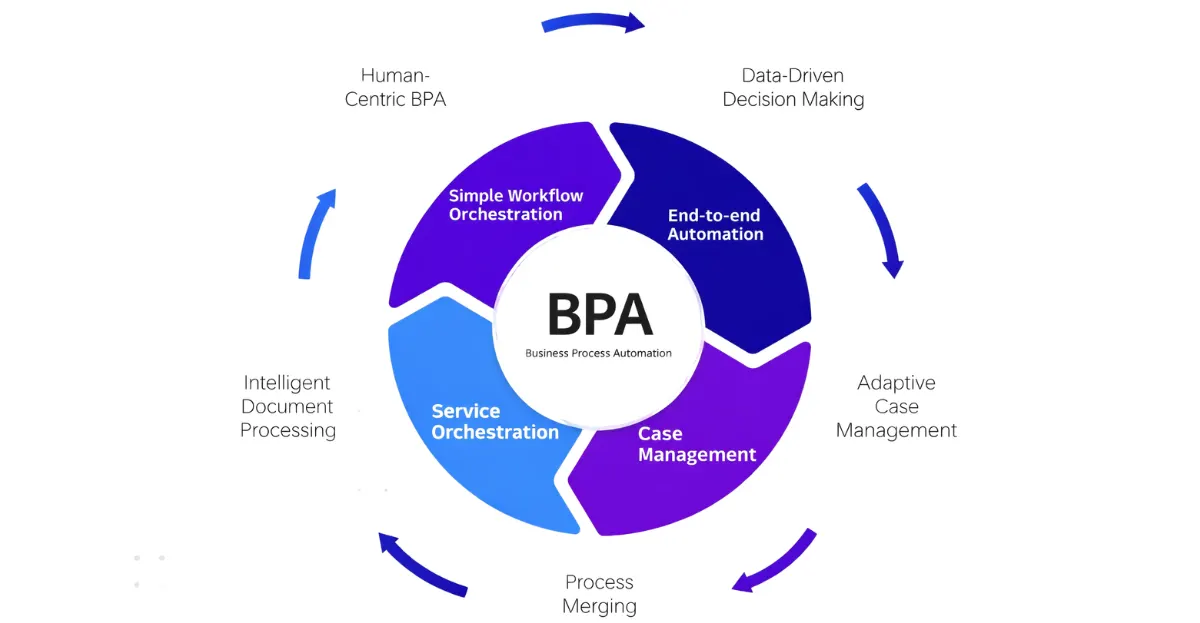
Business process automation (BPA) is the use of technology to perform recurring tasks or processes in a business where manual effort can be replaced. It goes beyond simply digitizing a paper form. True BPA redesigns the workflow so that entire sequences of actions — triggered by specific conditions — execute without human intervention.
The concept sits at the intersection of three disciplines:
- Workflow automation — orchestrating multi-step sequences across tools and teams. See how our workflow automation services handle this end-to-end.
- Robotic process automation (RPA) — software bots mimicking human interactions with digital systems
- AI-driven automation — intelligent decision-making layered on top of rule-based triggers
In 2026, the line between these three has blurred considerably. According to McKinsey, modern platforms combine rules, AI judgment, and integration pipelines into a single workflow — which is exactly why the opportunity for businesses of every size is greater than ever.
Quick Answer — What is business process automation?Business process automation is the use of technology to execute repetitive business tasks automatically — such as data entry, approvals, notifications, and reporting — reducing manual work, lowering errors, and freeing staff for higher-value activities.
Why Automate Your Business? The Real Cost of Staying Manual
Before choosing tools, it helps to understand what staying manual actually costs. MIT Sloan research consistently shows that most business owners underestimate this figure significantly.
Consider a five-person operations team spending two hours daily on data entry. At a conservative $25/hour blended rate, that is $65,000 per year in labor cost — for work that generates zero strategic value. Add the cost of human errors (incorrect invoices, missed follow-ups, compliance gaps), and the number climbs further.
“The real cost of manual processes is not just time. It is the compounding opportunity cost of decisions delayed, customers under-served, and growth throttled by operational drag.”
The benefits of business process automation compound over time:
- Faster cycle times on sales, onboarding, and fulfillment
- Consistent, error-free execution regardless of staff availability
- Real-time visibility into process bottlenecks and performance metrics
- Scalability without proportional headcount increases
- Improved employee satisfaction as drudgery is replaced with meaningful work
- Competitive parity — or advantage — against larger, better-resourced rivals
45% of current work activities can be automated with existing technology — McKinsey Global Institute$65K average annual cost of manual data-entry tasks in a 5-person operations team
How to Define Business Processes to Automate for Operational Efficiency
This is the question most guides skip. Buying automation software before knowing what to automate is the fastest path to wasted budget and abandoned projects.
Start with the IMPACT framework to prioritize intelligently:
- INVENTORY every recurring task — Ask each team member to log their time for one week. Identify tasks performed more than three times weekly with minimal variation each time.
- MEASURE the manual cost — Calculate hours × hourly rate for each task category. Include error-correction time and escalation overhead.
- ASSESS automation feasibility — Rate each task on a 1–5 scale for rule-clarity and data availability. Our team can assist with a free process audit — book a session at the Exotica AI contact page.
- PRIORITIZE by ROI × Risk — High-cost, high-feasibility tasks with low failure risk are your Tier 1 targets. Start here before moving to complex, judgment-dependent processes.
- CREATE a process map before touching any tool — Document inputs, decision points, outputs, and handoffs. Automation that mirrors a broken process just creates a faster broken process.
High-Impact Areas Where Businesses Automate First
Across industries, certain process categories deliver the fastest and most measurable returns. These are the areas where workflow automation for small businesses and enterprise operations alike tends to generate the clearest ROI within the first 90 days.
| Business Area | Processes to Automate | Time Saved |
|---|---|---|
| Sales & CRM | Lead routing, follow-up sequences, quote generation, pipeline updates | 8–14 hrs/week |
| Finance & Invoicing | Invoice creation, payment reminders, expense approvals, reconciliation | 6–10 hrs/week |
| HR & Onboarding | Offer letters, document collection, provisioning, compliance checklists | 4–8 hrs per hire |
| Marketing | Email nurture, social scheduling, lead scoring, reporting | 10–16 hrs/week |
| Customer Support | Ticket routing, AI chatbot responses, escalation rules, satisfaction surveys | 5–12 hrs/week |
| Operations | Inventory alerts, order processing, vendor communications, reporting | 7–15 hrs/week |
Need help prioritizing which row to tackle first? Our n8n workflow automation specialists can map your stack and recommend a deployment sequence in a single call.
Business Process Automation vs. Robotic Process Automation
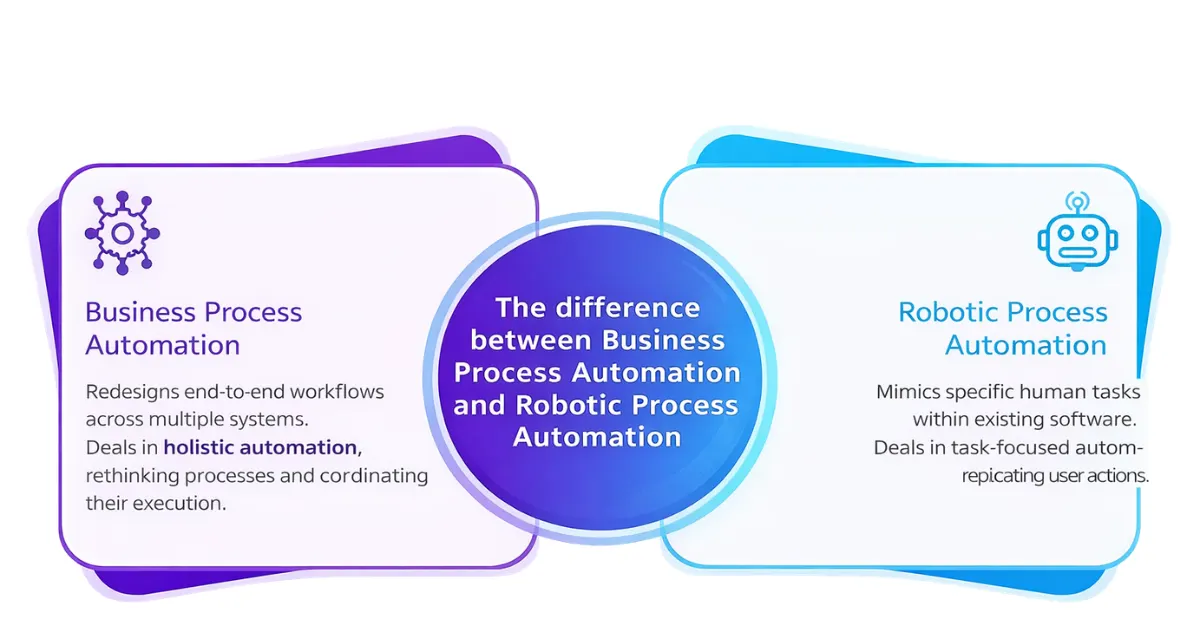
BPA takes a holistic view. It redesigns entire end-to-end workflows, often spanning multiple departments and software systems. Think: an automated new-client onboarding flow that touches your CRM integration, contract tool, project management platform, and billing system in sequence.
RPA is narrower. It deploys software bots to replicate specific human actions — clicking, copying, pasting, filling forms — within existing interfaces. RPA is powerful when you need to connect legacy systems that lack APIs. It is fragile when underlying interfaces change.
For most small and mid-sized businesses in 2026, native integrations and no-code workflow tools such as n8n, Zapier, or Make deliver BPA outcomes without the cost and maintenance overhead of traditional RPA. RPA remains the right call for enterprise-scale, legacy-system-heavy environments. Gartner’s hyperautomation research provides a deeper breakdown of where each approach fits best.
AI Automation Tools: What’s Actually Worth Using in 2026
The AI automation tools market has matured significantly. Here is an honest breakdown of categories that deliver measurable value versus those that remain mostly hype for most business contexts.
Workflow Orchestration Platforms
These tools connect your existing software stack and define trigger-action rules. They are the backbone of any business automation strategy. Our intelligent automation services use enterprise-grade orchestration platforms to build multi-step automations that scale with your business — no coding required on your end.
AI-Augmented Decision Automation
Where traditional automation handles predictable, rule-based processes, AI augmentation handles exceptions — classifying support tickets by sentiment, routing edge-case approvals, or generating first-draft documents for human review. Our RAG-as-a-Service solution layers retrieval-augmented generation on top of your automation stack so your AI draws from your actual business knowledge, not generic training data.
Intelligent Document Processing
Extracting data from invoices, contracts, and forms used to require manual entry or costly custom development. Modern intelligent document processing tools use AI to read, interpret, and route document content with accuracy that rivals human performance. Our custom Python development team builds bespoke document pipelines when off-the-shelf solutions don’t fit.
Conversational AI for Customer-Facing Processes
AI-driven chat and voice automation now handles tier-one support resolution, appointment scheduling, and lead qualification at a quality threshold that no longer frustrates users. Exotica AI Solutions builds both AI chatbots and AI calling agents that integrate directly with your CRM and workflow tools, enabling full end-to-end process automation from first contact to closed deal.
Related Reading:
How to Automate Business Processes: A Phased Implementation Approach
Failed automation projects follow a predictable pattern: companies try to automate too much at once, skip the process documentation phase, and underestimate change management. A phased approach dramatically improves success rates.
Phase 1 — Foundation (Weeks 1–4)
Audit current processes. Map the top five automation candidates. Standardize data formats and naming conventions across tools. Establish baseline performance metrics. Select and configure your workflow orchestration platform. For teams evaluating options, our n8n automation specialists offer a no-commitment discovery session to help scope your first build.
Phase 2 — Quick Wins (Weeks 5–10)
Deploy automations in your two highest-ROI areas. Keep workflows simple — three to five steps maximum at this stage. Run in parallel with existing manual processes for two weeks before switching fully. Our Go High Level implementation service is a popular Phase 2 choice for sales and marketing automation because it combines CRM, pipeline, and outreach in a single platform.
Phase 3 — Scale and Optimize (Months 3–6)
Expand to additional process areas using lessons from Phase 2. Introduce exception handling and error notifications. Begin exploring AI augmentation for processes with decision complexity. Review and refine automations quarterly as business needs evolve.
Companies like Exotica AI Solutions assist businesses through exactly this kind of structured deployment — combining process consulting with technical implementation to ensure automations are built on solid operational foundations, not bolted onto broken workflows. Browse our case studies to see real-world deployment timelines and ROI results.
Business Process Automation Across Industries
In healthcare, automation addresses patient intake, appointment reminders, insurance verification, and compliance documentation. HIPAA compliance is non-negotiable — our healthcare AI solutions are purpose-built for regulated environments where data privacy and audit trails are mandatory.
In retail and e-commerce, inventory management, order fulfillment notifications, abandoned cart sequences, and returns processing represent the highest-value automation targets. Our e-commerce AI solutions routinely deliver 20–35% reductions in fulfillment errors within the first quarter of deployment.
In manufacturing and logistics, production scheduling, quality control alerts, vendor communications, and supply chain reporting are prime automation targets. See how we serve manufacturing operations and logistics & supply chain businesses specifically.
In professional services — consulting, legal, accounting — document automation, proposal generation, time tracking, and client reporting workflows are the primary focus. Real estate agencies are a strong example: high-volume lead management, property matching, and follow-up automation directly translate to more listings closed with the same team.
When to Hire a Business Automation Consultant
Not every business automation project requires external help. Consider engaging a business process automation consultant when:
- Your processes span multiple departments and legacy systems with limited native integration
- You have completed a DIY automation but adoption has stalled or error rates remain high
- The process involves compliance requirements (data privacy, financial controls, healthcare regulations)
- You need an independent assessment of which processes to prioritize before committing to a platform
- The anticipated ROI justifies the investment in expert configuration and change management support
Exotica AI Solutions offers end-to-end business automation solutions that bridge the gap between strategic process design and technical deployment — the missing link in DIY automation projects that stall. Talk to an expert today to discuss your specific automation goals.
Business Process Automation Trends Shaping 2026
Agentic AI workflows represent the most significant shift underway. Rather than executing predefined rule sequences, AI agents can now reason about multi-step tasks, use tools autonomously, and adapt to novel inputs. Forrester’s automation research identifies agentic workflows as the primary driver of new automation ROI in 2026.
Process mining and discovery tools that automatically identify automation opportunities by analyzing system logs are moving from enterprise-only to mid-market availability. Gartner’s hyperautomation forecast projects that organizations combining process mining with automation will outperform peers by a significant margin through 2027.
Hyperautomation — the combination of RPA, AI, process mining, and analytics into a unified strategy — continues to define mature automation programs. Our workflow automation services are structured around exactly this layered approach.
Digital human employees (AI-driven virtual workers capable of handling end-to-end process ownership) are emerging as a category with meaningful business automation benefits in customer engagement and back-office operations. Our AI calling agents and AI chatbots represent the current leading edge of this capability.
Frequently Asked Questions
The Bottom Line: Start Small, Think Systematically
The businesses winning operationally in 2026 are not those with the largest technology budgets. They are the ones that approached automation as a strategic discipline — documenting processes before automating them, measuring outcomes rigorously, and expanding from proven quick wins to progressively sophisticated workflows.
You do not need to automate everything at once. You need to automate the right things in the right order. Start with your single most painful, high-volume, rule-based process. Build confidence. Measure the result. Then scale from there.
The hours you recover are not just hours. They are the margin that makes strategy possible. Ready to start?
Talk to an automation expert at Exotica AI Solutions and get a free process assessment within 24 hours.

Mohit Thakur is an experienced Digital Marketing Expert, SEO Team Leader, and Content Writer with over 6 years of expertise in search engine optimization, content strategy, and digital growth. He specializes in research-driven SEO and crafting high-quality, compelling content that helps businesses improve their online visibility, organic traffic, and lead generation.
With hands-on experience across multiple industries, Mohit focuses on creating user-focused, well-researched content aligned with the latest Google algorithms and AI search trends. His approach combines technical SEO, content writing, content optimization, and data analysis to deliver consistent and measurable results.