
What is digital process automation?
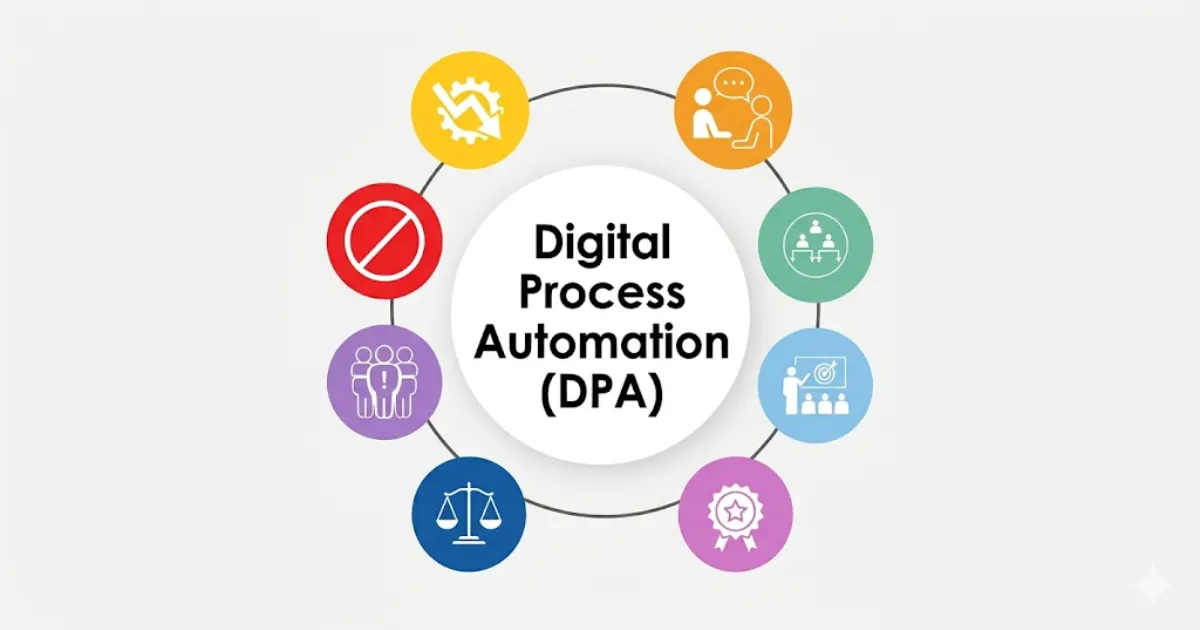
Digital process automation (DPA) is the use of AI, machine learning, and intelligent workflow technology to automate complex, end-to-end business processes — including those that involve unstructured data, human decisions, and multi-system coordination — going far beyond what rule-based automation alone can handle.
The result: faster operations, measurably lower costs, and business processes that continuously improve as they learn from real data.
Digital Process Automation in 2026
Your competitors aren’t winning because they have more people. They’re winning because their processes run themselves. In 2026, digital process automation (DPA) has become the single most consequential operational investment a business can make — and yet most organizations are still confusing it with basic RPA, underestimating its scope, or deploying it in the wrong order.
This guide is written for business owners, operations leaders, and IT decision-makers who are past the “should we automate?” question and are now asking: how do we automate the right things, in the right sequence, with the right technology? If you’re in telecom, financial services, insurance, manufacturing, or any field-service-intensive industry, what follows will directly apply to how your operation runs today — and how it needs to run by 2027.
What Is Digital Process Automation?
Digital process automation is the discipline of redesigning and automating business processes end-to-end using a combination of artificial intelligence, robotic process automation, low-code workflow orchestration, and system integration. Unlike traditional automation that handles isolated tasks, DPA coordinates people, data, decisions, and systems into a unified, intelligent process automation flow.
The digital process automation definition that matters most in practice: it’s automation that doesn’t just execute — it adapts. A DPA system reads unstructured documents, makes routing decisions based on context, escalates exceptions to the right human, updates downstream systems, and logs every action for compliance — all without manual intervention at each step.
According to Forrester’s Digital Process Automation Wave report, DPA platforms have emerged as the strategic foundation for enterprise digital transformation — replacing fragmented point solutions with integrated digital process automation platforms that span entire business functions.
Digital process automation meaning — in plain language
DPA means automating not just a step in a process, but the entire process — including the exceptions, the decisions, the document reading, and the human handoffs. It’s what happens when AI is applied on top of workflow automation to handle the full complexity of how real business actually operates.
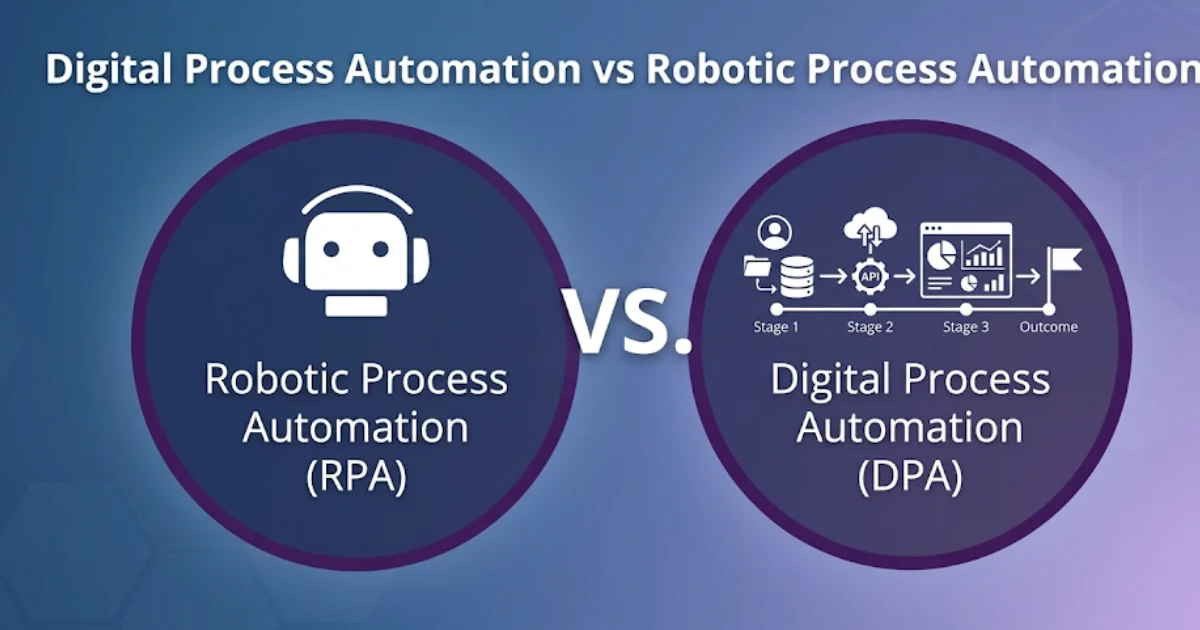
Digital Process Automation vs Robotic Process Automation: What’s the Real Difference?
The most common confusion in the digital process automation market is treating DPA and RPA as interchangeable. They are not — and choosing the wrong one for your use case is one of the most expensive mistakes an operations team can make.
| Factor | RPA | Digital Process Automation | DPA + AI (Intelligent Automation) |
|---|---|---|---|
| Input type | Structured, predictable | Structured + semi-structured | All types including unstructured |
| Decision-making | Rule-based only | Conditional logic + human routing | AI-driven judgment + adaptive ML |
| Process scope | Single task or step | End-to-end workflow | End-to-end + self-optimizing |
| Exception handling | Escalates to human | Conditional routing built in | AI-resolved with human fallback |
| Learns over time | No | Partial — logic updates manually | Yes — ML models improve automatically |
| Best for | High-volume structured tasks | Complex multi-step business processes | Enterprise-wide transformation |
| Deploy timeline | 2–8 weeks | 6–16 weeks | 3–12 months |
The practical answer to digital process automation vs robotic process automation: use RPA for the execution layer — the mechanical clicks, data extractions, and form fills. Use DPA for the orchestration layer — the workflow logic, routing decisions, exception handling, and system coordination. In mature digital automation systems, both work together: RPA performs the actions, DPA governs the process. Our intelligent automation services guide covers this architecture in full detail.
Telecom Automation: Why Digital Process Automation Is Mission-Critical for Communication Providers
Telecom automation represents one of the highest-ROI applications of digital process automation in any industry. Telecommunications providers operate at the intersection of extreme data volume, complex infrastructure, regulated customer interactions, and intense margin pressure — making manual process management not just inefficient, but operationally unsustainable at scale.
Modern AI in telecom deployments use digital process automation to orchestrate the full customer and network operations lifecycle — from service provisioning and onboarding to billing dispute resolution, network anomaly response, and proactive churn prevention.
Where DPA Creates Measurable Impact in Telecom
- Service provisioning automation. What previously took 48–72 hours of manual coordination across billing, network configuration, and customer notification systems now completes in minutes through automated process automation flow. When a customer activates a new plan, DPA coordinates every downstream system automatically — no human handoffs required.
- Network fault management. DPA-powered workflow automation monitors network health continuously, classifies fault severity, triggers corrective actions, dispatches field service teams, and closes tickets — all within a single orchestrated workflow.
- Customer service automation. AI chatbots and AI calling agents handle billing inquiries, plan changes, technical support triage, and payment processing with natural language understanding — resolving tier-1 queries entirely without human agents.
- CRM-integrated customer data management. CRM integration creates a unified customer view across all touchpoints — enabling personalized interactions, proactive retention offers, and seamless cross-channel support that manual processes cannot deliver at scale.
- Churn prediction and retention automation. AI models analyze behavioral signals — declining usage, billing disputes, support frequency — and automatically trigger retention workflows before customers reach a cancellation decision.
| Telecom process | Before DPA | After DPA | Efficiency gain |
|---|---|---|---|
| Service provisioning | 48–72 hours manual | Under 10 minutes automated | 95% time reduction |
| Network fault response | Manual detection + escalation | Auto-detect, classify, resolve | 70% faster resolution |
| Billing dispute handling | 3–5 day agent-led process | Same-day AI-assisted resolution | 80% cycle time reduction |
| Customer onboarding | Multiple manual touchpoints | Fully automated sequence | 60% admin cost reduction |
| Churn intervention | Reactive — post-cancellation | Proactive — AI-triggered 30 days prior | 35% churn reduction |
Digital Process Automation by Industry: Where the ROI Is Highest
Digital Process Automation for Financial Services and Banking
Digital process automation financial services applications deliver some of the most measurable ROI of any sector. Banks, lenders, and credit unions use DPA to automate loan origination, KYC verification, compliance reporting, and account onboarding workflows that previously required days of manual document review. According to McKinsey’s AI and automation research, financial services firms that deploy intelligent DPA platforms reduce back-office processing costs by 40–60% within 12 months.
Digital process automation software banking use cases include automated three-way matching in accounts payable, intelligent mortgage processing that extracts and validates data from variable-format documents, and real-time fraud detection workflows that trigger investigation sequences without human initiation.
Digital Process Automation for Insurance
Digital process automation for insurance transforms the two highest-friction areas in the industry: claims processing and policy administration. Our insurance AI solutions deploy DPA to automate first-notice-of-loss intake, damage assessment routing, policy validation, and payment processing — reducing claims cycle times from days to hours while maintaining full compliance audit trails. Digital process automation tools insurance teams deploy most frequently include intelligent document processing for variable-format claims submissions and AI-powered coverage verification that eliminates manual policy lookup.
Digital Process Automation for Manufacturing
Digital process automation for manufacturing connects production execution with quality control, supply chain coordination, and compliance documentation in real time. Our manufacturing AI solutions embed DPA into production workflows — automating purchase order processing, equipment maintenance scheduling, supplier communication, and regulatory documentation that previously required dedicated administrative headcount. Process digitalization and automation at the manufacturing level means every workflow exception is handled by logic, not by a person waiting for an email reply.
Digital Process Automation for Field Service
Digital process automation for field service is one of the fastest-growing application areas in 2026. Field service operations — utilities, telecom infrastructure, facilities management — involve complex scheduling, parts logistics, compliance documentation, and customer communication workflows that break down without automation. DPA orchestrates the full field service lifecycle: job creation, technician dispatch, parts ordering, SLA monitoring, completion documentation, and customer follow-up — all within a single process automation system.
Digital Process Automation for Healthcare
In healthcare, process automation technology addresses prior authorization, revenue cycle management, and patient communication — three of the most document-intensive, compliance-sensitive workflows in any industry. Our healthcare AI solutions deploy DPA to automate eligibility verification, claims submission, denial management, and appointment follow-up at scale — freeing clinical staff from administrative burden and accelerating revenue cycle performance.
Digital Process Automation Software and Platforms: What to Look For in 2026
The digital process automation market has consolidated significantly. According to Gartner’s automation research, the leading digital process automation platforms in 2026 share five defining characteristics that separate production-grade solutions from tools that look good in demos but underperform in real deployments.
-
End-to-end process orchestration — not just task execution. True digital process automation software coordinates the full workflow: triggers, decisions, exceptions, human tasks, and system updates. If a platform can only automate individual steps without governing the entire process, it’s a task tool — not a DPA platform.
-
Native AI and ML integration. The best digital process automation solutions embed machine learning directly into workflow logic — classifying documents, predicting exceptions, scoring routing decisions, and improving accuracy over time. Retrieval-Augmented Generation (RAG) is increasingly deployed inside DPA workflows to give automation access to internal knowledge bases for real-time decision support.
-
Low-code workflow design with enterprise-grade governance. Business analysts — not just developers — should be able to build and modify workflows. But the platform must enforce access controls, versioning, audit logging, and compliance documentation automatically. Our n8n workflow automation service delivers exactly this balance for organizations building self-hosted, customizable DPA pipelines.
-
Deep integration capability. A digital process automation platform is only as powerful as its ability to connect to your existing systems — CRM, ERP, HRMS, legacy databases, and third-party APIs. Platforms that require custom middleware for every connection create technical debt that slows every future automation project.
-
Real-time monitoring and continuous improvement. Cloud-based digital process automation platforms in 2026 provide live process dashboards, exception rate tracking, cycle time analytics, and AI-driven recommendations for optimization — turning your automation program into a self-improving operational system.
SAP Digital Process Automation
SAP digital process automation (SAP DPA) is SAP’s native low-code workflow and process automation capability embedded within the SAP Business Technology Platform. For organizations already running SAP ERP, SAP S/4HANA, or SAP SuccessFactors, SAP DPA provides a direct path to automating procurement approvals, HR workflows, financial close processes, and customer service cases without leaving the SAP ecosystem. For organizations that need custom Python-based automation extending SAP’s native capabilities, our custom Python development team builds the integration layer that connects SAP workflows to external AI models and third-party platforms.
Pega Digital Process Automation
Pega digital process automation is purpose-built for regulated industries — banking, insurance, government, and healthcare — where DPA workflows must handle complex case management, adaptive AI decision-making, and full compliance audit trails simultaneously. Pega’s adaptive AI layer adjusts decision recommendations in real time based on outcomes, making it the leading choice for organizations where DPA decisions have regulatory or financial consequences.
How Is Digital Process Automation Implemented? A Practical Framework
The most common reason digital process automation projects underperform is not technology — it’s sequencing. Organizations that start with the wrong process, skip discovery, or underestimate integration complexity consistently deliver results below their ROI targets. Here is the implementation framework that experienced digital process automation companies use to avoid those failure modes.
-
Process discovery and prioritization. Before selecting a platform or writing a single workflow, map your highest-friction processes. Prioritize based on three dimensions: volume (how often does this process run?), complexity (how many systems and decisions does it involve?), and business impact (what does a 50% cycle time reduction actually mean in dollars?). The best digital process automation solutions in USA engagements always start here — before any technology discussion.
-
Define your automation architecture. Decide how RPA, DPA, and AI layers will work together. Map your integration requirements against your existing process automation systems — CRM, ERP, databases, and communication platforms. Our CRM setup and integration services ensure your DPA platform connects cleanly to your customer data layer from day one.
-
Select your digital process automation platform. Match the platform to your use case: regulated industry with complex case logic → Pega. Microsoft-first environment → Power Automate. Custom AI-integrated workflows → intelligent automation services built on n8n, custom Python, and RAG. SAP-centric operations → SAP DPA.
-
Build and validate Phase 1 on your highest-ROI process. Deploy your first automation scope on the process with the clearest business case. Measure baseline performance before go-live. Validate results at 30, 60, and 90 days. This phase builds organizational confidence and surfaces edge cases safely before broader rollout.
-
Scale systematically with a DPA roadmap. A connected digital process automation program — where document processing, workflow orchestration, AI decision-making, and human escalation all work as a system — generates compounding operational advantage. Plan your roadmap before Phase 1 is complete. The best business process automation tools guide provides a detailed framework for how to structure this expansion.
Benefits of Digital Process Automation: What Real Deployments Deliver
The benefits of digital process automation are not theoretical — they are measurable and consistent across industries when implementation is done correctly. According to IBM’s AI and automation research, organizations that deploy DPA correctly report average operational cost reductions of 30–50% on automated processes within the first year.
- End-to-end process automation. DPA handles complete workflows including exception cases — not just isolated tasks — delivering true straight-through processing for your highest-volume operations.
- Dramatic error reduction. AI-validated outputs reduce error rates on document processing and data entry to near zero — critical for financial services, healthcare, and regulated telecom operations.
- Faster cycle times. Processes that took days complete in hours; hours become minutes. Process automation technology consistently delivers 60–80% cycle time reduction on document-intensive workflows.
- Scalability without headcount. Digital process automation scales with business volume without proportional staff increases — the defining financial advantage in 2026’s labor market.
- Full audit trails and compliance. Every automated action is logged, timestamped, and attributable — directly supporting compliance requirements in regulated industries.
- Continuous improvement. AI models embedded in DPA workflows get measurably more accurate as they process more of your business data — unlike static rule-based systems that degrade over time.
- Competitive differentiation. The digital process automation market is bifurcating: organizations that have deployed DPA are pulling ahead operationally while those still running manual processes are losing ground on cost, speed, and customer experience simultaneously.
Digital Transformation and Process Automation: How They Connect
Digital transformation and process automation are not the same initiative — but DPA is the most concrete, measurable action you can take inside a digital transformation program. Where digital transformation defines the strategic direction (moving from paper to digital, from reactive to predictive, from siloed to integrated), digital transformation process automation is how that direction gets operationalized at the workflow level.
Organizations that have successfully completed digital transformation consistently point to process digitalization and automation as the engine that made the change real and measurable. The organizations that treat digital transformation as an IT refresh project — replacing systems without automating the workflows that run on them — consistently underdeliver on their transformation ROI.
The robotic process automation digital transformation relationship is similarly nuanced: RPA is a tool within the transformation stack, not the transformation itself. True transformation requires DPA — the orchestration layer that connects RPA execution, AI decision-making, human judgment, and real-time data into a unified operational system.
For organizations beginning this journey, working with a specialist like Exotica AI Solutions — which combines digital process automation solutions with deep industry knowledge across telecom, financial services, healthcare, and logistics — compresses months of internal evaluation into weeks of structured delivery.
Frequently Asked Questions
Conclusion
Digital process automation is no longer a future investment — it is the operational infrastructure that separates high-performance organizations from those still absorbing the cost of manual processes in 2026. Whether you’re a telecom provider managing millions of customer interactions, a financial services firm processing thousands of documents daily, or a manufacturer coordinating a complex supply chain, the question is no longer whether to automate — it’s how to do it correctly, in the right sequence, with technology that actually fits your operation.
Start with your highest-friction, highest-volume process. Automate it well. Measure the result. Then scale that foundation into a connected digital process automation program that compounds operational advantage over time.
Ready to identify your highest-value digital process automation opportunity?
Talk to the Exotica AI Solutions team today.

Mohit Thakur is an experienced Digital Marketing Expert, SEO Team Leader, and Content Writer with over 6 years of expertise in search engine optimization, content strategy, and digital growth. He specializes in research-driven SEO and crafting high-quality, compelling content that helps businesses improve their online visibility, organic traffic, and lead generation.
With hands-on experience across multiple industries, Mohit focuses on creating user-focused, well-researched content aligned with the latest Google algorithms and AI search trends. His approach combines technical SEO, content writing, content optimization, and data analysis to deliver consistent and measurable results.