
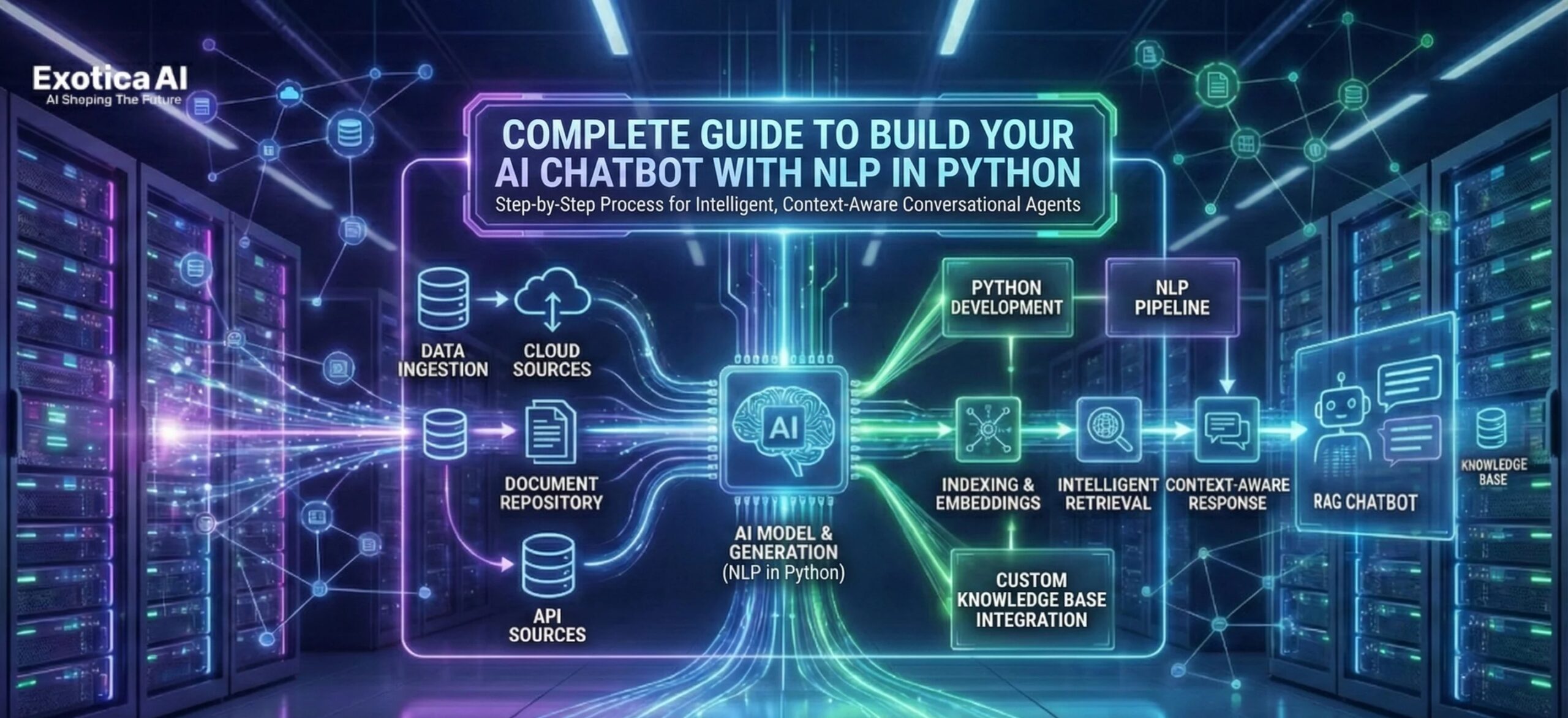
Artificial intelligence continues to transform how businesses communicate, operate, and support customers. One of the most impactful advancements is the development of AI chatbots capable of understanding natural language, responding intelligently, and automating conversations without human intervention. Modern chatbots built with Natural Language Processing (NLP) can interpret intent, extract meaning, handle context, and deliver human-like responses at scale.
Python has become the most widely used programming language for developing NLP-driven chatbots because of its simplicity, flexibility, and powerful library ecosystem. This guide explores the complete process of building an AI chatbot using NLP in Python, including core NLP concepts, development steps, deployment approaches, and practical applications.
What Makes an AI Chatbot Different from a Regular Chatbot?
A traditional chatbot follows strict, rule-based patterns and relies on predefined commands. When users type something unexpected, the bot fails to respond correctly.
AI chatbots powered by NLP can:
- Analyze human language in real time
- Interpret user intent
- Recognize names, dates, and key entities
- Understand variations and misspellings
- Generate natural responses dynamically
- Adapt to context across multiple messages
This flexibility makes NLP chatbots ideal for real-world business scenarios with diverse user questions and unpredictable inputs.
Why Python Is the Ideal Choice for NLP Chatbots
Python dominates AI and NLP development because it offers both simplicity and advanced functionality. Developers prefer Python due to:
1. Easy-to-read syntax
Python is beginner-friendly and efficient for writing scalable code.
2. Access to advanced NLP libraries
Python includes specialized libraries such as:
- NLTK for linguistic operations
- spaCy for tokenization and NER
- Transformers for large language models
- TextBlob for sentiment analysis
3. Smooth integration with machine learning frameworks
Python works seamlessly with TensorFlow, PyTorch, and scikit-learn, enabling chatbot models to learn from large datasets.
4. Efficient deployment frameworks
Frameworks like Flask and FastAPI allow easy API deployment on web servers or cloud platforms.
With Python, developers can scale chatbot capabilities from basic intent classification to advanced conversational intelligence.
Planning Your NLP Chatbot: The Strategic Foundation
Planning the chatbot’s structure creates a strong foundation for scalability and future enhancements.
Key planning areas include:
- Define the chatbot’s purpose: support, sales, onboarding, scheduling, or product assistance.
- Map user conversation flows: understand common questions and expected responses.
- Determine integrations: CRM, internal databases, messaging platforms, or e-commerce systems.
- Choose communication channels: website, mobile apps, or messaging platforms.
A strong plan ensures the chatbot remains adaptable and flexible as business needs evolve.

Core NLP Concepts Required for Chatbot Development
Developers must understand fundamental NLP processes, including:
- Tokenization: breaking text into words or phrases.
- Lemmatization/Stemming: simplifying words to their root forms.
- Intent Classification: determining the user’s goal.
- Named Entity Recognition (NER): extracting important details like names, dates, or numbers.
- Sentiment Analysis: detecting emotional tone.
- Contextual Understanding: tracking conversation history.
These components help the chatbot understand language and respond accurately.
How to Build an NLP Chatbot in Python: Step-by-Step
Below is a streamlined workflow for building a high-performing chatbot.
1. Gather and Clean Training Data
Sources include support logs, FAQs, user feedback, and help center queries. Clean, labeled data improves model accuracy.
2. Preprocess the Text
Preprocessing includes:
- lowercasing text
- removing noise
- eliminating stop words
- tokenizing
- lemmatizing
3. Create an Intent Classification Model
Models can include:
- Logistic Regression
- SVM
- LSTM/GRU networks
- BERT-based Transformers
4. Train Named Entity Recognition
NER extracts data such as customer details, dates, or order IDs using spaCy or Transformer-based models.
5. Create a Response Engine
- Template-based: predefined replies.
- Retrieval-based: selects best match response.
- Generative: creates responses dynamically.
6. Build and Integrate Chatbot Logic
Chatbot logic must:
- route messages
- analyze intent
- generate responses
- store conversation context
- connect to external APIs
How to Deploy Your Python Chatbot
Deployment options include:
- Web servers: Gunicorn, Nginx, Apache
- Cloud platforms: AWS, Google Cloud, Azure
- Containers: Docker, Kubernetes for scaling
Exotica AI Solutions often deploys chatbots using FastAPI and containerized infrastructure for high performance and reliability.
Industry Use Cases of NLP Chatbots
- Customer Service: automated replies for common queries.
- E-Commerce: product discovery and order tracking.
- Healthcare: appointment scheduling and pre-screening.
- HR Departments: onboarding and internal support.
- Finance: secure account-related assistance.
Challenges in NLP Chatbot Development
- Ambiguous Inputs: add clarification prompts.
- Data Limitations: expand training datasets.
- Context Misinterpretation: implement conversation memory.
- Scaling Issues: use Docker and load balancing.
Conclusion
Developing an NLP-powered chatbot in Python enables businesses to automate communication, enhance customer experience, and streamline operations. With the right data, NLP techniques, and scalable deployment methods, companies can build intelligent chatbots that deliver consistent and meaningful conversations. As conversational AI continues to evolve, organizations adopting NLP chatbots today are positioning themselves for long-term success in digital transformation.
Frequently Asked Questions

Mohit Thakur is an experienced Digital Marketing Expert, SEO Team Leader, and Content Writer with over 6 years of expertise in search engine optimization, content strategy, and digital growth. He specializes in research-driven SEO and crafting high-quality, compelling content that helps businesses improve their online visibility, organic traffic, and lead generation.
With hands-on experience across multiple industries, Mohit focuses on creating user-focused, well-researched content aligned with the latest Google algorithms and AI search trends. His approach combines technical SEO, content writing, content optimization, and data analysis to deliver consistent and measurable results.