
What are business process automation tools?
Business process automation tools are software platforms that allow companies to automate repetitive, rule-based workflows across departments — finance, HR, operations, customer service, and beyond. Unlike point-solution task automation, BPA tools orchestrate multi-step processes involving people, systems, data, and decisions within a unified platform.
The result: faster operations, measurably lower costs, and workflows that scale without adding headcount.
Business Process Automation Tools
If you’re running a business and still manually routing approvals, re-entering data between systems, or chasing employees for status updates — you’re burning time and money that your competitors are not. Business process automation tools have matured dramatically, and in 2026, the right business process automation software is no longer a luxury reserved for Fortune 500 companies. Organizations of every size are deploying AI tools for business automation to cut costs, reduce errors, and scale operations without adding headcount.
This guide cuts through the vendor noise and gives you an honest, experience-grounded breakdown of the best business automation tools available today — what they do well, who they’re for, and how to choose the right process automation platform without wasting months on the wrong solution.
What Are Business Process Automation Tools?
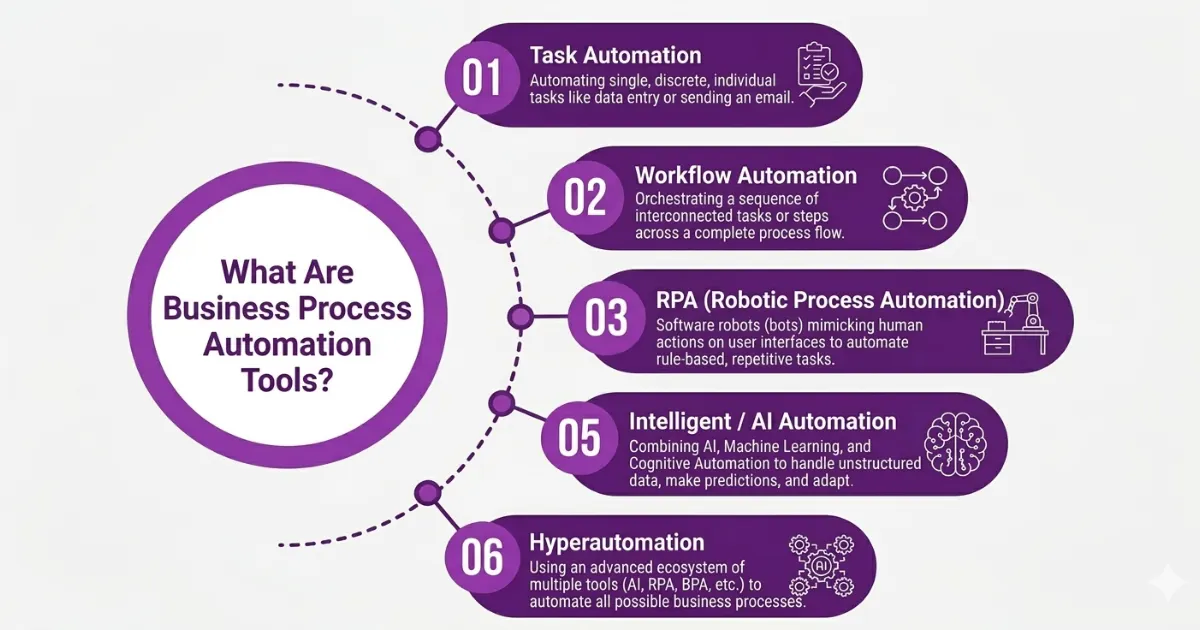
Business process automation (BPA) tools are software platforms that allow companies to automate repetitive, rule-based workflows across departments — finance, HR, operations, customer service, and beyond. Unlike point-solution task automation, BPA tools orchestrate multi-step processes involving people, systems, data, and decisions — all within a unified business process automation platform.
The distinction matters. You’re not just automating a single click. You’re automating an entire loan processing workflow, an employee onboarding sequence, or a multi-tier approval chain — with intelligent exception handling built in. That’s what separates true business process automation solutions from basic integration scripts.
Modern process automation platforms have converged with AI workflow automation tools, meaning they don’t just follow static rules anymore. They learn from patterns, surface anomalies, and trigger actions based on predictive signals — turning reactive workflows into proactive, self-optimizing systems.
| Automation type | What it handles | Best for | Example platforms |
|---|---|---|---|
| Task automation | Single-step, trigger-based actions | Small teams, simple SaaS connections | Zapier, Make (basic) |
| Workflow automation | Multi-step, conditional sequences across systems | Mid-market operations | Make, Power Automate |
| Process automation (BPA) | End-to-end orchestration: humans, decisions, data | Enterprise departments | Appian, Pega |
| RPA | UI-level, screen-based mimicry of human actions | Legacy system integration | UiPath, Automation Anywhere |
| Intelligent / AI automation | Adaptive, self-improving workflows with ML | Document-heavy, decision-intensive processes | UiPath AI, Exotica AI |
| Hyperautomation | Enterprise-wide: RPA + AI + process mining | Full digital transformation programs | UiPath, Pega, custom stacks |
Why Business Owners Are Searching for Automation Solutions Right Now
The demand for business process automation services and enterprise process automation software has surged in 2026 — and it’s not coincidental. Here’s what’s driving real business owners to search for business automation solutions:
- Labor costs keep climbing. Investing in business automation software is now a core margin strategy, not an IT project.
- Remote and hybrid operations demand digital handoffs. Paper-based or email-driven processes collapse without physical proximity. Digital process automation tools fill that gap.
- Compliance complexity is increasing. Regulated industries need AI compliance tools to automate audit preparation — not spreadsheets.
- AI is now table stakes. Business owners who spent 2023–2024 evaluating AI automation tools are now in full deployment mode. The best applied generative AI process automation tools in 2026 are already in production at your competitors.
The Top Business Process Automation Tools in 2026
#1 — Enterprise Scale
UiPath — Best for Enterprise-Scale RPA + BPA Convergence
UiPath remains the dominant player for enterprises that need to blend RPA capabilities with broader business process orchestration tools. Its platform now integrates natively with AI agents that handle unstructured data — invoice extraction, document classification, and email triage — making it one of the most capable enterprise-level automation tools powered by AI insights on the market.
#2 — Mid-Market
Make (formerly Integromat) — Best for Mid-Market AI Workflow Automation Without Code
Make has emerged as the go-to AI workflow automation tool for teams that want sophistication without Python. Its canvas-based interface lets non-technical users build complex, multi-step automations connecting 1,500+ apps — positioning it squarely among the best AI workflow automation tools for mid-market operators.
#3 — Microsoft Ecosystem
Microsoft Power Automate — Best for AI-Powered Automation in the Microsoft Ecosystem
If your organization runs on Microsoft 365, Teams, SharePoint, and Dynamics — Power Automate is the default business process automation software and for good reason. It integrates natively across the entire Microsoft stack, making it one of the most seamlessly deployed AI tools for business automation in enterprise environments.
#4 — Small Business
Zapier — Best Free and Entry-Level AI Automation Tool for Small Business
Zapier still owns the small business business automation tools space. It’s approachable, widely supported, and covers the most common use cases: lead capture to CRM, e-commerce order processing, notification routing, and form-to-database syncing. For teams exploring free AI automation tools, Zapier’s free tier remains one of the most accessible entry points.
#5 — Regulated Industries
Pega Platform — Best for Decision-Intensive Enterprise Process Automation
Pega is purpose-built for industries where process automation software intersects with high-stakes decision-making: banking, insurance, healthcare, and government. It’s one of the most capable enterprise process automation software platforms for organizations automating complex case management and regulatory logic at scale.
#6 — Low-Code Enterprise
Appian — Best Low-Code Business Process Automation Platform for Cross-System Orchestration
Appian sits in the sweet spot between RPA-heavy platforms and lightweight AI workflow automation tools. Its low-code environment lets business analysts build and modify workflows without deep developer dependency — a key differentiator for teams that need agility in their business process automation framework.
Quick Comparison: Top Business Process Automation Tools
| Tool | Best for | AI capability | Ease of use | Starting cost |
|---|---|---|---|---|
| UiPath | Enterprise RPA + BPA | Advanced (doc AI, ML) | Low — IT required | Custom enterprise pricing |
| Make | Mid-market no-code | Strong (conditional AI routing) | High — visual canvas | Free tier available |
| Power Automate | Microsoft-first orgs | Strong (Copilot AI design) | High — for M365 users | ~$15/user/month |
| Zapier | Small business / startup | Basic (AI steps add-on) | Very high — no-code | Free; $19.99/month+ |
| Pega | Regulated enterprise | Advanced (adaptive AI) | Low — certified devs | Custom enterprise pricing |
| Appian | Low-code enterprise | Strong (process mining) | Medium — low-code | Custom enterprise pricing |
How to Choose the Right Business Process Automation Tool
Choosing the wrong process automation platform costs more than money — it costs six to eighteen months of failed implementation. Here’s the decision framework experienced operators use when evaluating business process automation solutions:
-
Map your actual processes before evaluating tools. Don’t start with vendor demos. Start with a process audit. Document where manual handoffs happen, where errors occur, and where bottlenecks slow throughput. The best AI tools for business automation won’t save you if you’re automating a broken process. This is core to any sound business process automation framework.
-
Assess your technical environment. Are you primarily Microsoft, Google, or Salesforce ecosystem? Do you have legacy on-premise systems that need integration? What’s your team’s technical capacity for implementing and maintaining a business process automation platform? Your answers immediately eliminate half the BPA tools on the market.
-
Define scale and compliance requirements. A startup automating lead routing needs a fundamentally different platform than a bank running loan processing under regulatory oversight. Volume, compliance requirements, and exception-handling complexity should drive tier selection — not feature lists.
-
Evaluate total cost of ownership — not just license fees. Many process automation products appear affordable at entry level and become expensive at production scale. Factor in implementation time, training, ongoing maintenance, and business process automation consulting costs if your team lacks in-house expertise.
-
Pilot before you commit. Every serious vendor will support a proof of concept. Run one real workflow end-to-end before signing an annual contract. This surfaces integration gaps and usability issues that demos always hide.
AI Automation Tools for Business: What’s Actually New in 2026
The biggest shift across all business process automation software in 2026 is the deep convergence with generative AI. Every serious enterprise automation tool has added AI layers, but the real change is in how that AI is being deployed:
- Intelligent document processing — top AI tools now handle unstructured inputs — emails, PDFs, voice transcripts — without manual extraction setup. This powers RAG-based knowledge retrieval directly inside automation workflows.
- AI-assisted workflow design — the best AI workflow automation tools in 2026 let non-technical users describe a process in plain language and generate automation logic automatically.
- Anomaly detection and compliance monitoring — AI compliance tools flag exceptions before they become errors. Critical for financial reconciliation and regulated workflows.
- AI sales automation tools — leading platforms now trigger personalized outreach sequences, score leads, and update CRM records without human intervention.
- AI marketing automation tools — AI-powered tools generate, personalize, and schedule content campaigns based on behavioral signals entirely within the automation stack.
- Conversational process triggers — automation can now be initiated through AI chatbot inputs or voice commands — not just form submissions — reflecting the rise of enterprise digital transformation.
- n8n-based custom automation stacks — organizations building custom AI automation outside SaaS platforms are increasingly deploying n8n workflow automation for self-hosted, extensible pipeline orchestration.
Firms like Exotica AI Solutions are helping mid-market and enterprise clients implement these AI-powered business process automation solutions — bridging the gap between platform selection and production-scale deployment with measurable ROI.
Common Mistakes Businesses Make When Implementing Process Automation
- Automating without process standardization first. If five people handle the same task five different ways, your platform locks in inconsistency, not efficiency. Standardize first, then automate.
- Underestimating change management. Employees resist AI automation tools when deployment feels like a threat, not a relief. Communication and training matter as much as the technology itself.
- Over-engineering the first workflow. Start with high-volume, low-complexity processes. Quick wins build organizational confidence and surface real-world edge cases safely.
- Ignoring exception handling. Every automated workflow will hit an edge case. Build exception routes from day one, or your automation solution creates a backlog instead of clearing one.
- Not measuring baseline performance. You can’t prove ROI if you didn’t document how long the manual process took. Measure before you automate.
Business Process Automation by Department: Where the ROI Is Highest
| Department | High-ROI automation use cases | Typical efficiency gain |
|---|---|---|
| Finance & Accounting | Accounts payable, three-way matching, reconciliation, month-end close, audit trail generation | 50–70% cycle time reduction |
| Human Resources | Onboarding, offboarding, leave approvals, performance review routing, FMLA automation | 40–60% admin workload reduction |
| Operations & Supply Chain | Purchase order processing, inventory alerts, vendor communication, compliance documentation | 35–55% manual processing reduction |
| Sales & Marketing | Lead scoring, follow-up sequencing, proposal generation, CRM hygiene, campaign personalization | 3–5× faster lead response time |
| Customer Service | Ticket routing, SLA escalation, onboarding sequences, renewal reminders, AI tier-1 resolution | 60–80% tier-1 query automation rate |
| IT Operations | Ticket classification and routing, network monitoring alerts, incident response, access provisioning | 45–65% ticket handling reduction |
Frequently Asked Questions
Final Verdict: Which Business Process Automation Tool Should You Choose?
There is no single best business process automation tool — only the right process automation platform for your specific context, scale, and industry. Here’s the short version:
Small business / startup: Start with Zapier or Make — the most accessible AI automation tools for teams without dedicated IT.
Microsoft-first organization: Microsoft Power Automate — native business automation software built into your existing stack.
Mid-market needing flexibility: Make or Appian — powerful AI workflow automation tools that grow with you.
Enterprise with legacy systems and high volume: UiPath or Pega — the gold standard in enterprise process automation software.
Regulated industry with complex decision logic: Pega Platform — the leading enterprise automation platform for compliance-heavy environments.
The businesses winning in 2026 are not the ones with the most sophisticated business automation tools. They’re the ones that selected the right business process automation solution, implemented it correctly, and continuously improved their workflows based on real operational data. Working with experienced business process automation experts — like Exotica AI Solutions — can compress that learning curve significantly and help you avoid the costly mistakes that derail most process automation projects before they deliver measurable value.
Start with one process. Automate it well. Then scale.

Mohit Thakur is an experienced Digital Marketing Expert, SEO Team Leader, and Content Writer with over 6 years of expertise in search engine optimization, content strategy, and digital growth. He specializes in research-driven SEO and crafting high-quality, compelling content that helps businesses improve their online visibility, organic traffic, and lead generation.
With hands-on experience across multiple industries, Mohit focuses on creating user-focused, well-researched content aligned with the latest Google algorithms and AI search trends. His approach combines technical SEO, content writing, content optimization, and data analysis to deliver consistent and measurable results.