
Healthcare systems are under constant pressure to improve patient outcomes, reduce administrative burdens, and operate more efficiently. Over the past few years, I’ve seen how artificial intelligence is becoming a practical solution for many of these challenges. One of the most common ways organizations build these tools is by using Python, a programming language that has become the backbone of modern AI development.
Custom AI solutions for healthcare built with Python allow providers to automate repetitive tasks, analyze medical data, and deliver more personalized patient experiences. Instead of relying on generic software, healthcare organizations can develop tools that fit their specific workflows, compliance requirements, and patient needs.
What Are Custom AI Solutions for Healthcare?
Custom AI solutions for healthcare are intelligent systems designed to address specific clinical, operational, or patient engagement challenges. These systems are built using machine learning, natural language processing, and data analytics tools.
Python is widely used for these projects because it offers:
- Simple, readable syntax
- Powerful AI and machine learning libraries
- Strong data processing capabilities
- Easy integration with modern healthcare systems
Institutions such as the National Institutes of Health and the World Health Organization support the use of digital health technologies and data-driven tools to improve patient outcomes and system efficiency.
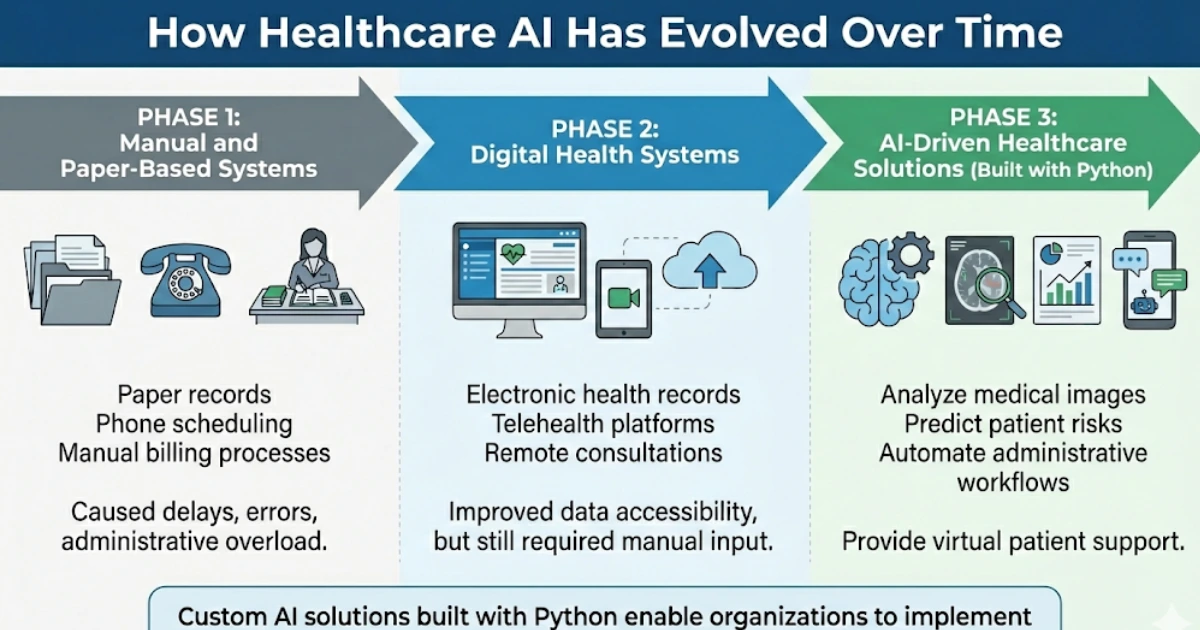
How Healthcare AI Has Evolved Over Time
Understanding how AI adoption has progressed helps clarify why custom solutions are becoming essential.
Phase 1: Manual and Paper-Based Systems
Healthcare organizations relied heavily on:
- Paper records
- Phone scheduling
- Manual billing processes
This approach often caused delays, errors, and administrative overload.
Phase 2: Digital Health Systems
Electronic health records and telehealth platforms improved:
- Data accessibility
- Appointment management
- Remote consultations
However, many processes still required manual input.
Phase 3: AI-Driven Healthcare Solutions
Today, AI tools can:
- Analyze medical images
- Predict patient risks
- Automate administrative workflows
- Provide virtual patient support
Custom AI solutions built with Python enable organizations to implement these capabilities in a way that fits their specific environment.
Key Use Cases for Custom AI Solutions in Healthcare
1. Patient Engagement and Virtual Assistants
AI chatbots and virtual assistants can:
- Answer patient questions
- Schedule appointments
- Send reminders
- Provide follow-up instructions
These tools reduce administrative workload while improving patient satisfaction.
2. Clinical Decision Support
AI models analyze:
- Medical images
- Lab results
- Patient histories
- Real-time monitoring data
This helps clinicians detect patterns and make more informed decisions.
Research from Harvard Medical School highlights how AI-based decision tools can assist clinicians when used responsibly alongside human expertise.
3. Predictive Analytics for Patient Outcomes
Predictive models can:
- Identify high-risk patients
- Forecast readmissions
- Detect early signs of complications
- Optimize resource allocation
According to studies referenced by the World Health Organization, predictive analytics plays a growing role in improving healthcare efficiency and outcomes.
4. Administrative Workflow Automation
AI systems can automate tasks such as:
- Patient intake processing
- Insurance verification
- Appointment scheduling
- Billing operations
Automation reduces errors and allows staff to focus on patient care.
Popular Python Libraries for Healthcare AI
Python’s ecosystem makes it ideal for building custom AI systems.
Machine Learning and Deep Learning
- TensorFlow
- PyTorch
- Scikit-learn
Data Processing and Analysis
- Pandas
- NumPy
Natural Language Processing
- spaCy
- NLTK
- Transformers
These libraries allow developers to create everything from simple predictive models to advanced conversational AI systems.
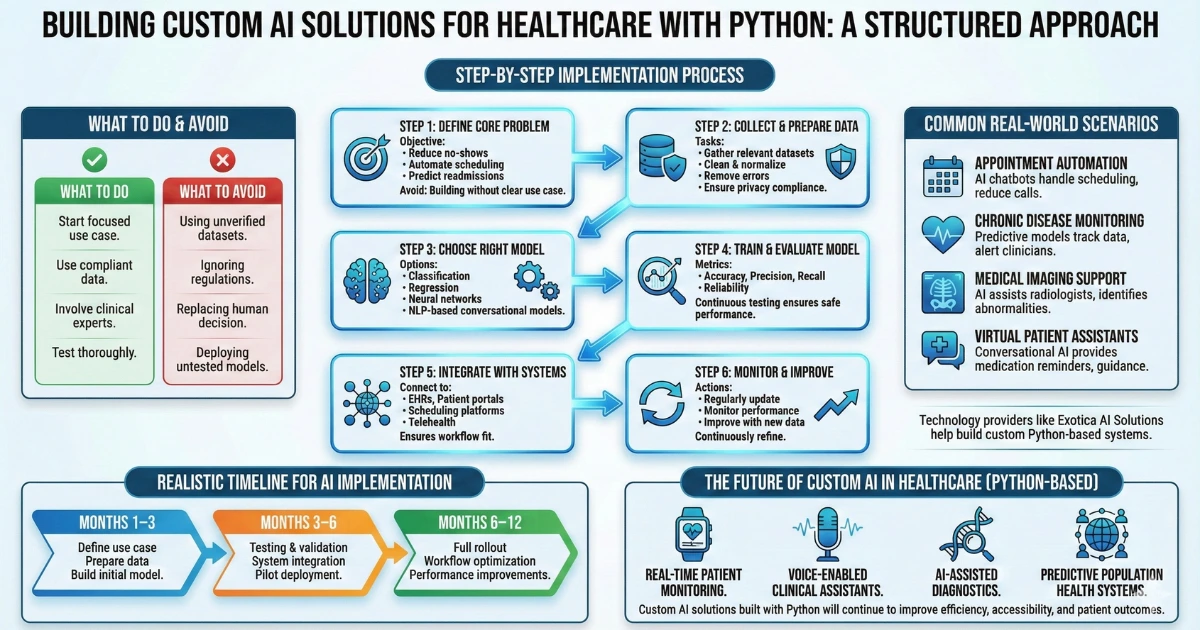
Step-by-Step: How to Build Custom AI Solutions for Healthcare With Python
From my experience, successful AI projects follow a structured process.
Step 1: Define the Core Problem
Start with a specific objective, such as:
- Reducing patient no-shows
- Automating appointment scheduling
- Predicting readmission risks
Step 2: Collect and Prepare Data
High-quality data is essential.
Key tasks include:
- Gathering relevant datasets
- Cleaning and normalizing data
- Removing errors and duplicates
- Ensuring privacy compliance
Step 3: Choose the Right ModelPredictive models track patient data and alert clinicians to risks.
Scenario 3: Medical Imaging Support
AI assists radiologists by identifying abnormalities in scans.
Scenario 4: Virtual Patient Assistants
Conversational AI provides medication reminders and recovery guidance.
Technology providers such as Exotica AI Solutions are helping healthcare organizations build custom Python-based AI systems tailored to these real-world challenges.
When NOT to Rely on AI Alone
AI should support, not replace, clinical judgment.
Seek professional intervention when:
- Symptoms are life-threatening
- Diagnoses are uncertain
- Ethical or legal decisions are involved
- Complex treatment planning is required
Human expertise remains essential in healthcare.
Realistic Timeline for AI Implementation
Months 1–3
- Define use case
- Prepare data
- Build initial model
Months 3–6
- Testing and validation
- System integration
- Pilot deployment
Months 6–12
- Full rollout
- Workflow optimization
- Performance improvements
Organizations that delay AI adoption may face:
- Higher operational costs
- Slower workflows
- Reduced competitiveness
The Future of Custom AI Solutions in Healthcare
Python will likely remain the dominant language for healthcare AI. Future developments may include:
- Real-time patient monitoring
- Voice-enabled clinical assistants
- AI-assisted diagnostics
- Predictive population health systems
Custom AI solutions built with Python will continue to play a major role in improving efficiency, accessibility, and patient outcomes.
Frequently Asked Questions

Mohit Thakur is an experienced Digital Marketing Expert, SEO Team Leader, and Content Writer with over 6 years of expertise in search engine optimization, content strategy, and digital growth. He specializes in research-driven SEO and crafting high-quality, compelling content that helps businesses improve their online visibility, organic traffic, and lead generation.
With hands-on experience across multiple industries, Mohit focuses on creating user-focused, well-researched content aligned with the latest Google algorithms and AI search trends. His approach combines technical SEO, content writing, content optimization, and data analysis to deliver consistent and measurable results.