
Every real estate broker in America has lived this scenario. It is 9 PM on a Friday. A motivated buyer in Austin fills out a contact form after finding your listing on Zillow. They are pre-approved. They want to schedule a showing this week. By the time your team sees the message on Monday morning, that buyer has already toured two properties with agents who called them back within sixty seconds of the inquiry.
That gap—the window between when a lead raises their hand and when a human agent responds—is the single biggest revenue leak in real estate today. In 2026, the solution is not a bigger team. It is a smarter system.
What Real Estate Business Owners Are Actually Searching For in 2026
Before understanding how AI calling agents work, it is worth looking at what brokers, team leads, and property managers across the US are actually typing into search engines right now:
- Can AI agents make outbound calls to my real estate leads automatically?
- Is AI cold-calling real estate leads legal under TCPA?
- What does CRM mean in real estate, and can AI integrate with it?
- What is the best CRM for real estate teams handling high lead volume?
- How do I use a CRM for real estate to stop losing follow-up opportunities?
- What real estate technology companies are building AI tools for brokerages?
- Are there AI calling agent lead conversion real estate case studies I can review?
- What are the best tools for managing real estate assets and pipelines at scale?
These are not abstract technology questions. They are operational questions from business owners watching their lead acquisition costs rise while conversion rates stay flat. Every single one of these searches points to the same root problem: the gap between lead capture and human response is too wide, too inconsistent, and too expensive to close with manual labor alone.
The Speed-to-Lead Problem That Is Costing US Brokerages Real Money
The data on lead response time in real estate is alarming for most teams running on manual follow-up. Research consistently shows that leads contacted within five minutes are significantly more likely to convert than those reached after thirty minutes. After one hour, the conversion probability drops sharply. After business hours on a Friday, most leads are functionally gone by Monday.
Here is why this matters financially:
- A mid-size brokerage generating 500 leads per month at a $40 average cost per lead spends $20,000 monthly on acquisition.
- If response time averages four hours, a substantial portion of those leads convert elsewhere before any human contact is made.
- That is not a marketing problem. It is a response infrastructure problem.
AI voice agents solve this by answering every call and following up on every form submission within seconds—capturing leads at the peak of their intent, regardless of what time they inquire. The economics shift immediately: the same lead budget starts producing more appointments because fewer leads go cold before contact is made.
How an AI Calling Agent Actually Works for Real Estate
An AI calling agent is an automated voice system that conducts real phone conversations using natural language processing. It is not a robocall. It is not a voicemail drop. It holds genuine, responsive dialogues—adapting to what the caller says, answering questions, and guiding the conversation toward the right outcome.
For a real estate brokerage, the workflow looks like this:
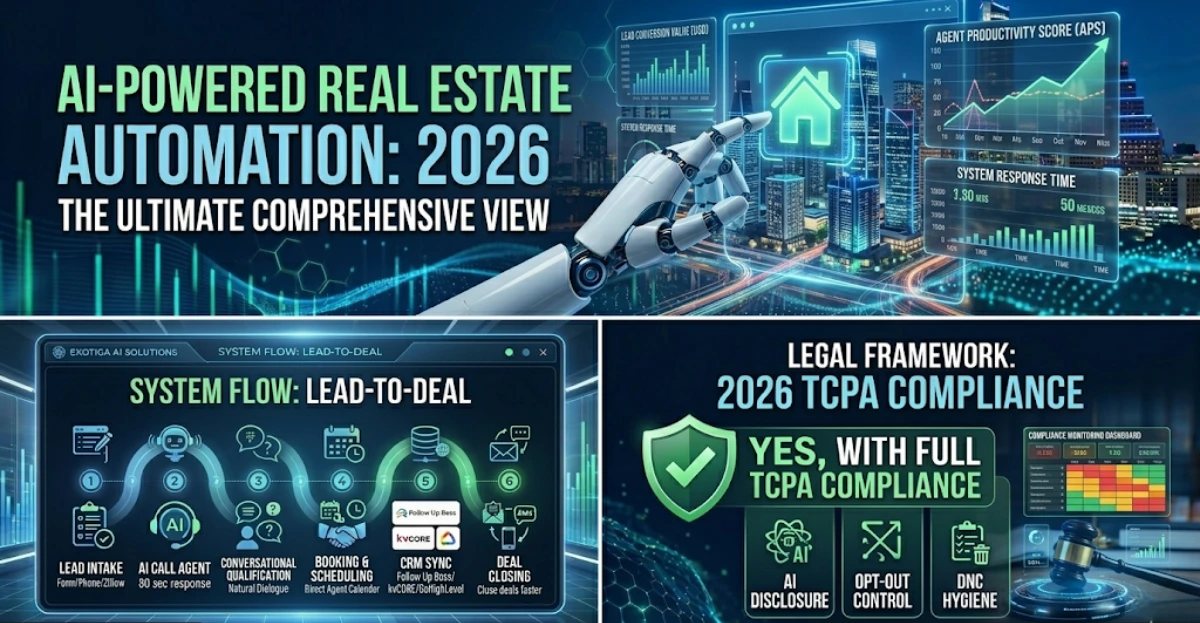
Step 1 — Lead triggers the system. A prospect submits a form on your website, clicks a Facebook lead ad, inquires through Zillow, or calls your office number. The AI system activates instantly.
Step 2 — Outbound call or inbound answer within 60 seconds. The AI dials the lead or picks up the inbound call immediately. It introduces itself as your virtual assistant and begins a natural qualification conversation.
Step 3 — Qualification happens through conversation. The AI works through your criteria in a natural dialogue—not a robotic script. It asks about:
- Timeline for buying or selling
- Target price range and mortgage pre-approval status
- Preferred neighborhoods and property types
- Whether the prospect is currently working with another agent
- What prompted their search today
Step 4 — Qualified leads get booked directly. If the lead meets your criteria, the AI offers appointment slots based on agent availability and confirms the booking — directly to your calendar; no manual step is required.
Step 5 — CRM updates automatically. Every conversation outcome, qualification score, and follow-up note flows into your real estate CRM without manual entry. Whether you use Follow Up Boss, GoHighLevel, kvCORE, HubSpot, LionDesk, or Salesforce, the data is there when your agent picks up the conversation.
Step 6 — Nurture sequences activate for not-yet-ready leads. Prospects who are still in research mode are enrolled in structured follow-up sequences — calls, texts, and emails at defined intervals — until they are ready to move forward.
Can AI Agents Make Outbound Calls? The Legal Reality in 2026
This is one of the most frequently searched questions among US real estate professionals today, and it deserves a direct answer.
Yes, AI agents can legally make outbound calls in the US — but TCPA compliance is non-negotiable. Here is what that means in practice:
- AI-generated voices in automated outbound calls require disclosure. The caller must be identified as an AI assistant.
- Proper opt-out mechanisms must be in place on every call.
- Do-Not-Call list hygiene must be maintained and updated regularly.
- Some states impose additional requirements beyond federal TCPA rules — California, Florida, and New York have stricter provisions worth verifying.
AI cold calling in real estate is entirely viable when implemented correctly. Reputable providers build these compliance layers into their infrastructure by default. The risk is not the technology — it is choosing a provider that treats compliance as an afterthought rather than a foundation.
Before deploying any AI cold caller for real estate at scale, verify your provider’s compliance architecture and consult your state’s specific calling regulations.
CRM Integration: Why It Is the Backbone of AI-Powered Lead Follow-Up
CRM stands for Customer Relationship Management. In real estate, a CRM is the system that stores lead data, tracks communication history, manages follow-up tasks, and helps agents prioritize their pipeline. Without AI, a CRM is an organized database. With AI, it becomes a deal-finding engine — predicting which leads are most likely to convert, triggering follow-up automatically, and surfacing the right prospect at the right moment.
Understanding how to use CRM for real estate effectively in 2026 means treating it not as a contact storage tool but as the operational core of your lead conversion process. The AI calling agent handles the outbound work. The CRM captures everything that comes back and feeds context into every subsequent interaction.
The best CRM for real estate depends on your team size, lead volume, and workflow complexity.
- Follow Up Boss—widely used by high-volume buyer teams and brokerages
- GoHighLevel — strong automation and pipeline customization for real estate agencies
- kvCORE — purpose-built for real estate teams with built-in lead routing
- Salesforce — enterprise-grade for large brokerages with complex operations
- HubSpot — flexible for teams that want CRM and marketing automation in one platform
What matters most is not the CRM brand but the integration depth. The AI should update the CRM after every call, and the CRM should feed lead history and behavior data back into the AI for context on every outbound attempt.
Real Estate Technology in 2026: What the Landscape Looks Like
The real estate technology sector has moved well beyond basic CRM and listing management. In 2026, the competitive advantage belongs to brokerages and teams that have built operational intelligence into their lead conversion infrastructure.
Leading real estate technology companies are deploying AI across four critical functions:
- Predictive lead scoring — analyzing listing views, search behavior, response timing, and engagement patterns to identify high-intent leads before they self-identify
- Automated outreach sequencing — coordinating AI calling agents, SMS, and email in structured cadences triggered by lead behavior signals
- Property management data integration with BI tools — combining tenant behavior, maintenance patterns, and occupancy data into operational dashboards that drive proactive decisions
- AI tools for predictive maintenance in property management — using sensor data and historical maintenance records to predict failures before they occur, reducing emergency repair costs and tenant turnover
The common thread across all of these applications is a shift from reactive to proactive operations. Real estate businesses that have adopted this infrastructure are outperforming those running on manual processes — not because they work harder, but because they lose fewer opportunities to friction and delay.
AI Calling Agent vs. Human Inside Sales Agent: An Honest Comparison
| Metric | AI Calling Agent | Human ISA |
|---|---|---|
| Availability | 24/7/365 | Business hours only |
| First response time | Under 60 seconds | 30 minutes to several hours |
| Monthly cost | Fraction of human cost | $4,000–$6,000+ salary and benefits |
| Consistency | 100% identical per call | Varies by day, energy, and mood |
| CRM updates | Automatic after every call | Manual, often delayed or incomplete |
| Scalability | Instant — handles any volume | Requires hiring, training, and ramp time |
| TCPA compliance | Built-in when properly configured | Requires training and ongoing oversight |
| Language support | Multiple languages available | Usually English only |
| Best application | Initial outreach and qualification | Relationship building and negotiation |
Which Real Estate Businesses Benefit Most From AI Calling Agents
Not every real estate operation sees the same return on this investment. The ROI is highest for businesses where response time is the primary conversion bottleneck — and where lead volume makes manual follow-up physically impossible to do consistently.
High-volume brokerages running paid acquisition across Zillow, Google, and Meta need an instant response infrastructure. Every hour of delay after a paid lead inquires is money lost on an acquisition that never converts.
Property management companies handling rental inquiries benefit from 24/7 qualification that captures prospects at peak intent — evenings and weekends, when most offices are closed.
Real estate investors running wholesale or acquisition operations need consistent outbound follow-up on motivated seller leads. AI cold callers execute that follow-up without fatigue, inconsistency, or burnout.
High-producing real estate teams where top agents are too busy to manage initial outreach gain a qualification layer that delivers only serious, pre-vetted prospects to human agents—protecting the most valuable hours in the business.
Solo agents competing against larger teams can project the operational presence of a full team without the overhead—responding instantly, following up persistently, and booking appointments consistently.
Topical Authority and Silo Structure: The Content Plan Behind This Guide
This article serves as the pillar page within a structured content silo covering AI automation for real estate businesses. The cluster topics that support and interlink with this guide include:
- A detailed breakdown of AI cold-calling real estate regulations—addressing the high-volume query, whether AI agents can make outbound calls illegal, and how Doworkes TCPCompliance works in practice across US states.
- A buyer’s guide to the best CRM for commercial real estate, covering integration requirements, lead routing logic, and AI scoring capabilities.
- A practical walkthrough of how to use CRM for real estate teams transitioning from manual follow-up to automated workflows.
- A technical guide on AI tools for predictive maintenance in property management, covering the growing overlap between property operations and data-driven AI analysis.
- A documented case study breakdown of AI calling agents and real estate lead conversion, with results across brokerage types and lead sources.
Each cluster topic links back to this pillar. This pillar links forward into Exotica AI Solutions’ service pages. The result is a topical authority structure that signals depth and expertise to both traditional search engines and AI-driven discovery platforms—including Google AI Overviews, ChatGPT, and Perplexity.
Frequently Asked Questions
The Bottom Line
In 2026, the real estate businesses closing the most deals in the US are not always the largest or the best funded. They are the fastest and the most consistent. They respond to every lead within sixty seconds. They qualify persistently. They follow up without fail. They show up at 10 PM on a Sunday when a motivated buyer is scrolling through listings in Phoenix.
An AI calling agent makes all of that operationally possible — at scale, at a fraction of the cost of human inside sales agents, and with a level of consistency no manual process can sustain across hundreds of leads per month.
If you are spending money generating real estate leads and watching too many of them go cold before contact, the gap is almost certainly speed and follow-up consistency. That is exactly the gap an AI calling agent closes.
Ready to see what automated lead follow-up looks like for your real estate business? Exotica AI Solutions builds and deploys AI calling agents designed specifically for US real estate brokerages, property management companies, and investment operations — with full CRM integration, TCPA-compliant workflows, and ongoing optimization included.
Talk to an Expert at Exotica AI Solutions

Mohit Thakur is an experienced Digital Marketing Expert, SEO Team Leader, and Content Writer with over 6 years of expertise in search engine optimization, content strategy, and digital growth. He specializes in research-driven SEO and crafting high-quality, compelling content that helps businesses improve their online visibility, organic traffic, and lead generation.
With hands-on experience across multiple industries, Mohit focuses on creating user-focused, well-researched content aligned with the latest Google algorithms and AI search trends. His approach combines technical SEO, content writing, content optimization, and data analysis to deliver consistent and measurable results.