
What is enterprise process automation?
Enterprise process automation is the use of AI, robotic process automation (RPA), and intelligent workflow orchestration to automate complex, high-volume business processes across an entire organization — covering finance, HR, operations, procurement, compliance, and customer operations simultaneously. Unlike departmental automation, enterprise-level automation connects every business unit into a single, coordinated operational system that runs, monitors, and improves itself.
There is a specific moment when every large organization realizes their automation problem is not a tool problem.
They have Zapier. They have a few RPA bots. Someone in finance built a Power Automate flow. And still — their month-end close takes two weeks, their procurement cycle requires six manual approvals, and their compliance team is buried in documentation that should have been generated automatically three years ago.
The issue is not the absence of automation. It is the absence of enterprise process automation — the disciplined, architecture-led approach to automating entire business processes end-to-end, across every department, at the scale and complexity that large organizations actually operate.
This guide covers what enterprise process automation actually means in 2026, what separates it from departmental automation, which platforms deliver at enterprise scale, how to build the business case, and how to implement it without the failures that derail most large-scale automation programs.
Table of Contents
- What Is Enterprise Process Automation?
- Enterprise Automation vs Departmental Automation
- Core Components of an Enterprise Automation Platform
- Enterprise Process Automation Use Cases by Function
- Best Enterprise Process Automation Platforms in 2026
- Intelligent Process Automation at Enterprise Scale
- How to Implement Enterprise Process Automation
- Frequently Asked Questions
What Is Enterprise Process Automation?
Enterprise process automation is the systematic application of automation technology — including RPA, AI, machine learning, and low-code orchestration — to automate and coordinate business processes across an entire organization at scale.
The critical distinction from standard business process automation is scope and architecture. Departmental automation solves a problem in one team. Enterprise-level automation solves the problem of how every team’s processes connect, hand off to each other, and operate as a unified operational system.
A fully realized enterprise automation platform handles:
- End-to-end business processes that span multiple departments and systems
- High-volume, document-intensive workflows that involve unstructured data
- Complex approval chains, compliance documentation, and audit trail generation
- Exception handling and intelligent routing without human intervention at each step
- Real-time monitoring, anomaly detection, and continuous process optimization
- Integration with legacy ERP, CRM, HRMS, and financial systems
The result is not just faster processes. It is an organization where operational throughput scales independently of headcount — where doubling transaction volume does not require doubling the team that processes it.
What is enterprise automation?
Enterprise automation is the coordinated deployment of RPA, AI, and workflow orchestration across an entire organization to automate complex, cross-departmental business processes. It differs from point-solution automation in that it governs entire process lifecycles — from trigger to completion — including exceptions, compliance documentation, system updates, and human escalation paths, all within a unified enterprise automation system.
Enterprise Automation vs Departmental Automation: Why the Difference Matters
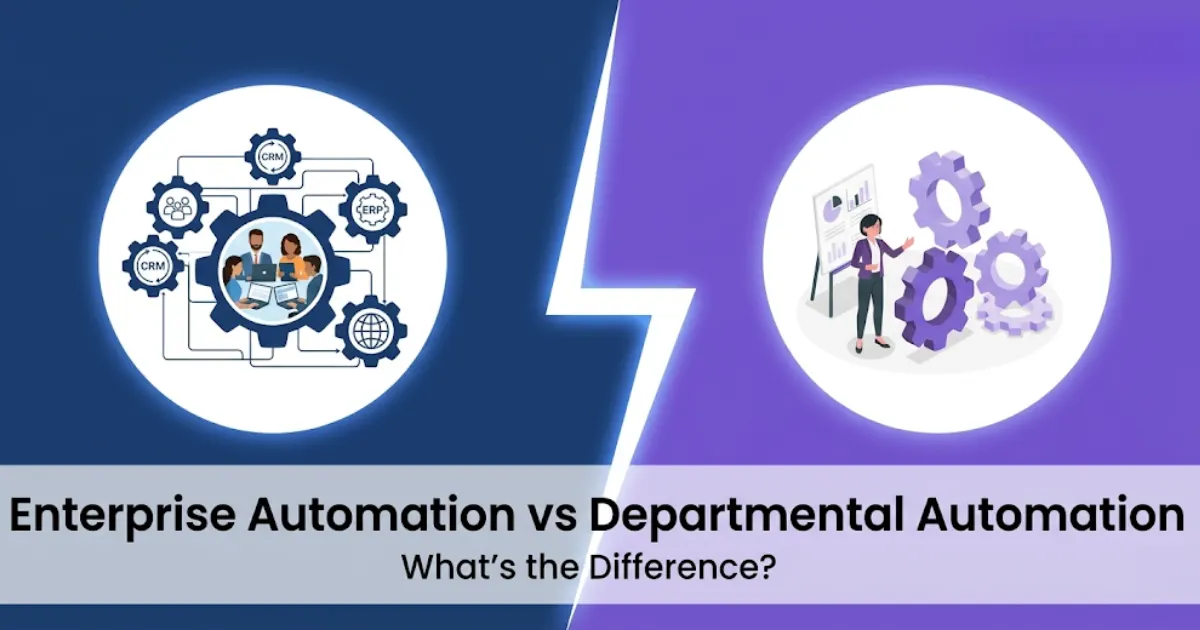
Most organizations have deployed automation. Very few have deployed enterprise process automation. Understanding the gap between the two is the most important first step in building an effective automation strategy.
| Factor | Departmental automation | Enterprise process automation |
|---|---|---|
| Scope | Single team or function | Cross-departmental, organization-wide |
| Process coverage | Individual tasks or steps | End-to-end business processes |
| Integration depth | One or two systems | Full ERP, CRM, HRMS, and legacy stack |
| Exception handling | Manual escalation | AI-driven routing with defined fallback |
| Governance | Team-level ownership | Centralized CoE with enterprise standards |
| Compliance | Manual documentation | Automated audit trails and reporting |
| ROI horizon | Single process savings | Compound operational leverage at scale |
The organizations that generate the highest ROI from automation are not those with the most bots. They are those that treat automation as an enterprise automation solution — a governed, architecture-led program that coordinates every automated process into a single operational system. Our intelligent automation services guide covers the full technology stack that powers this approach.
Core Components of an Enterprise Automation Platform
An enterprise automation platform is not a single tool. It is a technology stack that combines several layers working together to govern, execute, and optimize business processes at organizational scale.
1. Process orchestration layer
The orchestration layer governs the end-to-end flow — defining triggers, routing decisions, approval chains, exception paths, and escalation logic. This is what separates a true enterprise automation system from a collection of disconnected bots. Without orchestration, you have individual automations. With it, you have an end-to-end business process that runs itself.
2. RPA execution layer
Robotic process automation handles the mechanical execution — logging into systems, extracting data, filling forms, triggering actions across applications. At enterprise scale, enterprise robotic process automation typically involves hundreds of bots operating across dozens of systems simultaneously, governed by the orchestration layer above them.
3. Intelligent document processing
Enterprise operations are document-intensive. Invoices, contracts, compliance submissions, insurance claims, and loan applications arrive in variable formats that rule-based systems cannot reliably process. Intelligent document processing — combining OCR, NLP, and machine learning — extracts, validates, and routes document data automatically, enabling fully automated invoice processing, contract review, and claims handling at scale.
4. AI and machine learning decision layer
This is what separates intelligent business process automation from basic workflow tools. AI models embedded in enterprise automation workflows classify incoming data, predict exception likelihood, score routing decisions, and improve accuracy over time. This layer is what allows enterprise process automation solutions to handle the complexity and variability of real business operations — not just the predictable structured cases.
5. Integration and connectivity layer
An enterprise automation solution is only as powerful as its ability to connect to existing infrastructure. Integration with SAP, Salesforce, ServiceNow, Oracle, Microsoft 365, and proprietary legacy systems is not optional — it is the foundation. CRM integration and ERP connectivity are typically the two most critical integration requirements in enterprise automation programs.
6. Governance, compliance, and monitoring
At enterprise scale, every automated action must be logged, auditable, and compliant with industry regulations. The monitoring layer provides real-time process dashboards, exception rate tracking, SLA compliance reporting, and AI-driven optimization recommendations — turning your automation program into a continuously improving operational system.
Enterprise Process Automation Use Cases by Business Function
Finance and accounting automation
Enterprise process automation delivers some of its highest ROI in finance operations. The combination of high transaction volume, strict compliance requirements, and document-intensive workflows makes finance the natural starting point for most enterprise automation programs.
- Automated invoice processing — AI extracts and validates invoice data from variable-format documents, performs three-way matching, routes exceptions for human review, and posts approved invoices to the ERP automatically. Organizations processing 500+ invoices monthly consistently report 70–80% processing time reduction
- Financial close automation — automated reconciliation, intercompany eliminations, journal entry processing, and close checklist management reduce month-end close cycles from weeks to days
- Enterprise billing process automation — billing cycle generation, payment application, dispute routing, and collections follow-up handled automatically with full audit trails
- Compliance and regulatory reporting — automated data collection, report generation, and submission with SOX, GAAP, and industry-specific compliance documentation generated as a byproduct of the process — not as a separate step
Human resources and workforce operations
- Employee onboarding and offboarding — triggered automatically at offer acceptance or resignation, coordinating IT provisioning, payroll enrollment, benefits setup, and access management without manual handoffs between departments
- Leave and absence management — automated approval routing, HRIS updates, payroll adjustments, and coverage notifications based on configurable policy logic
- Credentialing and compliance verification — particularly critical in healthcare and financial services where employee credential validation has direct regulatory implications
Procurement and supply chain
- Purchase order automation — PO generation from approved requisitions, supplier communication, receipt confirmation, and three-way matching handled automatically
- Vendor onboarding — document collection, compliance verification, ERP setup, and contract execution coordinated across procurement, legal, and finance without manual process management
- Enterprise asset management automation — maintenance scheduling, work order generation, parts ordering, and compliance documentation triggered automatically based on asset condition data
Customer operations
- Customer onboarding — KYC verification, document collection, account setup, and welcome communication orchestrated automatically across compliance, operations, and customer success
- Service request handling — AI chatbots and AI calling agents handle tier-1 customer interactions, route complex cases to the right human with full context, and update CRM records automatically
- Contract lifecycle management — contract creation, approval routing, execution, and renewal tracking automated with intelligent document processing handling variable contract formats
Best Enterprise Process Automation Platforms in 2026
| Platform | Strength | Best for | IPA capability |
|---|---|---|---|
| UiPath | Enterprise RPA + AI orchestration | Large enterprises with legacy systems | Very strong |
| Pega | Case management + adaptive AI | Regulated industries, complex decisions | Very strong |
| ServiceNow | IT and enterprise workflow orchestration | IT-centric enterprises, ITSM integration | Strong |
| SAP BTP / DPA | Native SAP process automation | SAP ERP-centric organizations | Medium-strong |
| Appian | Low-code cross-system orchestration | Enterprises needing analyst-led builds | Strong |
| Microsoft Power Automate | Microsoft ecosystem integration | Microsoft-first organizations | Growing (Copilot) |
| n8n + Custom AI stack | Maximum flexibility + AI integration | Organizations needing custom DPA pipelines | Fully custom |
The best enterprise automation software for your organization is not determined by feature lists — it is determined by your existing technology stack, your industry’s compliance requirements, your team’s technical capacity, and the complexity of the processes you need to automate. Our digital process automation guide covers platform selection in detail, including how to evaluate best enterprise automation platforms for specific industry requirements.
For organizations that need custom AI-integrated automation pipelines — connecting n8n workflow automation, RAG-based knowledge retrieval, and enterprise systems into a unified orchestration layer — a custom stack frequently outperforms off-the-shelf platforms on both capability and total cost of ownership.
Intelligent Process Automation at Enterprise Scale
Intelligent process automation (IPA) is the evolution of enterprise automation that adds AI decision-making on top of RPA execution and workflow orchestration. At enterprise scale, IPA is what enables automation to handle the full complexity of real business operations — not just the structured, predictable cases that basic bots can manage.
The distinction matters because most enterprise processes are not fully structured. A procurement approval workflow involves variable contract terms. A financial close involves judgment calls on reconciling items. A customer onboarding involves document review of variable-format submissions. Rule-based automation handles none of these reliably. Intelligent business process automation handles all of them.
The benefits of intelligent process automation at enterprise scale are compounding:
- Higher straight-through processing rates — more transactions complete without human intervention because AI handles the exceptions that previously required manual review
- Continuous accuracy improvement — ML models embedded in IPA workflows improve as they process more of your organization’s data, unlike static rule sets that degrade
- Reduced exception volume over time — as the AI learns your organization’s patterns and edge cases, the volume of exceptions that require human handling decreases systematically
- Consistent compliance output — every automated action is logged and documented to the same standard regardless of transaction volume, time of day, or staff availability
Our intelligent automation services pillar guide covers the full IPA architecture — how RPA, AI, and orchestration layers work together to deliver enterprise-scale automation that improves over time.
How to Implement Enterprise Process Automation
The most consistent reason enterprise process automation programs underperform is not technology selection — it is sequencing and governance. Organizations that skip discovery, underestimate integration complexity, or deploy without a Center of Excellence consistently report results below their ROI targets.
Step 1: Establish your Center of Excellence (CoE)
Enterprise automation requires organizational infrastructure, not just technology. A CoE defines automation standards, governs bot deployment, manages the automation pipeline, and ensures compliance across every automated process. Without CoE governance, enterprise automation programs fragment into the same disconnected departmental automations they were intended to replace.
Step 2: Conduct enterprise process discovery
Map your highest-friction, highest-volume cross-departmental processes before selecting any technology. Prioritize based on: transaction volume, manual effort per transaction, error rate, compliance sensitivity, and integration complexity. The processes with the strongest ROI case — not the easiest to automate — should define your Phase 1 scope.
Step 3: Define your end-to-end process architecture
Document the full end-to-end workflow for each target process — every trigger, every decision point, every system touched, every exception path, and every compliance requirement. This end-to-end process mapping is the technical specification your automation platform will execute. Automating an undefined process locks in its complexity rather than eliminating it.
Step 4: Select and configure your enterprise automation platform
Match your platform selection to your process requirements, compliance environment, and integration stack. Evaluate vendors on: native integration depth with your existing systems, IPA and AI capability, governance and audit trail features, total cost of ownership at your expected transaction volume, and post-deployment support model. Compare enterprise process automation software vendors specifically on how they handle your highest-complexity use case — not their generic demo workflow.
Step 5: Deploy Phase 1 on your highest-ROI process
Validate your architecture on one process before scaling. Measure baseline performance before go-live. Validate results at 30, 60, and 90 days. Use Phase 1 outcomes to build the internal business case for Phase 2 — the data from a successful first deployment is more persuasive than any vendor ROI model.
Step 6: Scale with a governed automation roadmap
With Phase 1 validated, expand systematically through your prioritized process list. Each new automation should connect to and strengthen the ones already running — building toward an integrated enterprise automation solution where every business function operates as a coordinated, continuously improving system.
For enterprises that want to compress this timeline and reduce the risk of the sequencing failures that derail most large-scale automation programs, working with a specialist like Exotica AI Solutions provides the discovery methodology, architecture expertise, and implementation experience needed to deliver results in weeks rather than quarters.
Frequently Asked Questions
Conclusion
Enterprise process automation is not a technology initiative. It is a strategic operational investment with compounding returns. The organizations that treat it as infrastructure — building a governed, architecture-led automation program that coordinates every business function — generate advantages that widen every year as their automation program matures and their competitors continue processing the same transactions manually.
The starting point is not the most complex process on your roadmap. It is the process where high volume, manual inefficiency, and measurable business impact make the ROI case undeniable.
Find that process. Build the governance structure to support it. Deploy Phase 1 correctly. Then scale from a foundation that compounds.
Ready to build your enterprise process automation program?
Talk to the Exotica AI Solutions team today.
Related Reading
- Intelligent Automation Services: ROI, Use Cases & Getting Started
- Digital Process Automation: The Complete 2026 Guide
- Best Business Process Automation Tools in 2026
- Intelligent Process Automation Solutions
- Workflow Automation Services
- n8n Workflow Automation

Mohit Thakur is an experienced Digital Marketing Expert, SEO Team Leader, and Content Writer with over 6 years of expertise in search engine optimization, content strategy, and digital growth. He specializes in research-driven SEO and crafting high-quality, compelling content that helps businesses improve their online visibility, organic traffic, and lead generation.
With hands-on experience across multiple industries, Mohit focuses on creating user-focused, well-researched content aligned with the latest Google algorithms and AI search trends. His approach combines technical SEO, content writing, content optimization, and data analysis to deliver consistent and measurable results.