
What is telecom automation?
Telecom automation is the application of AI, robotic process automation (RPA) in telecom, and intelligent workflow orchestration to execute rule-based telecommunications operations — network provisioning, billing, fault management, SLA compliance, and customer service — without continuous human intervention. It reduces operational expenditure, accelerates service delivery, and allows communication service providers (CSPs) to scale without proportional headcount growth. Explore the full telecom industry automation solutions available to operators today.
Telecom Automation
Every telecom operator running manual provisioning queues, paper-heavy billing cycles, or reactive NOC operations is paying a tax their competitors are eliminating. The real question in 2026 is no longer whether to pursue telecom automation — it’s how fast you can implement it without breaking the infrastructure your customers depend on.
The economics are no longer subtle. Labor costs in network operations and customer service have outpaced revenue growth for most Tier 2 and Tier 3 carriers for the past four years. Meanwhile, hyperscaler cloud providers are absorbing enterprise communications workloads at a pace that will only accelerate if traditional telecom service providers fail to match them on speed and operational efficiency. According to McKinsey’s telecom research, operators that fully automate their network operations can reduce OpEx by 20–30% within three years.
This guide is written for telecom operators, CSPs, and IT leaders who are done evaluating and ready to implement — covering automation in the telecom industry from OSS/BSS integration and network provisioning through billing, field workforce management, and AI-driven customer service, with a clear decision framework for choosing where to start. For a full picture of how we support the telecom sector, visit our telecom industry solutions page.
What Is Telecom Automation — And What It Actually Covers in 2026
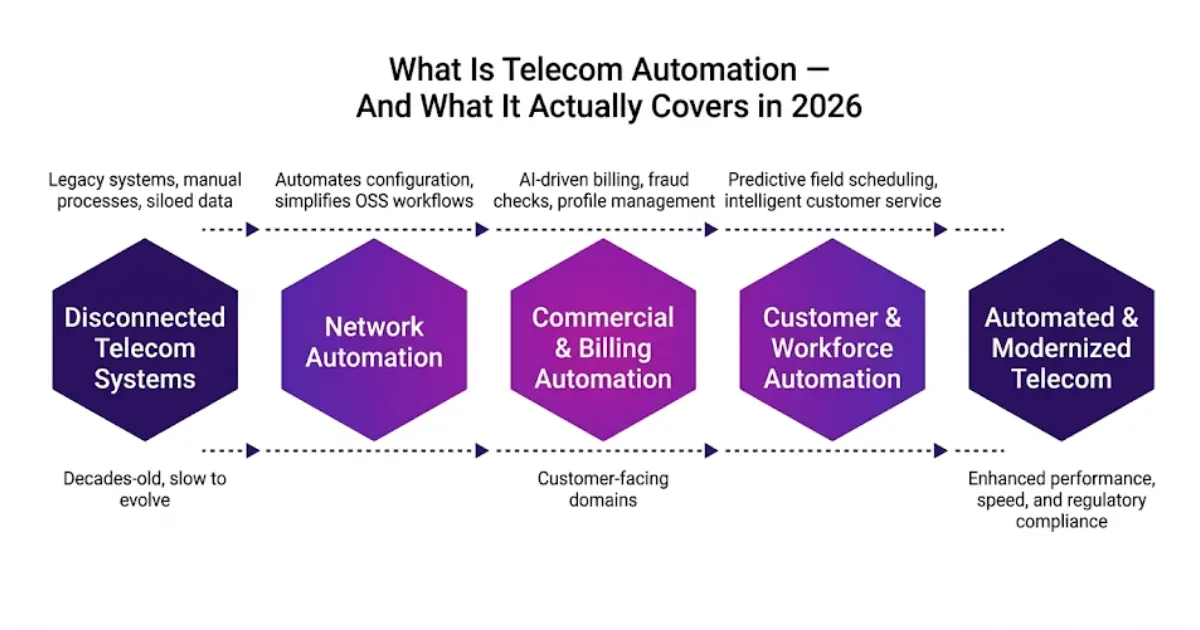
Telecom automation encompasses the full spectrum of AI, RPA, and workflow orchestration technologies applied to telecommunications operations. It is not a single product or platform — it is an operational strategy that layers intelligent automation across your OSS (Operations Support Systems), BSS (Business Support Systems), and network management infrastructure to eliminate manual touchpoints. The TM Forum’s Open Digital Architecture framework provides the industry-standard reference model for how these automation layers connect.
In practice, automation in telecom means your provisioning team doesn’t manually configure each new service activation. Your NOC doesn’t wait for a human to detect and escalate a fault. Your billing team doesn’t reconcile usage records line by line. Your field technicians receive AI-optimized dispatch schedules rather than manual assignments. Each of these was a full-time function. Collectively, they represent 40–60% of a mid-size operator’s operational expenditure.
Modern telecom process automation spans six operational layers — all covered in detail on our telecom automation solutions overview:
- Network automation — zero-touch provisioning, configuration management, fault detection, performance monitoring
- OSS/BSS automation — order management, inventory, mediation, and service assurance workflows
- Telecom billing automation — usage rating, invoice generation, revenue recognition, and dispute management
- Customer service automation — conversational AI, automated case routing, self-service portals
- Field workforce automation — technician scheduling, job dispatch, real-time status tracking
- Compliance and reporting automation — SLA monitoring, regulatory filing, performance dashboards
The distinction between telecom systems automation and true intelligent automation for telecom matters. Legacy automation follows rigid scripts — if the screen changes, the bot breaks. Intelligent automation combines RPA with AI, enabling systems to handle unstructured inputs, learn from exceptions, and make decisions that previously required human judgment. The GSMA Open Gateway initiative is accelerating this shift by standardizing the APIs that make cross-carrier intelligent automation possible.
Why Telecom Operators Are Automating Faster Than Ever in 2026
Three structural forces are compressing the timeline for automation in the telecom industry:
5G is overwhelming manual operations. 5G network automation is not optional — it is architecturally required. A 5G core with network slicing, dynamic QoS, and massive IoT connectivity generates configuration changes and performance events at a volume that human operators cannot process in real time. 5G automation is the only operating model that works at 5G scale. The ITU-T’s autonomous network standards outline exactly why closed-loop automation is now mandatory for 5G-era operations.
ARPU pressure is structural, not cyclical. Average revenue per user continues to decline across voice and data services. The only sustainable path to margin preservation at flat or declining revenue is operational cost reduction — and telecom operations automation is the primary lever available to most operators without a network replacement cycle. Learn how telecom operators are using automation to protect margins in 2026.
Customer expectations have shifted permanently. Enterprise buyers now expect the same instant provisioning and self-service transparency from their telecom providers that they get from SaaS platforms. Automated telecom service delivery is no longer a differentiator — it is the baseline expectation, especially in competitive B2B segments.
50–70%Reduction in Mean Time to Repair (MTTR) from automated incident response for telecom IT
30–40%Reduction in NOC labor costs through telecom network management automation
60–80%Faster service activation through telecom network provisioning automation
25–35%Revenue leakage recovery through telecom billing automation and revenue assurance
Top Telecom Automation Use Cases Delivering ROI in 2026
#1 — Network Operations
Telecom Network Provisioning Automation — Zero-Touch Service Activation
Telecom network provisioning automation eliminates the manual configuration steps between a customer order and a live service. When an enterprise customer orders a new circuit, MPLS VPN, or SaaS-connected SD-WAN service, automated provisioning workflows trigger network device configuration, IP address allocation, QoS policy assignment, and service monitoring setup — without a technician touching a CLI. Automated provisioning for telecom services reduces activation time from days to hours, or hours to minutes for software-defined services. See how our telecom network automation solutions handle zero-touch provisioning end-to-end.
#2 — Billing & Revenue
Telecom Billing Automation — Eliminating Revenue Leakage at Scale
Telecom billing automation covers the full revenue cycle: usage mediation, rating, invoice generation, dispute management, revenue recognition under IFRS 15 automation for telecom companies (and ASC 606 for US GAAP reporters), and payment processing. An automated telecom billing system connects mediation output directly to your billing platform, validates usage against service entitlements, flags anomalies before invoice generation, and routes disputes to automated resolution workflows. Telecom wholesale billing automation is especially high-value — inter-carrier settlement errors generate disputes that cost more to resolve than the original revenue. Explore our workflow automation services for billing and revenue assurance.
#3 — Customer Experience
Telecom Customer Service Automation — AI at the Front Line
Telecom customer service automation uses conversational AI, automated case routing, and self-service portals to resolve the high-volume, low-complexity contacts that consume the majority of contact center capacity — service status checks, billing inquiries, usage queries, password resets, and service configuration changes. A low-code CX automation platform for telecom enables operations teams to build and deploy these flows without developer involvement, dramatically reducing time-to-value. AI customer support automation in telecom handles 60–70% of tier-1 contacts automatically in leading deployments. Our AI chatbot solutions are purpose-built for telecom CX automation at scale.
#4 — Field Operations
Field Workforce Automation for Telecom — Smarter Dispatch, Fewer Rolls
Field workforce automation for telecom (sometimes called FSM automation for telecom) uses AI scheduling, real-time job management, and mobile workforce platforms to optimize technician dispatch, reduce unnecessary truck rolls, and maximize first-time fix rates. Integrated with your network management system, telecom site automation can trigger automated remote diagnostics before dispatching a field technician — resolving a significant portion of fault tickets remotely that would otherwise require a site visit. This capability is detailed further on our telecom field operations automation page.
RPA in Telecom: How Robotic Process Automation Fits the OSS/BSS Stack
Robotic process automation in telecom (RPA) addresses one of the most persistent challenges in the industry: the majority of telecom operators run OSS and BSS systems that were designed before APIs were standard. Replacing these platforms is a multi-year, nine-figure program that most operators cannot execute without business continuity risk. RPA in the telecom industry bridges the gap — software bots interact with legacy systems exactly as a human operator would, extracting data, updating records, and triggering downstream workflows without any changes to the underlying infrastructure. According to Gartner’s RPA research, organizations deploying RPA in legacy-heavy environments reduce process cycle time by 40–75% on targeted workflows.
The top robotic process automation in telecom use cases by deployment frequency are:
- OSS/BSS data reconciliation — automated cross-system comparison of inventory, provisioning, and billing records to identify and correct discrepancies
- Order management — automated order capture from CRM into OSS provisioning workflows, eliminating manual re-keying between systems
- SLA compliance reporting — automated extraction of network performance data and SLA metric calculation for customer reporting
- Telecom expense automation — automated processing of inter-carrier invoices, validation against CDRs, and dispute identification
- Telecom agent onboarding automation — automated provisioning of new agent access rights, system credentials, and training task assignment
- Regulatory reporting — automated compilation and submission of regulatory performance filings
Telecom Network Automation and Orchestration in the 5G Era
Telecom network automation is the operational backbone of 5G and cloud-native network architectures. Where traditional network management relied on human operators interpreting alarms and manually executing changes, automated network operations uses closed-loop automation — the network detects an anomaly, determines the appropriate corrective action, executes the change, and validates the outcome without human intervention. The ETSI ZSM (Zero-touch Network & Service Management) framework defines the architecture for this closed-loop automation in 5G environments.
The key components of a modern telecom network automation and orchestration stack in 2026:
- Intent-based networking — operators define desired network outcomes rather than explicit configurations; the system determines and implements the required changes automatically
- Automated fault management — AI-driven root cause analysis and automated remediation for common fault patterns, reducing MTTR by 50–70%
- 5G service automation — automated network slice creation, modification, and teardown based on real-time demand signals
- Telecom performance management automation — continuous monitoring with automated threshold alerting and capacity optimization recommendations
- Automated SLA compliance for telecom networks — real-time SLA tracking with automated escalation and customer notification when thresholds are at risk
- Software-defined networking (SDN) automation — programmatic control of network configuration across multi-vendor environments
Advanced AI automation for telecom site deployment and operations is enabling operators to manage significantly larger network footprints with the same or smaller NOC teams — a critical capability as 5G densification increases the number of managed network elements by an order of magnitude. See the full network automation capabilities we deliver for telecom operators.
Want to identify the highest-ROI automation opportunities in your specific telecom operations environment?
OSS/BSS Automation: Where Most Telecom Operators Leave Money on the Table
OSS/BSS automation in telecom is the highest-value, most underinvested area of operational automation for mid-size operators. While network operations gets the most attention, the majority of manual labor in a typical telecom organization sits in the BSS stack — order management, billing, customer management, and revenue assurance — where data flows between systems still rely heavily on human re-keying, manual validation, and spreadsheet-based reconciliation. The TM Forum’s BSS automation guide estimates that manual OSS/BSS processes account for 35–45% of total telecom OpEx in operators that haven’t yet automated this layer.
The highest-value BSS automation targets for most operators:
- Telecom expense process automation — automated processing of vendor invoices, validation against contracted rates, and exception flagging
- Revenue recognition automation for telecom companies — automated IFRS 15 / ASC 606 compliant revenue allocation across bundled service contracts
- Telecom CPQ automation — automated configure, price, quote workflows that eliminate manual pricing errors and accelerate deal closure
- Telecom billing platform with quote-to-cash automation — end-to-end automation from signed order through invoice, payment, and revenue recognition
- Automated copper inventory replacement planning — AI-driven network decommissioning planning for operators managing legacy copper infrastructure transitions
How to Integrate Automation into Telecom Operations: A Practical Framework
The biggest implementation mistakes in telecom automation come from starting with the platform rather than the process. Here’s the decision framework that experienced operators use. For a deeper walkthrough, our telecom automation implementation guide covers each step in operator-specific detail.
-
Audit your highest-volume, most repetitive workflows first. Document where manual handoffs create delays, where data is re-keyed between systems, and where errors generate downstream rework. The best telecom automation tools deliver zero value if deployed on a broken or inconsistent process.
-
Assess your OSS/BSS architecture and integration points. Which systems have APIs? Which require RPA in telecom for screen-level interaction? Which are on-premise vs. cloud-hosted? Your architecture determines whether you need RPA, API-based integration, or a hybrid orchestration layer. Most operators need all three.
-
Prioritize by ROI and implementation risk. Telecom billing automation and BSS data reconciliation typically deliver the fastest financial returns. Telecom network automation delivers the largest operational impact but requires longer implementation timelines and more complex change management. Our workflow automation consulting team helps operators sequence this correctly.
-
Pilot on a single workflow end-to-end before scaling. Run one complete process — from trigger to resolution — in production before expanding. This surfaces integration gaps and exception-handling failures that sandbox testing consistently misses in telecom environments.
-
Measure baseline KPIs before you start. Cycle time, error rate, headcount cost per transaction. You cannot prove ROI on telecom process automation if you didn’t document how long the manual process took before automation. Measure first, then automate. Accenture’s telecom automation research confirms that operators who measure baselines achieve 2× the documented ROI vs. those who don’t.
Top Workflow Automation Platforms for Telecom Infrastructure in 2026
Choosing the right telecom automation software depends entirely on your architecture, the processes you’re automating, and your team’s technical capacity. Here’s how the leading platforms map to telecom-specific use cases:
| Platform type | Best for | Telecom use case fit | Typical timeline |
|---|---|---|---|
| RPA platforms (UiPath, Automation Anywhere) | Legacy OSS/BSS with no APIs | BSS data reconciliation, order entry, billing validation | 4–12 weeks per workflow |
| Low-code orchestration (n8n via Exotica AI, Appian) | Cross-system workflow automation with API access | Order-to-activation, quote-to-cash, SLA reporting | 2–8 weeks per workflow |
| Network orchestration (ONAP, Cisco NSO) | Multi-vendor network configuration management | Zero-touch provisioning, fault remediation, 5G slicing | 6–18 months |
| AI/ML platforms | Predictive and intelligent automation | Fault prediction, fraud detection, churn scoring | 3–12 months |
| Custom AI stacks (Exotica AI telecom solutions) | Operators needing tailored automation outside standard SaaS | Full OSS/BSS pipeline orchestration, intelligent NOC | Varies by scope |
For mid-size carriers and ISPs who need to move faster than enterprise platform sales cycles allow, working with a specialist like Exotica AI Solutions delivers faster time-to-value through pre-built telecom-specific connectors and workflow templates — bridging the gap between platform selection and production deployment. Their n8n workflow automation implementations are particularly well-suited for telecom operators needing self-hosted, extensible orchestration across OSS/BSS systems without enterprise license costs.
Frequently Asked Questions About Telecom Automation
Final Verdict: Where to Start Your Telecom Automation Program
There is no universal starting point — only the right entry point for your specific operational environment, architecture, and ROI timeline. Our telecom automation specialists help operators make this decision based on real workflow data, not vendor demos. Here’s the short version:
Fastest ROI (4–8 weeks): BSS data reconciliation via RPA — automated comparison of provisioned services vs. billed services. Typically recovers 2–5% of revenue in the first cycle.
Highest impact (3–6 months): Telecom billing automation end-to-end — from mediation through invoice generation, dispute management, and revenue recognition.
Largest operational transformation (6–18 months): Telecom network automation and orchestration — zero-touch provisioning, closed-loop fault management, and 5G service automation.
Best for contact-center cost reduction: Telecom customer service automation — conversational AI handling 60–70% of tier-1 contacts with seamless agent escalation for complex issues. See our AI chatbot for telecom.
For operators with legacy infrastructure: Start with RPA in telecom to bridge existing systems before investing in platform replacement. The bridge pays for itself while you plan the longer-term architecture. Full implementation options are on our telecom solutions page.
The telecom operators gaining competitive distance in 2026 are not necessarily those with the largest automation budgets — they’re the ones that started with a single high-volume workflow, documented the ROI, and used that proof point to accelerate the next automation initiative. The compounding effect of automation in the telecom industry is real, but it requires disciplined sequencing rather than broad simultaneous deployment.
Start with one workflow. Automate it completely. Measure it. Then scale.
Talk to Exotica AI Solutions about your telecom automation strategy →

Mohit Thakur is an experienced Digital Marketing Expert, SEO Team Leader, and Content Writer with over 6 years of expertise in search engine optimization, content strategy, and digital growth. He specializes in research-driven SEO and crafting high-quality, compelling content that helps businesses improve their online visibility, organic traffic, and lead generation.
With hands-on experience across multiple industries, Mohit focuses on creating user-focused, well-researched content aligned with the latest Google algorithms and AI search trends. His approach combines technical SEO, content writing, content optimization, and data analysis to deliver consistent and measurable results.