
What are intelligent automation services?
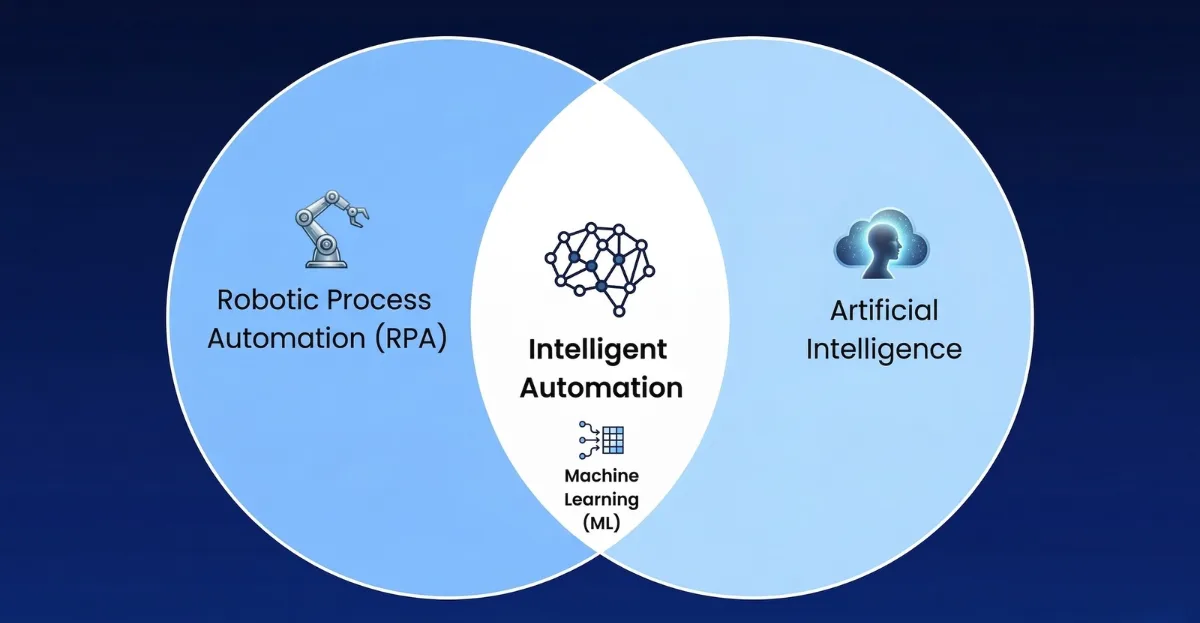
Intelligent automation services combine robotic process automation (RPA), artificial intelligence, and machine learning to automate complex business processes that involve unstructured data, decision-making, and human judgment — going far beyond what rule-based automation alone can handle.
The result: faster operations, measurably lower costs, and business processes that improve themselves over time.
Intelligent Automation Service
Most businesses have already experimented with basic automation—whether through a Zapier workflow, email sequence, or an RPA bot handling repetitive tasks. But these solutions quickly hit a limit. Rule-based systems only work for predictable, structured processes. The moment variability, unstructured data, or human judgment is required, they break down—forcing manual intervention and reducing efficiency gains.
Intelligent automation services go beyond these limitations. By combining AI, machine learning, and natural language processing with traditional automation, they enable businesses to automate complex, context-driven tasks. This guide explains what intelligent automation services are, how they differ from RPA, key real-world use cases, and how to assess if your business is ready to implement them.
What Is Intelligent Automation?
Intelligent automation is the combination of artificial intelligence and automation technology to execute complex business processes that involve variable inputs, unstructured data, and contextual decision-making — without human intervention.
Where traditional automation follows fixed rules on predictable inputs, intelligent automation learns. It reads documents that do not follow a template. It understands customer intent from unstructured messages. It makes routing decisions based on context. And it gets measurably better over time as it processes more of your business data.
The three technologies that define intelligent automation are:
- Robotic Process Automation (RPA) — the execution layer. Bots perform the mechanical tasks: logging in, extracting data, filling forms, and triggering actions across systems
- Artificial Intelligence and Machine Learning — the intelligence layer. AI models classify, interpret, predict, and decide — handling the judgment calls that rule-based bots cannot
- Natural Language Processing (NLP) — the understanding layer. Enables automation to read, interpret, and generate text from emails, documents, contracts, and customer communications in natural language
When these three layers work together, the result is an automation system that handles end-to-end business processes — not just the easy structured parts, but the full complexity of how real business actually operates.
What is the main purpose of intelligent process automation?
The main purpose of intelligent process automation (IPA) is to automate complex, judgment-intensive business processes that involve unstructured data — documents, emails, images, and variable inputs — that rule-based RPA alone cannot handle. IPA combines AI and ML with automation execution to deliver end-to-end process automation, not just task automation.
Intelligent Automation vs RPA: What Is the Real Difference?
This is the question most business leaders ask when they first encounter intelligent automation — and getting the answer right determines whether you choose the right technology for your problem.
| Factor | RPA | Intelligent Automation | Hyperautomation |
|---|---|---|---|
| Input type | Structured, predictable | Structured + unstructured | All input types |
| Decision-making | Rule-based only | AI-driven judgment | AI + human-in-loop |
| Learns over time | No | Yes — ML models improve | Yes — continuously |
| Handles exceptions | Limited — escalates to human | Yes — contextual handling | Yes — end-to-end |
| Best for | High-volume structured tasks | Complex document-heavy processes | Enterprise-wide transformation |
| Time to deploy | 2–8 weeks | 6–16 weeks | 3–12 months |
RPA and intelligent automation are not competing technologies — they are complementary layers. Most mature intelligent automation deployments use RPA as the execution engine and AI as the decision engine. You choose intelligent automation when your process involves variable inputs that a rule-based bot cannot reliably handle.
Types of Intelligent Automation Services
Intelligent Document Automation
Intelligent document automation uses AI and OCR to extract, classify, and process information from unstructured documents — invoices, contracts, medical records, insurance claims, legal filings — at scale. Where basic OCR reads fixed templates, intelligent document automation understands variable document formats and learns from corrections over time.
This is one of the highest-ROI intelligent automation services for organizations processing large volumes of incoming documents. Accounts payable teams processing 500+ invoices monthly, legal departments reviewing contracts, and healthcare organizations handling prior authorization paperwork all see 60–80% time reduction with intelligent document automation deployed correctly.
Intelligent Process Automation (IPA)
Intelligent process automation connects RPA execution with AI decision-making to automate end-to-end business processes. Rather than automating individual tasks, IPA automates the full workflow — including the exception handling, routing decisions, and judgment calls that would otherwise require human review at each step.
IPA is the right service for processes that are high-volume but irregular — claims processing with variable documentation, customer onboarding with different requirements by client type, or procurement workflows with variable approval criteria.
Intelligent Workflow Automation
Intelligent workflow automation orchestrates people, systems, and AI across multi-step business processes. It is the connective layer that ensures the right action happens at the right time — triggering the RPA bot, routing to the right human when escalation is needed, updating downstream systems, and monitoring for exceptions in real time.
Built on platforms like n8n or enterprise orchestration tools, intelligent workflow automation turns a collection of individual automations into a coordinated operational system.
Intelligent Automation Consulting
Intelligent automation consulting services provide the strategic layer — process discovery, automation feasibility assessment, technology selection, ROI modeling, and deployment roadmap. For organizations evaluating whether to invest and where to start, consulting engagements identify the highest-value automation opportunities before any technology spend is committed.
AI and Automation Integration Services
These services connect AI models — GPT-4, Claude, custom LLMs — directly into automation workflows. Rather than AI as a standalone tool, AI and automation integration embeds intelligence into business processes: classifying inbound messages, generating document summaries, routing decisions based on content analysis, and triggering follow-up actions based on AI outputs.
Intelligent Automation Use Cases by Industry
Intelligent automation in financial services and banking
Financial services firms are among the heaviest deployers of intelligent automation, driven by high transaction volumes, document-intensive processes, and strict regulatory requirements.
- Loan and mortgage processing — intelligent document automation extracts and validates data from application documents, reducing processing time from days to hours
- KYC and compliance verification — automated identity verification, sanctions screening, and compliance documentation with full audit trails
- Intelligent automation in insurance — intelligent process automation in insurance handles first-notice-of-loss intake, policy validation, damage assessment routing, and payment processing with dramatically reduced manual handling
- Automated threat intelligence — AI models analyze transaction patterns in real time and trigger automated investigation workflows for flagged cases
Intelligent automation in healthcare
Healthcare organizations face high volumes of document-intensive, regulated processes with the additional constraint of HIPAA compliance and patient safety requirements.
- Prior authorization — intelligent process automation in healthcare submits, tracks, and follows up on prior authorization requests automatically, reducing the administrative delay that slows patient care
- Patient communication and scheduling — AI-powered workflows handle appointment scheduling, reminders, intake distribution, and post-visit follow-up at scale
- Revenue cycle automation — claims generation, eligibility verification, denial management, and payment posting handled automatically with intelligent exception handling for non-standard cases
Intelligent automation for IT and business operations
- IT process automation — intelligent ticket automation classifies, routes, and in many cases resolves IT support tickets without human intervention, freeing IT teams for higher-complexity issues
- Business intelligence automation — automated data collection, transformation, and report generation that delivers dashboards without manual data pulling
- Office automation systems — document generation, approval workflows, and data synchronization between systems that previously required manual coordination
Marketing automation with artificial intelligence
- Lead scoring and routing — AI models score inbound leads based on behavioral signals and route them to the right sales rep or nurture sequence automatically
- Automated sales intelligence — AI enriches contact records with firmographic data, identifies purchase intent signals, and alerts sales teams to high-priority opportunities in real time
- Personalized communication at scale — intelligent automation generates personalized sequences triggered by contact behavior without manual campaign management
Benefits of Intelligent Automation for Business
- End-to-end process automation — handles complete workflows including exception cases, not just isolated tasks
- Continuous improvement — ML models get measurably more accurate as they process more data, unlike static rule-based systems
- Dramatic error reduction — AI-validated outputs reduce error rates on document processing and data entry to near zero
- Faster cycle times — processes that took days complete in hours; hours become minutes
- Scalability without headcount — intelligent automation scales with business volume without proportional staff increases
- Full audit trails — every automated action is logged, supporting compliance requirements in regulated industries
- Staff redeployment — employees freed from repetitive processing shift to relationship management, strategy, and higher-value work
According to McKinsey’s research on AI and automation, intelligent automation has the potential to automate up to 70% of business processes when AI is applied on top of traditional RPA foundations — with the highest concentration in document processing, customer operations, and back-office functions.
What ROI Looks Like in Practice
The strongest returns from intelligent automation consistently come from organizations that start with a high-volume, document-heavy process and expand systematically.
| Business type | Process automated | Time saving | ROI achieved |
|---|---|---|---|
| Insurance brokerage | Claims intake + document processing | 65% reduction | 420% in 9 months |
| Mortgage company | Application processing + compliance | 72% reduction | 780% in 9 months |
| Healthcare practice | Prior auth + eligibility verification | 80% reduction | 520% in 6 months |
| SaaS platform | Customer onboarding + data sync | 84% reduction | 560% in 8 months |
| Events business | Lead-to-booking pipeline | 78% reduction | 650% in 8 months |
The common pattern across every high-ROI intelligent automation deployment: narrow starting scope, clearly defined success metrics, and systematic expansion after Phase 1 validation.
How to Get Started with Intelligent Automation Services
- Identify your highest-complexity manual processes — not just high-volume, but specifically the processes where humans spend time on judgment calls, document interpretation, or exception handling. Those are the highest-value intelligent automation targets.
- Assess your data readiness — intelligent automation is only as good as the data it learns from. Processes with rich historical data deliver faster ROI.
- Choose the right service type — document-heavy processes → intelligent document automation. End-to-end complex workflows → IPA. Multi-system orchestration → intelligent workflow automation.
- Engage intelligent automation consulting services first — before committing to a platform or a build, a structured discovery engagement identifies your highest-ROI use case and validates feasibility against your existing data. This prevents the most expensive mistake: building the right automation for the wrong process.
- Deploy Phase 1 on your proven highest-ROI process — validate results, measure outcomes, and build organizational confidence before scaling.
- Build your intelligent automation roadmap — a connected intelligent automation program where document processing, workflow orchestration, AI decision-making, and human escalation all work as a system generates transformational operational advantage.
For businesses that want to move from evaluation to production deployment quickly — with the right architecture and a team that has built intelligent automation systems across industries — working with a specialist like Exotica AI Solutions compresses months of internal development into weeks of structured delivery, with ROI built into the engagement from day one.
Frequently Asked Questions
Conclusion
Intelligent automation services are no longer a future investment—they are core operational infrastructure in 2026. Businesses that rely on manual processes to handle documents, exceptions, and decision-making are leaving significant ROI on the table.
The best starting point is not the most complex project, but the process with high volume, document complexity, and clear business impact. Start there, prove ROI, and scale from that foundation.
Ready to identify your highest-value intelligent automation opportunity?
Talk to the Exotica AI Solutions team today.

Mohit Thakur is an experienced Digital Marketing Expert, SEO Team Leader, and Content Writer with over 6 years of expertise in search engine optimization, content strategy, and digital growth. He specializes in research-driven SEO and crafting high-quality, compelling content that helps businesses improve their online visibility, organic traffic, and lead generation.
With hands-on experience across multiple industries, Mohit focuses on creating user-focused, well-researched content aligned with the latest Google algorithms and AI search trends. His approach combines technical SEO, content writing, content optimization, and data analysis to deliver consistent and measurable results.