
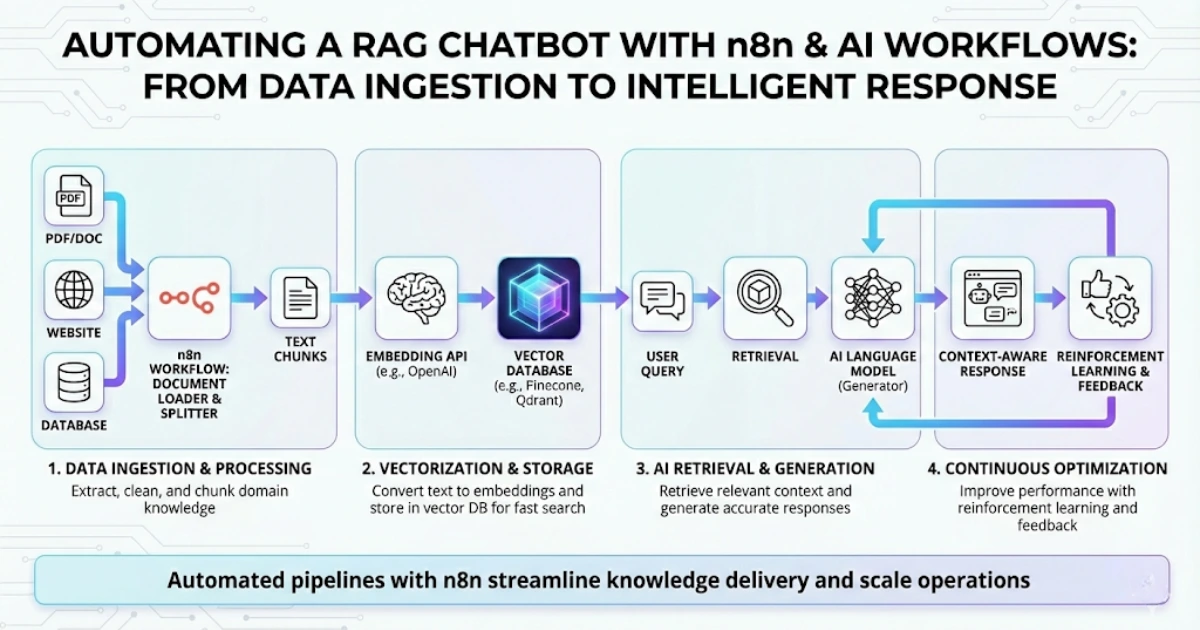
Automating a RAG chatbot allows businesses to deliver accurate, context-aware answers using their own knowledge base. Instead of relying on generic AI responses, a Retrieval-Augmented Generation system connects automation, vector search, and language models to produce reliable results in real time. With workflow platforms like n8n, organizations can automate the entire pipeline—from document ingestion to AI-generated responses—without building complex infrastructure.
This guide explains how automated RAG chatbots work, how to build them using n8n, and how reinforcement learning can improve domain-specific performance.
What Is a RAG Chatbot?
A RAG chatbot is an AI system that retrieves relevant information from a knowledge base before generating a response.
It combines two components:
- Retriever: Searches a vector database or knowledge source.
- Generator: Uses a language model to create responses from retrieved context.
This architecture provides:
- Higher accuracy
- Context-aware responses
- Real-time knowledge updates
- Domain-specific intelligence
RAG chatbots are commonly used for:
- Customer support automation
- Internal knowledge assistants
- Technical documentation bots
- Sales and onboarding assistants
Why Automate a RAG Chatbot with n8n?
n8n is a workflow automation platform that connects APIs, databases, and AI services into automated pipelines.
Key Advantages
- Visual workflow builder
- Low-code or no-code setup
- AI and API integrations
- AI and API integrations
- Self-hosted or cloud deployment
With n8n, you can automate:
- Document ingestion
- Text processing
- Embedding generation
- Vector storage
- Chatbot responses
Companies such as Exotica AI Solutions implement automated RAG workflows to help organizations deploy scalable knowledge assistants without heavy engineering overhead.
Core Components of an Automated RAG Workflow
1. Knowledge Sources
Your chatbot’s data may come from:
- PDFs
- Websites
- Databases
- Google Docs
- Internal documentation
2. Document Processing
Content is:
- Extracted
- Cleaned
- Split into smaller chunks
Chunking improves retrieval accuracy.
3. Embedding Model
Text is converted into vector embeddings that represent meaning.
4. Vector Database
Embeddings are stored in a vector database such as:
- Pinecone
- Qdrant
- Weaviate
- Chroma
5. Language Model
The model generates responses using the retrieved context.
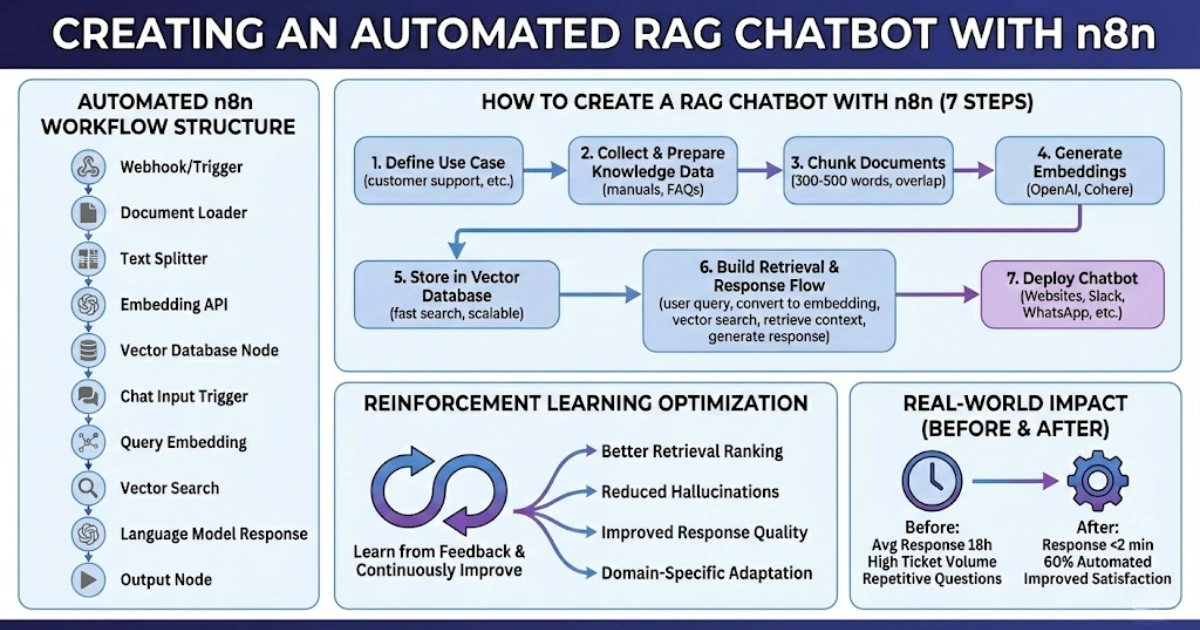
How to Create a RAG Chatbot with n8n
Understanding how to create a RAG chatbot helps you design an automated workflow that is accurate and scalable.
Step 1: Define the Use Case
Choose the chatbot’s purpose:
- Customer support
- Internal knowledge assistant
- Technical help desk
- Sales chatbot
This determines the data sources and workflow structure.
Step 2: Collect and Prepare Knowledge Data
Gather domain-specific content such as:
- Manuals
- FAQs
- Policies
- Product documentation
Then:
- Clean the data
- Remove duplicates
- Standardize formatting
Step 3: Chunk the Documents
Split documents into smaller sections.
Recommended settings:
- 300–500 words per chunk
- 10–20% overlap
This improves retrieval quality.
Step 4: Generate Embeddings
Send text chunks to an embedding model such as:
- OpenAI embeddings
- Cohere embeddings
- Open-source models
Step 5: Store in a Vector Database
Upload embeddings to a vector database.
This enables:
- Fast similarity search
- Scalable knowledge storage
- Real-time updates
Step 6: Build the Retrieval and Response Flow
When a user asks a question:
- Convert the query into an embedding.
- Search the vector database.
- Retrieve relevant content.
- Send context to the language model.
- Generate the final response.
Step 7: Deploy the Chatbot
Deploy your chatbot on:
- Websites
- Slack
- Internal dashboards
- Mobile app
Automated n8n Workflow Structure
A typical n8n RAG workflow includes:
- Webhook or scheduled trigger
- Document loader
- Text splitter
- Embedding API
- Vector database node
- Chat input trigger
- Query embedding
- Vector search
- Language model response
This entire pipeline runs automatically with minimal manual intervention.
Reinforcement Learning for Optimizing RAG for Domain Chatbots
While basic RAG systems are effective, reinforcement learning can significantly improve performance in specialized domains.
Reinforcement learning allows the chatbot to learn from feedback and continuously improve its responses.
Key Benefits
- Better retrieval ranking
- Reduced hallucinations
- Improved response quality
- Domain-specific adaptation
How Reinforcement Learning Improves Domain Chatbots
Better Retrieval Accuracy
The system learns which documents lead to correct answers and adjusts ranking strategies.
Improved Response Quality
Feedback from users or experts helps the chatbot produce more accurate and helpful responses.
Domain-Specific Behavior
Reinforcement learning helps the chatbot:
- Follow industry terminology
- Maintain consistent tone
- Respect domain rules
This is critical in:
- Healthcare
- Finance
- Legal sectors
- Technical support systems
Real-World Example
A mid-size SaaS company implemented an automated RAG chatbot for its support center.
Before automation:
- Average response time: 18 hours
- High support ticket volume
- Repetitive questions
After deploying an automated RAG chatbot:
- Response time reduced to under 2 minutes
- 60% of support queries handled automatically
- Improved customer satisfaction scores
This type of automation is increasingly deployed by providers such as Exotica AI Solutions to streamline knowledge delivery across organizations.
Best Practices for Automated RAG Chatbots
Use High-Quality Domain Data
Accurate data leads to accurate responses.
Optimize Chunk Size
Typical chunk sizes:
- 300–500 words
- With overlap for context
Automate Knowledge Updates
Use n8n triggers to:
- Re-index new documents
- Refresh embeddings
Monitor Chatbot Performance
Track:
- Answer accuracy
- User satisfaction
- Response speed
Common Challenges
Outdated Knowledge
Solution:
Automate document ingestion and re-indexing.
Poor Retrieval Results
Solution:
Adjust chunk size and improve embedding models.
Slow Responses
Solution:
Optimize vector database queries and limit retrieval results.
RAG Chatbot Development Services
Businesses across the USA and Canada are adopting automated RAG chatbots to improve customer support, internal knowledge access, and sales processes.
Professional RAG chatbot development services typically include:
- Custom knowledge base integration
- Workflow automation with n8n
- Vector database setup
- Domain-specific optimization
- Continuous model improvement
Frequently Asked Questions
Final Thoughts
Automating a RAG chatbot using n8n and AI workflows enables organizations to build intelligent knowledge assistants without complex engineering. By combining automation, vector search, and language models, businesses can deploy chatbots that deliver accurate, real-time answers.
When reinforcement learning is added, these systems continuously improve based on feedback, making them ideal for domain-specific applications. This combination of automation and intelligent optimization is shaping the next generation of enterprise AI assistants.

Mohit Thakur is an experienced Digital Marketing Expert, SEO Team Leader, and Content Writer with over 6 years of expertise in search engine optimization, content strategy, and digital growth. He specializes in research-driven SEO and crafting high-quality, compelling content that helps businesses improve their online visibility, organic traffic, and lead generation.
With hands-on experience across multiple industries, Mohit focuses on creating user-focused, well-researched content aligned with the latest Google algorithms and AI search trends. His approach combines technical SEO, content writing, content optimization, and data analysis to deliver consistent and measurable results.