

Python continues to dominate modern software development, powering everything from AI models and SaaS platforms to enterprise automation and cloud-native applications. As Python software programming grows more sophisticated, choosing the right cloud platform for deployment has become a strategic decision rather than a technical afterthought.
In 2026, cloud platforms are no longer judged only by infrastructure strength. Developers and businesses now evaluate them based on scalability, security, DevOps automation, AI integration, cost efficiency, and how well they support Python software engineering workflows.
This guide explores the top cloud platforms for Python application deployment in 2026, helping developers, startups, and enterprises make informed decisions based on real-world use cases.
Why Cloud Platform Choice Matters for Python Applications
Python applications often evolve quickly, handling fluctuating workloads, data-intensive operations, and API-driven architectures. A well-matched cloud platform ensures:
- Faster deployment and iteration cycles
- Seamless scaling without performance bottlenecks
- Strong support for frameworks like Django, Flask, and FastAPI
- Integrated CI/CD and DevOps automation
- Secure handling of data and user traffic
The wrong platform, however, can increase operational costs, slow down development, and limit future growth.
Key Evaluation Criteria Used in This Comparison
To identify the most reliable platforms in 2026, each cloud provider was evaluated based on:
- Python runtime and framework compatibility
- Deployment flexibility (VMs, containers, serverless)
- Scalability and global infrastructure
- DevOps and CI/CD tooling
- Security, compliance, and monitoring
- Cost transparency and pricing control
1. Amazon Web Services (AWS)
AWS remains the most comprehensive cloud ecosystem for Python application deployment.
Why AWS Leads
- Native Python support across EC2, Elastic Beanstalk, Lambda, ECS, and EKS
- Deep integration with AI, data analytics, and machine learning services
- Mature DevOps tooling for enterprise-grade workflows
Best Use Cases
- Large-scale Python applications
- AI-driven platforms and data pipelines
- Startups planning long-term scalability
AWS is particularly strong for advanced Python software engineering projects that require reliability, geographic redundancy, and fine-grained infrastructure control.
2. Google Cloud Platform (GCP)
Google Cloud excels in performance optimization, data handling, and developer experience.
Key Strengths
- Optimized Python runtimes for App Engine and Cloud Run
- Excellent support for containerized Python deployments
- Seamless integration with big data and AI services
Ideal For
- Data-heavy Python applications
- AI and machine learning platforms
- Fast-scaling APIs and microservices
GCP is often preferred by teams that prioritize clean architecture, automation, and speed.
3. Microsoft Azure
Azure has matured into a strong contender for Python deployments, especially in enterprise environments.
What Makes Azure Stand Out
- Azure App Service and Azure Functions offer smooth Python deployment
- Strong DevOps pipeline integration with GitHub and Azure DevOps
- Enterprise-grade security and compliance
Best Fit
- Enterprise Python applications
- Hybrid cloud solutions
- Organizations already using Microsoft ecosystems
Azure’s strength lies in stability, governance, and structured deployment pipelines.
4. DigitalOcean
DigitalOcean continues to be a favorite for developers who value simplicity and cost efficiency.
Advantages
- Easy Python app deployment via App Platform and Droplets
- Transparent pricing with predictable costs
- Minimal learning curve
Best Use Cases
- Small to mid-scale Python applications
- SaaS MVPs and prototypes
- Freelancers and startups
For teams focused on rapid deployment without enterprise complexity, DigitalOcean remains highly competitive.
5. Heroku (Managed Platform Use Cases)
While no longer the default choice it once was, Heroku still holds value for specific Python deployment scenarios.
Why Some Teams Still Use Heroku
- Extremely fast Python app deployment
- Strong support for Django and Flask
- Managed infrastructure with minimal configuration
Ideal Scenarios
- Rapid prototyping
- Proof-of-concept applications
- Short-term projects
Heroku is best used strategically rather than as a long-term scaling solution.
6. Vercel and Railway (Modern Deployment Platforms)
Modern platforms like Vercel and Railway have expanded Python support for API-centric applications.
Key Benefits
- Git-based deployment workflows
- Serverless Python support for APIs
- Developer-friendly interfaces
Best For
- Python APIs
- Microservices
- Frontend-backend integrated systems
These platforms work well when Python services are part of a larger modern web architecture.
7. Cloudflare Workers (Edge-Focused Python Use Cases)
Cloudflare Workers has introduced Python support for specific edge deployment scenarios.
Strengths
- Ultra-low latency
- Edge-based execution
- Built-in security and DDoS protection
Best Applications
- Lightweight Python APIs
- Security-sensitive applications
- Edge computing workloads
This platform is not suited for heavy backend processing but excels at speed-critical use cases.
Comparing Cloud Platforms at a Glance
| Platform | Scalability | Python Support | Best For |
|---|---|---|---|
| AWS | Very High | Extensive | Enterprise & AI |
| Google Cloud | High | Optimized | Data & ML |
| Azure | High | Strong | Enterprise & Hybrid |
| DigitalOcean | Medium | Excellent | Startups & SMBs |
| DigitalOcean | Medium | Excellent | Startups & SMBs |
| Heroku | Medium | Very Good | Prototypes |
| Vercel/Railway | Medium | API-Focused | Microservices |
| Cloudflare Workers | Specialized | Limited | Edge Computing |
Choosing the Right Platform for Your Python Application
There is no universal “best” cloud platform. The right choice depends on:
- Application complexity
- Expected traffic growth
- Budget constraints
- Compliance requirements
- Team expertise
Organizations focused on long-term Python software engineering scalability often combine multiple platforms to optimize cost and performance.
Companies like Exotica AI Solutions adopt cloud-agnostic strategies, ensuring Python applications remain flexible, secure, and future-ready across different cloud environments.
Future Trends in Python Cloud Deployment (2026 and Beyond)
Several trends are shaping Python deployment strategies:
- Increased adoption of serverless Python architectures
- AI-assisted DevOps automation
- Edge computing for latency-sensitive Python APIs
- Security-first deployment pipelines
- Cost-optimized multi-cloud setups
These trends emphasize the need for platforms that support both innovation and operational stability.
Frequently Asked Questions
AWS and Google Cloud are the most versatile platforms for Python applications, while DigitalOcean remains ideal for smaller projects.
Yes. Python is widely used for cloud-native development, microservices, APIs, and AI-powered systems.
DigitalOcean and Heroku offer the simplest onboarding experience for Python developers.
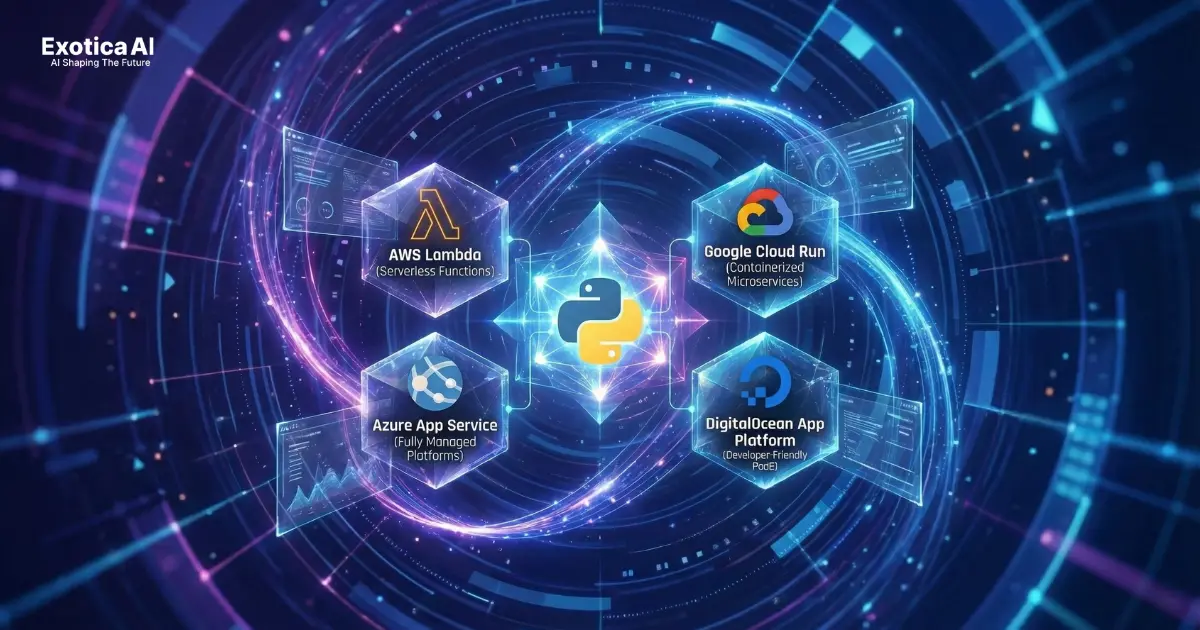
Serverless platforms like AWS Lambda and Google Cloud Run are excellent for event-driven and API-based Python applications.
Yes. With containerization and DevOps automation, Python applications can be deployed across multi-cloud environments efficiently.
Final Thoughts
In 2026, deploying Python applications is no longer just about infrastructure—it’s about aligning technology with business goals. The right cloud platform empowers developers, improves performance, and supports sustainable growth.
Whether you’re building a startup MVP, scaling an enterprise application, or architecting an AI-driven system, selecting the right cloud environment is a critical step in modern Python software programming and long-term software success.

Mohit Thakur is an experienced Digital Marketing Expert, SEO Team Leader, and Content Writer with over 6 years of expertise in search engine optimization, content strategy, and digital growth. He specializes in research-driven SEO and crafting high-quality, compelling content that helps businesses improve their online visibility, organic traffic, and lead generation.
With hands-on experience across multiple industries, Mohit focuses on creating user-focused, well-researched content aligned with the latest Google algorithms and AI search trends. His approach combines technical SEO, content writing, content optimization, and data analysis to deliver consistent and measurable results.