
RAG AI for enterprise workflows is transforming how organizations use artificial intelligence across operations, customer support, and decision-making. Instead of relying only on pre-trained knowledge, RAG systems retrieve real-time data from enterprise sources before generating responses. This approach improves accuracy, reduces hallucinations, and ensures AI outputs are grounded in current business information. As enterprises adopt AI at scale, retrieval-augmented systems are becoming essential for secure, reliable, and context-aware automation.
This guide explains what RAG AI for enterprise workflows is, how it works, and why it has become a foundational technology for modern enterprise operations.
What Is RAG AI for Enterprise Workflows?
RAG AI for enterprise workflows refers to the use of Retrieval-Augmented Generation systems inside business environments to provide accurate, context-aware, and data-driven AI responses. Instead of depending only on the model’s training data, the system retrieves relevant information from enterprise sources before generating an answer.
In simple terms:
- Traditional AI: answers from pre-trained knowledge
- RAG AI: answers using real-time enterprise data
This makes responses more accurate, more relevant, and aligned with internal business processes.
Key Takeaways
- RAG AI for enterprise workflows combines AI models with real-time data retrieval
- It reduces hallucinations and outdated responses
- It improves knowledge access across departments
- It enables secure, internal AI assistants
- It supports scalable automation across enterprise operations
How RAG AI for Enterprise Workflows Works
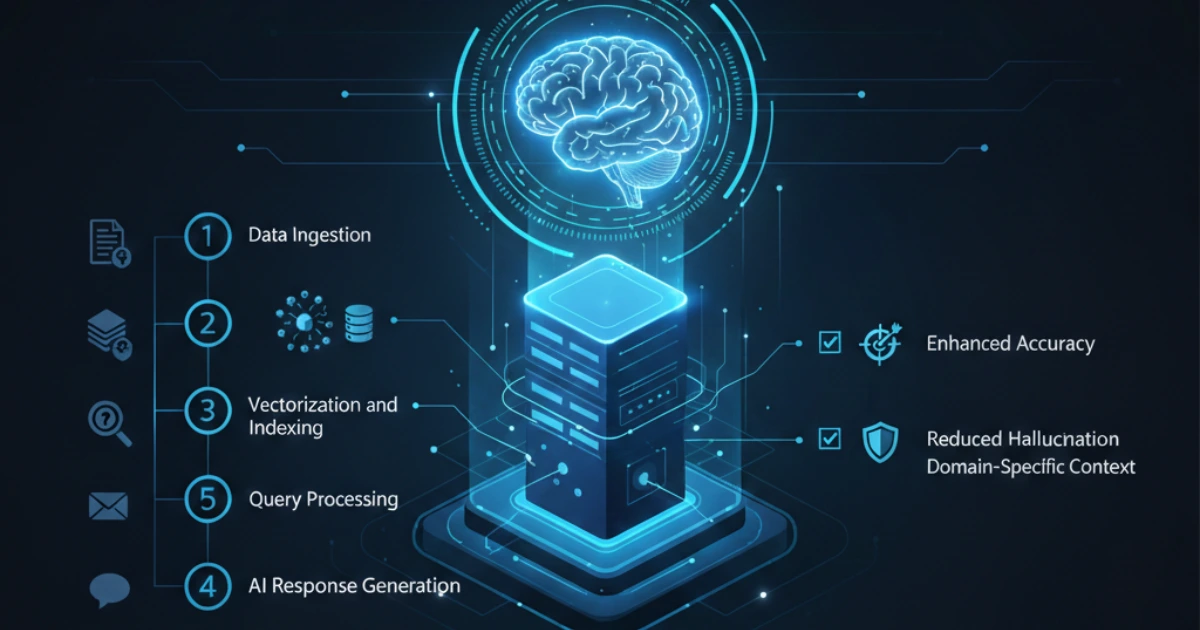
A typical RAG system follows a structured pipeline that connects enterprise data sources with a language model.
Step 1: Data Ingestion
Enterprise data is collected from sources such as:
- Internal documents and PDFs
- Knowledge bases
- CRM and ERP platforms
- Support tickets and emails
- Databases and structured records
Step 2: Vectorization and Indexing
The system converts the data into vector embeddings that represent the meaning of the content. These vectors are stored in a searchable vector database.
Step 3: Query Processing
When a user submits a question, the system converts the query into an embedding and searches for the most relevant information.
Step 4: Context Injection
The retrieved data is inserted into the prompt as context.
Step 5: AI Response Generation
The language model generates an answer based on the retrieved enterprise information.
This process ensures that RAG AI for enterprise workflows always responds using the most relevant and up-to-date business data.
Traditional AI vs RAG AI for Enterprise Workflows
| Traditional AI | RAG AI for Enterprise Workflows |
|---|---|
| Uses pre-trained knowledge | Retrieves real-time enterprise data |
| May produce outdated answers | Generates current, context-aware responses |
| Higher hallucination risk | Grounded, evidence-based outputs |
| Limited customization | Tailored to company knowledge |
| Requires retraining for updates | Updates automatically through data retrieval |
Why RAG AI for Enterprise Workflows Matters in 2026
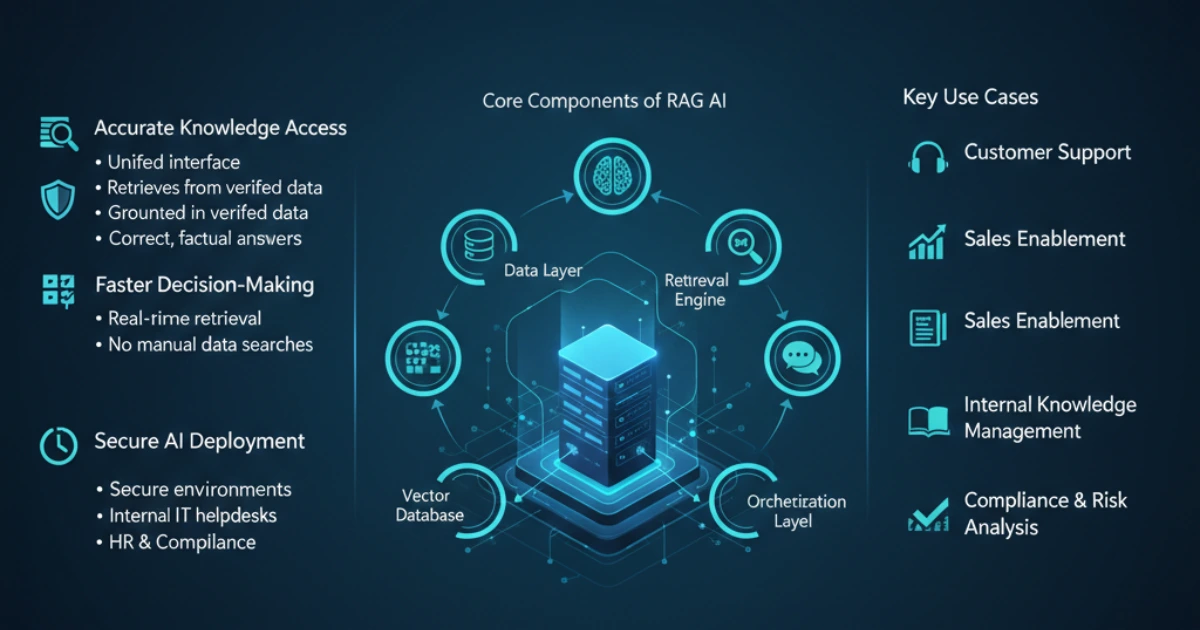
1. Accurate Knowledge Access
Employees often struggle to find information across multiple systems. RAG AI for enterprise workflows provides a unified interface that retrieves answers from all connected data sources.
2. Reduced Hallucinations
Traditional models may generate incorrect or fabricated answers. RAG-based systems ground responses in verified enterprise data.
3. Faster Decision-Making
With real-time knowledge retrieval, teams can make decisions faster without waiting for manual data searches or reports.
4. Secure AI Deployment
RAG AI for enterprise workflows can be deployed inside secure environments, ensuring sensitive company data remains protected.
5. Scalable Automation
RAG systems support automation across multiple departments, including:
- Customer support
- Sales enablement
- Internal IT helpdesks
- HR knowledge systems
- Compliance and policy management
Key Use Cases of RAG AI for Enterprise Workflows
Customer Support Knowledge Assistants
RAG systems retrieve answers from help center articles, internal documentation, and product manuals to provide accurate responses.
Sales Enablement Tools
Sales teams use RAG AI for enterprise workflows to access pricing, product details, and competitive insights instantly.
Internal Knowledge Management
Employees can ask questions and receive answers drawn from company policies, training materials, and operational guides.
Compliance and Risk Analysis
RAG systems retrieve regulatory data and internal policies to support compliance checks and risk assessments.
Core Components of RAG AI for Enterprise Workflows
A production-ready system includes several essential layers.
Data Layer
Stores structured and unstructured enterprise data.
Vector Database
Holds embeddings for fast semantic search.
Retrieval Engine
Finds the most relevant information for each query.
Language Model
Generates responses using retrieved context.
Orchestration Layer
Manages workflows, integrations, and security.
Together, these components create a reliable RAG AI architecture for enterprise operations.
How RAG AI for Enterprise Workflows Improves Automation
RAG is not only a knowledge system—it is also a powerful automation engine.
Intelligent Document Processing
RAG systems extract and interpret information from contracts, invoices, and forms.
Context-Aware Workflow Automation
AI can trigger actions based on retrieved data, such as:
- Approving requests
- Routing tickets
- Updating records
- Sending notifications
AI-Driven Decision Support
RAG AI for enterprise workflows provides contextual recommendations based on historical data and internal policies.
This transforms automation from static, rule-based systems into adaptive, intelligent processes.
Common Challenges in RAG AI for Enterprise Workflows
While powerful, RAG systems require thoughtful implementation.
Data Quality Issues
Outdated or poorly structured data reduces system accuracy.
Integration Complexity
Connecting multiple enterprise systems requires careful architecture.
Security and Access Control
Organizations must ensure that AI only retrieves authorized data.
Continuous Optimization
RAG AI for enterprise workflows requires ongoing monitoring and tuning.
Working with experienced partners such as Exotica AI Solutions helps enterprises design secure, scalable, and business-aligned RAG architectures.
Frequently Asked Questions
Final Thoughts
RAG AI for enterprise workflows represents a major shift in how organizations deploy artificial intelligence. By combining language models with real-time enterprise data, businesses can build AI systems that are accurate, secure, and deeply integrated into daily operations.
As adoption grows, RAG-based architectures will become the foundation of intelligent automation, knowledge management, and decision support across the enterprise. With the right strategy and implementation support from experienced teams like Exotica AI Solutions, organizations can turn RAG AI into a long-term engine for efficiency, innovation, and competitive advantage.

Mohit Thakur is an experienced Digital Marketing Expert, SEO Team Leader, and Content Writer with over 6 years of expertise in search engine optimization, content strategy, and digital growth. He specializes in research-driven SEO and crafting high-quality, compelling content that helps businesses improve their online visibility, organic traffic, and lead generation.
With hands-on experience across multiple industries, Mohit focuses on creating user-focused, well-researched content aligned with the latest Google algorithms and AI search trends. His approach combines technical SEO, content writing, content optimization, and data analysis to deliver consistent and measurable results.