
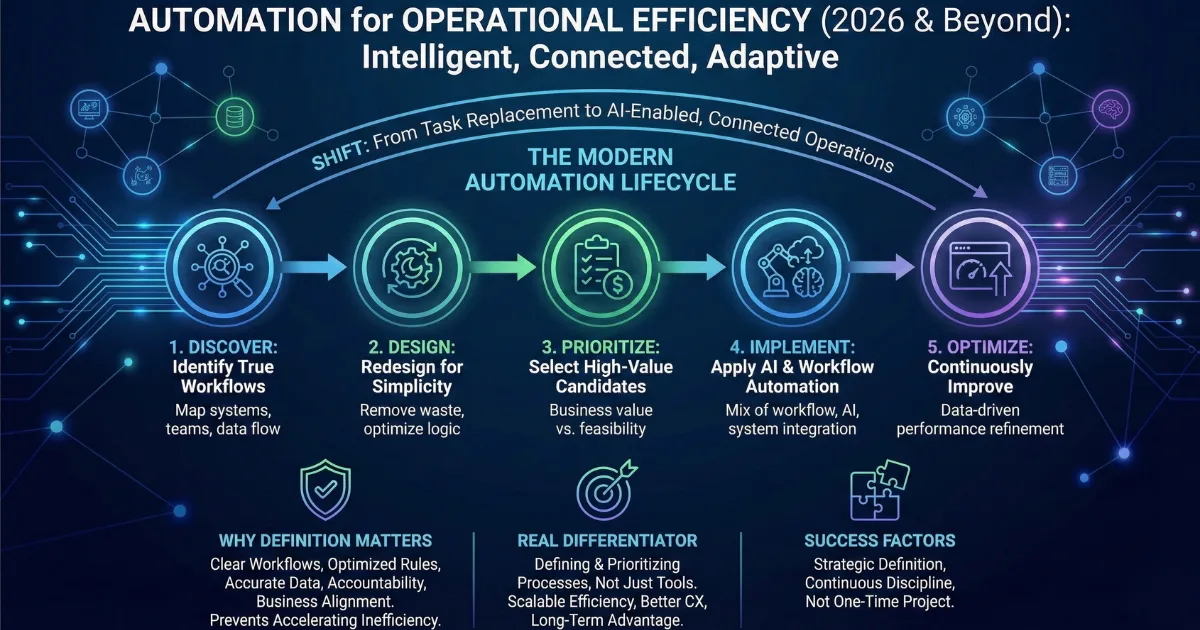
Operational efficiency in 2026 is defined by how intelligently a business connects people, data, and systems. Automation is no longer limited to simple task replacement. Today’s leading organizations are building connected, AI-enabled operations where workflows adapt, decisions are supported by data, and processes continuously improve.
The real differentiator is not which automation tools you use, but how you define and prioritize the business processes to automate. Automating the wrong workflows leads to wasted investment, limited ROI, and operational complexity. Automating the right workflows creates scalable efficiency, better customer experiences, and long-term competitive advantage.
This flagship guide explains how modern organizations define, prioritize, and structure automation initiatives for maximum operational impact in 2026 and beyond.
Why Process Definition Drives Automation Success
Automation technology has matured rapidly. AI can now interpret documents, classify requests, orchestrate workflows, and support decision-making. However, many automation programs underperform because they start with tools instead of business logic.
Strong automation outcomes depend on:
- Clearly defined workflows
- Optimized business rules
- Accurate data flows
- Ownership and accountability
- Alignment with business objectives
When processes are not clearly defined, automation simply accelerates inefficiency. Strategic process definition ensures automation amplifies performance instead of scaling problems.
The Modern Automation Lifecycle
High-performing organizations follow a structured lifecycle for automation:
Discover
Identify how work truly flows across systems and teams.
Design
Redesign workflows to remove waste and simplify logic.
Prioritize
Select automation candidates based on business value and feasibility.
Implement
Apply the right mix of workflow, AI, and system automation.
Optimize
Continuously improve based on performance data.
This lifecycle ensures automation is treated as a continuous operational discipline rather than a one-time project.
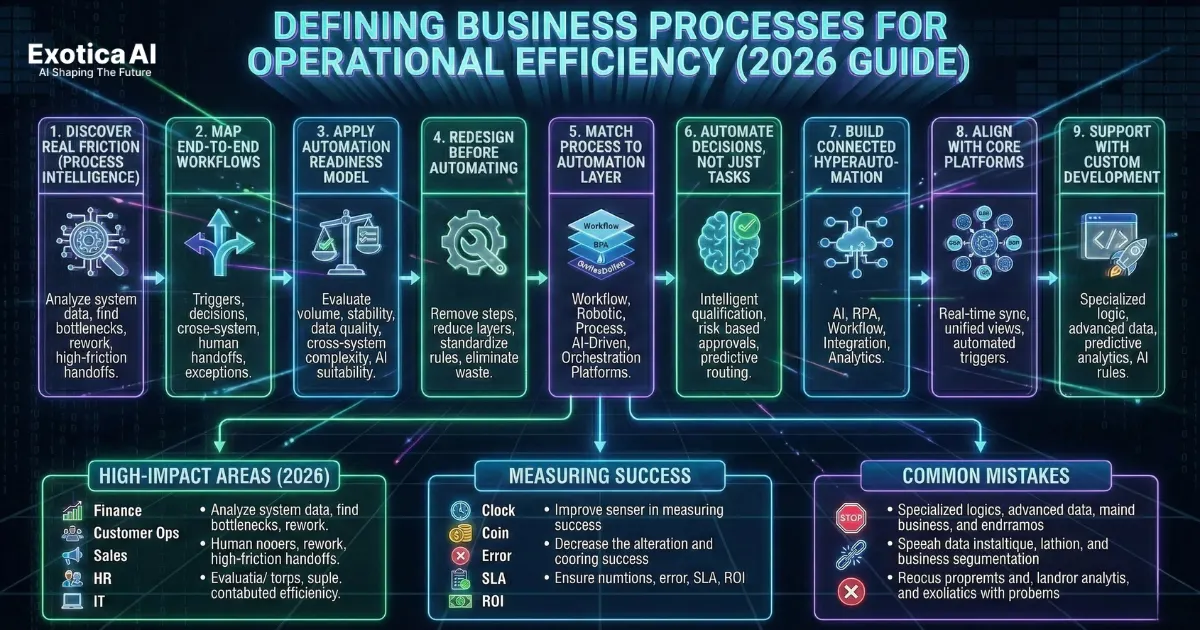
Step 1:Use Process Intelligence to Discover Real Friction
In 2026, organizations rely on more than interviews and workshops. Process intelligence analyzes real system data to show how work actually happens.
Process intelligence reveals:
- Bottlenecks and delays
- Rework loops
- Manual workarounds
- High-friction handoffs
- Compliance and exception hotspots
This data-driven discovery replaces assumptions with evidence, allowing leaders to focus automation efforts where they deliver the greatest impact.
Step 2: Map End-to-End Workflows Across Systems
True efficiency is achieved at the process level, not the task level. Many inefficiencies occur between systems and teams.
Effective mapping includes:
- Process triggers and inputs
- Decision points
- Systems involved (CRM, ERP, support tools, finance systems)
- Human approvals and handoffs
- Exceptions and edge cases
- Final outputs and outcomes
End-to-end visibility exposes cross-functional friction and identifies opportunities for orchestration instead of isolated automation.
Step 3: Apply an Automation Readiness Model
To prioritize objectively, each process should be evaluated using consistent criteria. This prevents emotional or anecdotal prioritization.
Key evaluation dimensions include:
- Transaction volume
- Rule stability
- Exception frequency
- Data structure and quality
- Cross-system complexity
- Compliance sensitivity
- Suitability for AI-based decisioning
- Business impact on cost, revenue, or experience
- Long-term scalability value
Processes that score highly across these dimensions are ideal candidates for automation in the near term.
Step 4: Redesign Before Automating
Automation should never be applied to inefficient workflows without optimization.
Before automation:
- Remove unnecessary steps
- Reduce approval layers
- Standardize business rules
- Eliminate redundant handoffs
- Simplify exception paths
This ensures automation multiplies efficiency rather than encoding waste into software.
Step 5: Match Each Process to the Right Automation
Layer
Modern automation is multi-layered. Different processes require different technologies.
Workflow Automation
Best for approvals, notifications, and structured logic.
Robotic Process Automation
Best for interacting with legacy or non-API systems.
AI-Driven Automation
Best for document understanding, intelligent routing, classification, and predictive logic.
Orchestration Platforms
Best for managing end-to-end workflows across multiple systems and departments.
This layered approach supports scalable, enterprise-grade automation.
Step 6: Automate Decisions, Not Only Tasks
One of the most important shifts in 2026 is decision automation. Organizations are increasingly automating logic that previously required human judgment.
Examples include:
- Intelligent lead qualification
- Risk-based approvals
- Claims and case routing
- Context-aware exception handling
- Predictive workflow branching
Decision automation increases speed, consistency, and scalability while reducing operational dependency on manual reviews.
Step 7: Build Connected Hyperautomation
True operational efficiency comes from connecting multiple automation technologies into a unified system.
Connected automation environments typically include:
- AI models for understanding and reasoning
- RPA for legacy interaction
- Workflow engines for orchestration
- Integration layers for real-time data flow
- Analytics for performance optimization
This creates event-driven, self-improving operations where systems respond dynamically to business conditions.
Step 8: Align Automation With Core Business Platforms
High-impact automation almost always connects to core platforms such as CRM, customer support, and internal systems.
Effective alignment ensures:
- Real-time data synchronization
- Unified customer and operational views
- Automated triggers based on business events
- Accurate reporting and forecasting
This integration layer is essential for end-to-end efficiency and consistent execution.
Step 9: Support Advanced Automation With Custom Development
Some workflows require more than off-the-shelf tools. Advanced automation often depends on tailored development.
Custom development enables:
- Specialized workflow logic
- Advanced data processing
- Predictive analytics integration
- AI-enhanced business rules
- Custom system connectors
This flexibility allows automation strategies to adapt to unique operational requirements.
High-Impact Business Areas to Automate in 2026
Finance and Accounting
Invoice processing, reconciliation, approvals, and financial close workflows.
Customer Operations
Onboarding, support routing, account updates, and feedback loops.
Sales and Marketing
Lead qualification, CRM updates, pipeline automation, and campaign orchestration.
HR and People Operations
Onboarding, document processing, approvals, and payroll workflows.
IT and Operations
Access provisioning, incident routing, monitoring, and asset management.
Measuring Automation Success
Automation should be measured using business outcomes, not just activity.
Key performance indicators include:
- Cycle time reduction
- Cost per transaction
- Error and rework rates
- SLA compliance
- Automation coverage ratio
- ROI per automated process
These metrics ensure automation remains aligned with operational and financial goals.
Common Mistakes That Limit Automation ROI
- Automating low-impact processes
- Skipping process redesign
- Ignoring exception handling
- Failing to establish ownership
- Tool-first instead of outcome-first strategy
- Isolated task automation without orchestration
Avoiding these pitfalls is essential for sustainable automation success.
Frequently Asked Questions
Final Thoughts
Defining the right business processes to automate is the foundation of operational excellence in 2026. Organizations that succeed treat automation as a strategic discipline supported by data, structured prioritization, and continuous optimization.
By combining process intelligence, objective scoring, decision automation, and connected orchestration, businesses build operations that are scalable, adaptive, and resilient.
With a structured approach and expert implementation from teams such as Exotica AI Solutions, organizations can transform automation into a long-term growth engine—driving efficiency, performance, and competitive advantage across every layer of the business.

Mohit Thakur is an experienced Digital Marketing Expert, SEO Team Leader, and Content Writer with over 6 years of expertise in search engine optimization, content strategy, and digital growth. He specializes in research-driven SEO and crafting high-quality, compelling content that helps businesses improve their online visibility, organic traffic, and lead generation.
With hands-on experience across multiple industries, Mohit focuses on creating user-focused, well-researched content aligned with the latest Google algorithms and AI search trends. His approach combines technical SEO, content writing, content optimization, and data analysis to deliver consistent and measurable results.