
Automation has helped businesses operate faster and more efficiently for decades. Traditional automation systems follow predefined rules to complete repetitive tasks. But as artificial intelligence evolves, a new model has emerged—Agentic AI.
Agentic AI goes beyond rule execution. These systems can understand goals, make decisions, adapt to change, and act independently. For businesses across the USA, this marks a major shift from task automation to intelligent, autonomous operations.
This guide explains the difference between agentic AI and traditional automation in simple, practical terms, and why organizations are adopting agentic systems with support from advanced AI providers like Exotica Ai Solutions
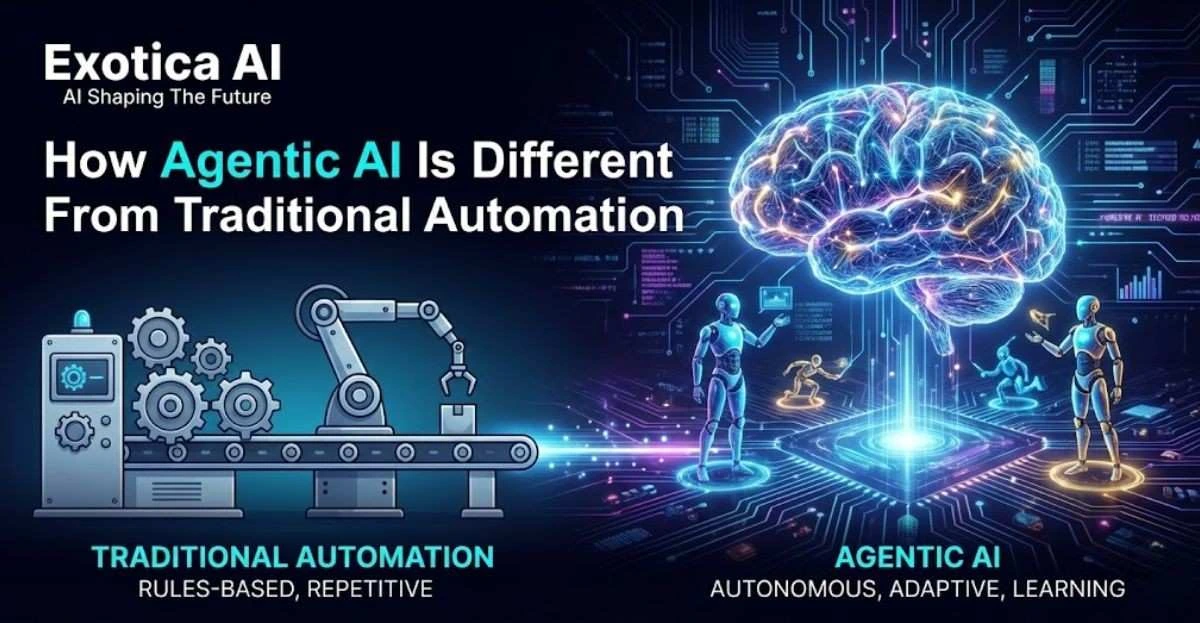
Agentic AI is different from traditional automation because it can make decisions, adapt to new situations, and work toward goals on its own, while traditional automation only follows predefined rules.
- Traditional automation follows fixed rules
- Agentic AI makes decisions
- Automation is task-based
- Agentic AI is goal-based
- Agentic AI learns from outcomes
- Automation requires frequent human updates
In short: traditional automation executes tasks, while agentic AI thinks and adapts.
What Is Traditional Automation?
Traditional automation refers to systems designed to execute tasks using predefined logic and workflows.
If the rule exists, the system works.
If the rule does not exist, the system stops.
Common examples include:
- Rule-based chatbots
- Automated billing and invoicing
- Email drip campaigns
- Robotic Process Automation (RPA)
- Static approval workflows
Traditional automation works best for predictable, repetitive processes and remains valuable for operational efficiency and compliance-driven tasks.
However, it has clear limitations:
- No reasoning ability
- No learning capability
- Poor performance in unexpected situations
What Is Agentic AI?
Agentic AI refers to artificial intelligence systems that operate as autonomous agents.
Instead of following step-by-step instructions, agentic AI:
- Understands a goal
- Decides what actions to take
- Uses tools and data sources
- Evaluates results
- Adjusts behavior over time
This allows agentic AI to handle complex workflows, decision-making, and dynamic environments that traditional automation cannot manage.
Agentic AI vs Traditional Automation: Key Differences
Decision-Making
Traditional automation executes predefined rules.
Agentic AI evaluates multiple options and selects the best action.
According to Gartner, autonomous AI agents are becoming central to modern enterprise systems.
Learning and Adaptation
Traditional automation does not learn.
Agentic AI improves continuously based on outcomes and feedback.
This makes agentic AI suitable for long-term AI transformation rather than short-term automation.
Task-Based vs Goal-Based
- Automation completes tasks such as “send an email.”
- Agentic AI pursues goals such as “improve customer satisfaction.”
The AI determines which actions best support the goal, similar to human problem-solving.
Context Awareness
Traditional automation reacts only to direct inputs.
Agentic AI understands broader business context and real-time signals.
As highlighted by MIT Technology Review, context-aware AI is a major driver of intelligent automation.
Agentic AI vs Traditional Automation: Comparison Table
| Feature | Traditional Automation | Agentic AI |
|---|---|---|
| Core Purpose | Execute predefined rules | Achieve goals autonomously |
| Decision-Making | Rule-based | Reasoning-based |
| Learning Ability | None | Continuous learning |
| Adaptability | Low | High |
| Context Awareness | Limited | Broad and dynamic |
| Human Oversight | High | Minimal |
| Error Handling | Stops or fails | Adjusts strategy |
| Scalability | Task volume | Intelligence and decisions |
| Best Use Cases | Repetitive processes | Complex, dynamic workflows |
Real-World Examples
Customer Support
- Traditional automation: Scripted chatbot replies
- Agentic AI: Resolves issues end-to-end and learns from past interactions
Marketing
- Traditional automation: Scheduled campaigns
- Agentic AI: Optimizes content and timing using real-time user behavior
Operations
- Traditional automation: Fixed workflows
- Agentic AI: Predicts bottlenecks and reallocates resources dynamically
Most organizations begin by enhancing existing automation and then layering agentic AI on top.
Why Agentic AI Matters for US Businesses
Agentic AI enables organizations in the USA to:
- Respond faster to market changes
- Reduce operational friction
- Scale decision-making without increasing headcount
- Improve outcomes across departments
Businesses investing in enterprise AI solutions, AI consulting, and intelligent automation strategies are increasingly prioritizing agentic systems.
Does Agentic AI Replace Traditional Automation?
No.
Traditional automation remains valuable for:
- Compliance-heavy tasks
- Simple repetitive workflows
- Legacy system integrations
Agentic AI acts as an intelligence layer, guiding and optimizing automation rather than replacing it.
Risks and Responsible Use
Agentic AI requires:
- High-quality data
- Clear governance frameworks
- Strong ethical and security safeguards
Technology leaders like IBM emphasize responsible AI design to ensure trust, transparency, and long-term value.
The Future of Automation
Automation is evolving from execution to intelligence.
Agentic AI represents systems that:
- Think
- Decide
- Act
- Improve autonomously
Organizations that adopt agentic AI early gain agility, resilience, and sustainable competitive advantage.
Frequently Asked Questions

Mohit Thakur is an experienced Digital Marketing Expert, SEO Team Leader, and Content Writer with over 6 years of expertise in search engine optimization, content strategy, and digital growth. He specializes in research-driven SEO and crafting high-quality, compelling content that helps businesses improve their online visibility, organic traffic, and lead generation.
With hands-on experience across multiple industries, Mohit focuses on creating user-focused, well-researched content aligned with the latest Google algorithms and AI search trends. His approach combines technical SEO, content writing, content optimization, and data analysis to deliver consistent and measurable results.