
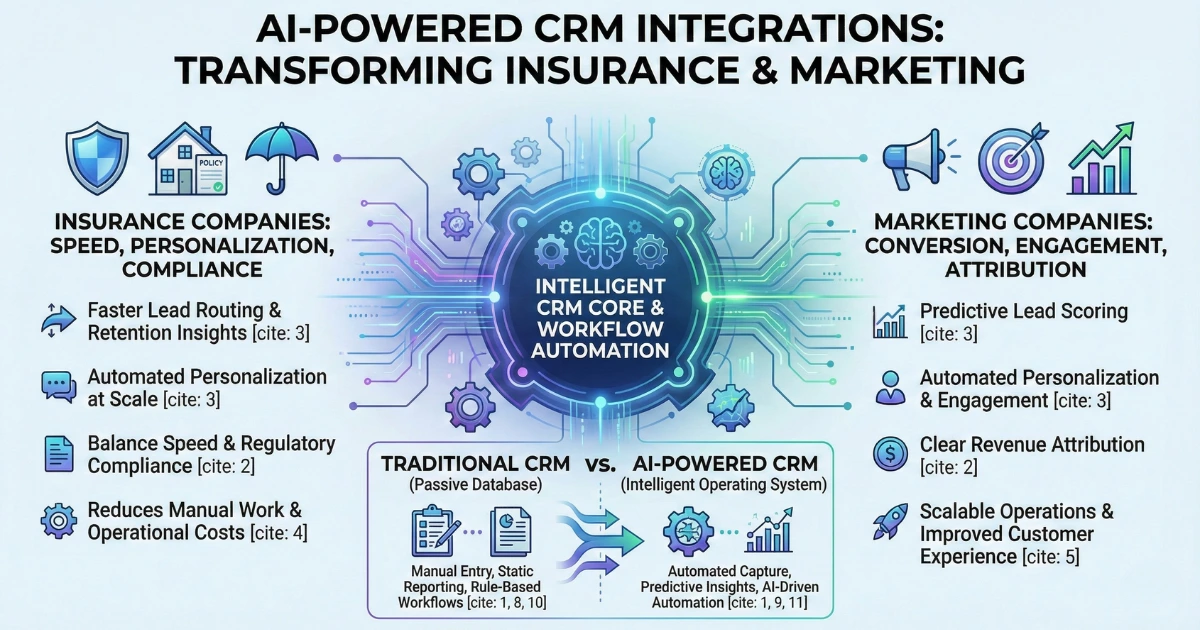
AI-powered CRM integrations are transforming how insurance and marketing companies manage customer relationships, automate workflows, and scale growth. In 2026, CRM platforms are no longer passive databases used only for tracking contacts and deals. They have evolved into intelligent operating systems that connect data, workflows, and decision-making across sales, service, and marketing.
Insurance companies must balance speed, personalization, and regulatory compliance, while marketing companies are under constant pressure to convert leads faster, personalize campaigns at scale, and clearly attribute revenue. AI-powered CRM integrations address both challenges by unifying systems, automating processes, and turning raw data into real-time, actionable insight.
This guide explores the best AI-powered CRM integrations for insurance and marketing companies, how they work, and how to implement them to improve efficiency, conversion rates, and customer experience.
What Are AI-Powered CRM Integrations?
AI-powered CRM integrations are systems that connect CRM platforms with artificial intelligence to automate workflows, analyze customer data, and deliver predictive insights across sales, service, and marketing operations.
Unlike traditional integrations that only sync data, AI-driven CRM integrations continuously learn from customer behavior, optimize workflows, and recommend next-best actions. This allows teams to focus on strategy and relationships while AI handles repetitive tasks and complex analysis.
Key Takeaways
- AI-powered CRM integrations transform CRMs into intelligent decision platforms
- Insurance companies benefit from faster lead routing and retention insights
- Marketing teams gain predictive lead scoring and automated personalization
- Workflow automation reduces manual work and operational costs
- Integrated CRM intelligence improves scalability and customer experience
Why AI-Powered CRM Integrations Matter in 2026
Traditional CRM systems depend heavily on manual data entry, static rules, and disconnected tools. As customer journeys span more channels and touchpoints, these limitations create bottlenecks, data silos, and missed opportunities.
Modern AI-powered CRM integrations enable:
- Automated data capture across websites, email, ads, and messaging platforms
- Predictive lead and customer scoring based on real behavior
- Intelligent CRM workflow automation across sales, service, and marketing
- Personalized engagement at scale
- Actionable recommendations delivered directly inside the CRM
For insurance and marketing organizations, this shift turns CRM platforms into growth engines rather than administrative tools.
Traditional CRM vs AI-Powered CRM Integrations
| Traditional CRM | AI-Powered CRM Integrations |
|---|---|
| Manual data entry | Automated data capture |
| Static reporting | Predictive insights |
| Rule-based workflows | AI-driven workflow automation |
| Reactive engagement | Proactive personalization |
| Limited scalability | Scales with business growth |
This difference explains why AI-powered CRM integrations consistently deliver higher ROI and faster operational improvements.
AI-Powered CRM Integrations for Insurance Companies
Insurance companies operate in data-intensive environments where response time, accuracy, and compliance directly impact revenue and customer trust.
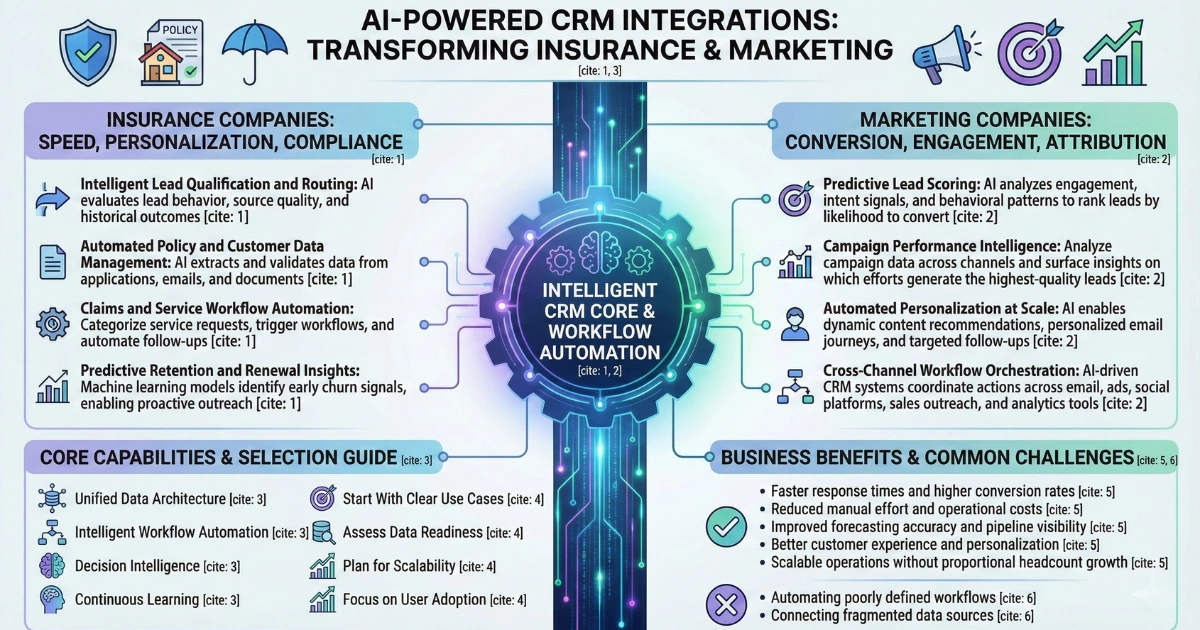
Intelligent Lead Qualification and Routing
AI evaluates lead behavior, source quality, and historical outcomes to route prospects to the right agents instantly. This improves response times and increases close rates through CRM automation for insurance companies.
Automated Policy and Customer Data Management
AI extracts and validates data from applications, emails, and documents, ensuring CRM records stay accurate without manual data entry. This supports reliable CRM setup and automation across insurance operations.
Claims and Service Workflow Automation
AI-powered CRM integrations categorize service requests, trigger workflows, and automate follow-ups, improving resolution times and service consistency.
Predictive Retention and Renewal Insights
Machine learning models identify early churn signals, enabling proactive outreach and personalized retention strategies through intelligent CRM automation.
AI-Powered CRM Integrations for Marketing Companies
Marketing teams rely on CRM systems to connect campaigns, leads, and revenue attribution. AI enhances this connection by adding intelligence and automation.
Predictive Lead Scoring
AI analyzes engagement, intent signals, and behavioral patterns to rank leads by likelihood to convert, supporting AI-driven lead intelligence.
Campaign Performance Intelligence
AI-powered CRM integrations analyze campaign data across channels and surface insights on which efforts generate the highest-quality leads.
Automated Personalization at Scale
AI enables dynamic content recommendations, personalized email journeys, and targeted follow-ups through marketing CRM automation workflows.
Cross-Channel Workflow Orchestration
AI-driven CRM systems coordinate actions across email, ads, social platforms, sales outreach, and analytics tools, improving execution consistency.
Core Capabilities to Look for in AI-Powered CRM Integrations
Not all CRM integrations deliver the same value. High-performing organizations prioritize the following capabilities.
Unified Data Architecture
CRM integrations should connect marketing platforms, support tools, analytics systems, and core business applications to create a single source of truth using CRM data integration with AI.
Intelligent Workflow Automation
Tasks such as follow-ups, approvals, reminders, and escalations should be automated using AI workflow orchestration logic that adapts in real time.
Decision Intelligence
The CRM should surface recommendations, not just reports, helping teams decide who to contact, when to engage, and how to personalize outreach.
Continuous Learning
AI models should improve over time as data volume and quality increase, ensuring long-term performance gains.
How to Choose the Right AI-Powered CRM Integration
Selecting the right AI-powered CRM integration requires aligning technology with business objectives.
Start With Clear Use Cases
Define whether the primary goal is lead conversion, customer retention, service efficiency, or campaign optimization.
Assess Data Readiness
AI performs best when CRM and connected systems maintain clean, structured data pipelines.
Plan for Scalability
Choose integrations that evolve as business volume, channels, and operational complexity grow.
Focus on User Adoption
The most effective integrations work within existing CRM interfaces, supporting adoption without disrupting teams.
Business Benefits of AI-Powered CRM Integrations
Insurance and marketing companies that adopt AI-driven CRM integrations experience:
- Faster response times and higher conversion rates
- Reduced manual effort and operational costs
- Improved forecasting accuracy and pipeline visibility
- Better customer experience and personalization
- Scalable operations without proportional headcount growth
Organizations implementing AI-driven CRM automation consistently report measurable improvements in efficiency, revenue performance, and customer lifetime value.
Common Challenges and How to Avoid Them
AI-powered CRM integrations can underperform when organizations automate poorly defined workflows or connect fragmented data sources.
Successful teams optimize processes before automation, establish governance frameworks, and continuously monitor performance across CRM workflow automation systems.
Frequently Asked Questions
Final Thoughts
AI-powered CRM integrations are no longer optional for insurance and marketing companies. They are essential for managing complexity, improving performance, and delivering personalized customer experiences at scale.
Organizations that treat CRM integration as a strategic capability—supported by experienced partners such as Exotica AI Solutions—can transform their CRM platforms into intelligent growth engines that drive efficiency, insight, and long-term competitive advantage.

Mohit Thakur is an experienced Digital Marketing Expert, SEO Team Leader, and Content Writer with over 6 years of expertise in search engine optimization, content strategy, and digital growth. He specializes in research-driven SEO and crafting high-quality, compelling content that helps businesses improve their online visibility, organic traffic, and lead generation.
With hands-on experience across multiple industries, Mohit focuses on creating user-focused, well-researched content aligned with the latest Google algorithms and AI search trends. His approach combines technical SEO, content writing, content optimization, and data analysis to deliver consistent and measurable results.